
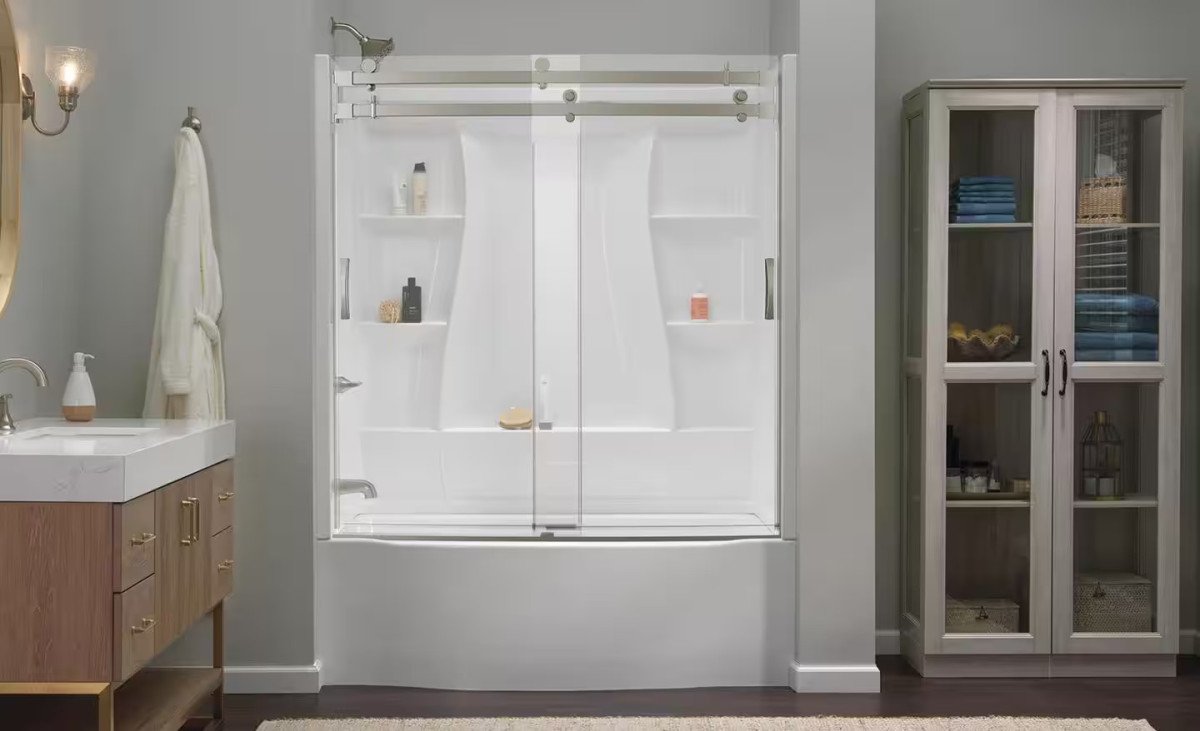

This guide covers the best bathtub replacement ideas for small bathrooms — five strategies from tub-to-shower conversions to Japanese soaking tubs. The best bathtub replacement idea for a small bathroom is a tub-to-shower conversion — removing the bathtub entirely and installing a walk-in shower with a frameless glass enclosure. The shower occupies the same 60-by-30-inch footprint as the tub but looks and feels twice as large, notes RPM Queen City professionals.
If eliminating the bathtub is not an option — it is the only bathtub in the home, or the homeowner wants to preserve a tub for bathing, children, or resale value — the bathtub replacement strategy shifts. The goal becomes replacing the existing tub with a tub that fits the same footprint but looks and functions better: a deeper soaking tub, a freestanding tub in the alcove, or a smaller tub that opens up floor space. The small bathroom bathtub replacement is an exercise in maximizing function within a fixed footprint. The footprint is 60 by 30 inches — the standard alcove. The replacement must work within it or justify expanding beyond it. Here are the ideas that work.
Idea 1: Tub-to-Shower Conversion, the Most Transformative Option
Removing the bathtub and installing a walk-in shower in the same 60-by-30-inch alcove is the single most transformative bathroom remodel decision. The shower enclosure, a frameless glass panel or a sliding glass door, is transparent. The eye travels through the glass to the tile on the back wall of the shower. The bathroom feels twice as large because the shower is part of the room, not a compartment hidden behind a curtain. The tub that visually and physically divided the room is gone. The shower that replaced it unifies the room. The floor is continuous, a curbless entry or a low-profile curb makes the transition from the bathroom floor to the shower floor nearly seamless. The bathroom reads as a single space with a wet zone at one end. The wet zone is the shower. The rest of the room is the bathroom. The distinction is functional, not visual.
A tub-to-shower conversion costs $5,000 to $15,000. The cost is driven by the tile choice, $1,500 to $5,000, the glass enclosure, $800 to $2,500, the plumbing modifications, $500 to $1,500 to move the drain from the tub location to the center of the shower footprint and possibly upsize the drain line from 1.5 inches to 2 inches, and the labor, $3,000 to $6,000. The conversion takes one to three weeks. The disruption is significant. The result is a bathroom that feels larger, functions better for adults, and appeals to a broad range of buyers, provided there is another bathtub in the home. Eliminating the only bathtub excludes families with young children from the buyer pool. The decision is financial only if the home has another tub. If it does not, the decision is strategic. The strategy depends on the target buyer.
The National Association of Home Builders (NAHB) identifies bathroom remodels as one of the highest-return home improvement projects. A tub-to-shower conversion in the primary bathroom, where the home has another bathtub in a secondary bathroom, is a popular and value-positive upgrade. The walk-in shower is desirable. The bathtub somewhere in the home is necessary. The combination of the two satisfies both preferences.
Idea 2: Replace with a Deeper Soaking Tub in the Same Footprint
A standard alcove bathtub is 14 to 16 inches deep. A deeper soaking tub, an alcove tub with a 17- to 20-inch depth, fits in the same 60-by-30-inch footprint and provides a significantly better bathing experience. The water covers the bather’s shoulders instead of their mid-torso. The bath is a bath, not a shallow pool. The deeper tub costs $800 to $2,000, $300 to $1,000 more than a standard alcove tub. The installation cost is the same, $1,500 to $4,000 including the surround, the plumbing, and the labor. The deeper tub is the simplest bathtub upgrade because the footprint does not change. The drain location is the same. The plumbing connections are the same. The tub drops into the same alcove. The only thing that changes is the depth of the water. The deeper water changes the experience. The experience is the reason to take a bath.
Soaking tubs are available in acrylic, enameled steel, and cast iron. Acrylic is the most practical choice for a replacement, lightweight at 50 to 75 pounds, warm to the touch, and available in the deepest profiles. Cast iron provides the best heat retention and the most luxurious feel, and weighs 300 to 500 pounds, requiring two to four people to carry and position. The cast iron soaking tub costs $1,500 to $2,500 for the tub alone. The acrylic soaking tub costs $500 to $1,200. The cast iron tub is a lifetime purchase. The acrylic tub is a 15- to 20-year purchase. Both fit in the same alcove. Both provide a deeper bath. The difference is the weight, the heat retention, and the cost. The acrylic tub is the practical upgrade. The cast iron tub is the premium upgrade.
Idea 3: Place a Freestanding Tub in the Alcove
A freestanding tub, a sculptural tub with finished sides, designed to sit in the open rather than against three walls, can be placed in an alcove for a modern, unexpected look. The tub sits in the alcove with a gap of 2 to 4 inches between the tub and the walls on three sides. The gap is intentional. The tub is not built in. It is placed. The gap emphasizes the tub’s sculptural quality. The tub is a piece of furniture in a niche. The niche is the alcove. The alcove frames the tub. The framing makes the tub the focal point of the bathroom.
A freestanding tub in an alcove requires a floor-mounted tub filler, a freestanding faucet that rises from the floor next to the tub, because the tub has no deck for mounting a faucet. The floor-mounted filler costs $300 to $800 for the fixture and $300 to $500 for the plumbing rough-in. The filler is a design element in its own right. The filler and the tub are a matched pair. The pair is the focal point. The freestanding tub in the alcove costs $1,000 to $3,000 for the tub and $3,500 to $8,000 total installed. The cost is higher than a standard alcove tub because the tub is more expensive, the filler adds cost, and the plumbing modifications are greater, the drain must be centered under the tub, and the supply lines must be run through the floor. The result is a bathroom where the tub is the star. The star is in an alcove. The alcove is the stage.
Idea 4: Japanese Soaking Tub, Deep, Compact, and Vertical
A Japanese soaking tub, an ofuro, is deep and compact: typically 36 to 48 inches in diameter or square, and 26 to 32 inches deep. The bather sits upright with knees bent, submerged to the shoulders. The tub occupies less floor space than a standard 60-inch alcove tub, roughly 12 to 16 square feet versus 15 square feet for a standard tub, and provides a significantly deeper soak. The tub is a vertical vessel rather than a horizontal basin. The vertical orientation saves floor space. The depth provides the immersion. The compactness is the advantage in a small bathroom.
A Japanese soaking tub costs $2,000 to $5,000 for the tub, typically made of acrylic, stone resin, or hinoki wood, and $3,000 to $5,000 for installation including the plumbing modifications, the floor reinforcement if needed, and the surround. The total installed cost is $5,000 to $10,000. The Japanese tub is the most space-efficient bathtub available. The tub is deeper than it is wide. The depth is the luxury. The width is the concession to the small bathroom. The concession is invisible when you are submerged to your shoulders. The concession is only visible when you are standing next to the tub, looking at it. The looking is brief. The soaking is long.
Idea 5: Corner Tub, Freeing Up Floor Space
A corner bathtub fits into the corner of the bathroom, typically in a triangular or neo-angle configuration. The tub occupies the corner, the least useful space in a bathroom, and frees up the rest of the floor for the vanity, the toilet, and circulation. A corner tub is typically 48 by 48 inches or 54 by 54 inches in a triangular footprint. The space saved along the walls can be significant. The corner that was empty becomes the tub. The walls that were partially blocked by the tub become available for a larger vanity or a more spacious layout.
A corner tub costs $1,500 to $4,000 for the tub and $3,000 to $6,000 installed including the plumbing modifications, the drain must be centered in the corner, and the surround. The total installed cost is $4,500 to $10,000. The corner tub is the right choice when the existing tub location is preventing a better bathroom layout. Moving the tub to the corner opens up the wall that the tub previously occupied. The wall becomes available for a double vanity, a linen cabinet, or simply open floor space. The open floor space makes the bathroom feel larger. The corner tub makes the layout possible. The layout is the reason to choose a corner tub. The corner is the means. The layout is the end.
Frequently Asked Questions
What is the best bathtub replacement for a small bathroom?
A deeper acrylic soaking tub in the same 60-by-30-inch alcove footprint is the simplest and most affordable upgrade. A tub-to-shower conversion is the most transformative, the bathroom feels twice as large. A Japanese soaking tub saves floor space while providing the deepest soak. The choice depends on whether the tub is the only one in the home and how much the homeowner values bathing versus showering.
How much does it cost to replace a bathtub in a small bathroom?
Replacing a standard alcove tub with another alcove tub costs $1,500 to $4,000. Replacing with a deeper soaking tub costs $2,000 to $5,500. A freestanding tub in the alcove costs $3,500 to $8,000. A Japanese soaking tub costs $5,000 to $10,000. A tub-to-shower conversion costs $5,000 to $15,000.
Should I keep the bathtub or convert to a walk-in shower in a small bathroom?
Keep the bathtub if it is the only one in the home. Convert to a walk-in shower if there is another bathtub elsewhere in the home. Eliminating the only bathtub excludes families with young children from the buyer pool and typically reduces resale value. The second bathtub elsewhere in the home makes the conversion acceptable.
What is the smallest bathtub that still functions well?
A 48-by-30-inch alcove tub is the smallest standard bathtub that accommodates an average adult. A Japanese soaking tub with a 36-to-40-inch diameter is smaller in floor area but deeper, the bather sits upright rather than reclining. A corner tub frees up wall space but requires more total floor area, the triangle footprint is larger than the wall space it replaces.
How long does bathtub replacement take?
A standard alcove tub replacement, swapping one tub for another in the same footprint, takes one to three days. A freestanding tub installation with plumbing modifications takes three to five days. A tub-to-shower conversion takes one to three weeks because of the tile installation and the curing time for the mortar pan and the grout.
Can a freestanding tub fit in a small bathroom?
Yes, in an alcove, the tub sits in the former alcove with a gap between the tub and the walls. A freestanding tub in the open center of the room requires a bathroom that is at least 8 by 8 feet, which is larger than most small bathrooms. The alcove placement is the practical solution. The open placement is the aspirational one. The alcove placement works. The open placement requires space that most small bathrooms do not have.
The Tub That Fits the Room
A deeper acrylic soaking tub in the same 60-by-30-inch alcove costs $2,000 to $5,500 installed and transforms the bathing experience without changing the footprint. The tub is the same size. The water is deeper. The bath is a bath. The deeper tub is the simplest upgrade with the highest return in daily satisfaction.
A tub-to-shower conversion costs $5,000 to $15,000 and makes the bathroom feel twice as large. The tub is gone. The shower is open. The room is unified. The conversion is the most transformative option, and the most disruptive. A Japanese soaking tub costs $5,000 to $10,000 and saves floor space while providing the deepest immersion. The tub is a vertical vessel in a horizontal room. The vessel fits. The immersion is deep. The room is small. The tub is not.
The small bathroom bathtub replacement is a constraint problem. The constraint is the footprint. The solution is either to work within it, a deeper tub, a Japanese tub, or to eliminate it, a tub-to-shower conversion. The constraint does not limit the options. The constraint defines them. The defined options are all better than the standard builder-grade tub that came with the house. The standard tub is shallow and forgettable. The replacement is deep and memorable. The replacement is the choice. The choice is the upgrade. The upgrade fits the room. The room is small. The upgrade is not. Ever sat in a standard builder-grade bathtub, knees poking out of the water, shoulders cold, wondering why you bothered to fill it? The tub was designed to fit the room, not to fit a person. The room was designed by a builder who never took a bath. The tub was chosen because it was the cheapest option that met code. The tub has been there since the house was built. You have been taking baths in it for years, tolerating it because replacing it seemed too complicated. It is not too complicated. It is $2,000 to $5,500 for a deeper tub that fits the same alcove and covers your shoulders. The builder who chose the original tub never sat in it. You sit in it every week. Replace it with a tub that was designed for the person who sits in it. The builder will never know. You will.