
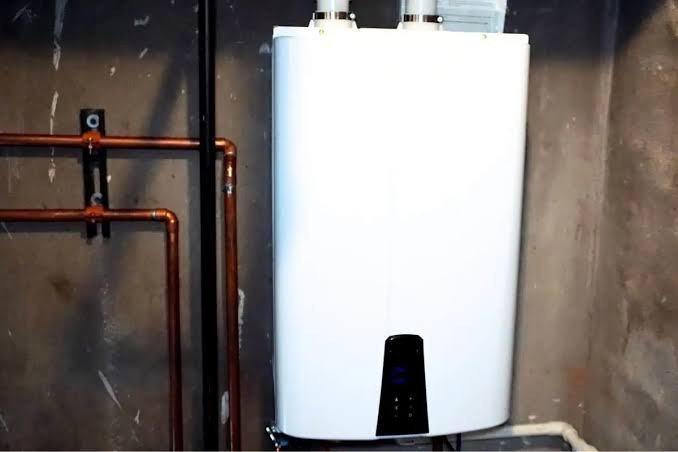

A tankless water heater costs $1,200 to $3,500 for the unit versus $600 to $1,500 for a comparable tank model. The installation adds $1,500 to $3,000 more than a tank replacement because the gas line often needs upsizing and the venting requirements are completely different. The payback period from energy savings alone is 6 to 12 years. The question is not whether a tankless water heater is better — it is, by almost every engineering measure — but whether the premium is worth it for your specific household, your specific gas line size, and your specific hot water usage pattern, highlights Rico Real Estate solutions.
The sales pitch for tankless is straightforward: endless hot water, half the energy cost, twice the lifespan, and a unit the size of a carry-on suitcase instead of a 5-foot-tall cylinder. All four claims are true in laboratory conditions. In real houses with real incoming water temperatures and real gas lines that were sized for a 40,000-BTU tank heater, not a 199,000-BTU tankless unit, some of those claims come with asterisks that the brochure does not print. The analysis below separates the engineering reality from the marketing language so the decision is based on what the unit will actually do in your house, not what it does in a controlled test lab.
How a Tankless Water Heater Actually Works
A tank water heater stores 40 to 80 gallons of water and maintains it at 120 to 140 degrees Fahrenheit 24 hours a day, 365 days a year. When you open a hot water tap, hot water leaves the top of the tank and cold water enters the bottom. The burner or heating element cycles on when the tank temperature drops below the set point. The energy lost to keeping 50 gallons of water hot while nobody is using it is called standby loss, and it accounts for roughly 10% to 20% of a tank heater’s total energy consumption.
A tankless water heater has no stored water. When a hot water tap opens, cold water flows through a heat exchanger — a coil of copper or stainless steel tubing wrapped around or passing through a burner or electric element. The burner fires at full capacity the moment flow is detected and heats the water as it passes through. When the tap closes, the burner shuts off. There is zero standby loss because there is no stored water to keep hot. According to ENERGY STAR, certified tankless water heaters are 24% to 34% more energy efficient than conventional storage tank models for homes that use 41 gallons or less of hot water daily, which covers most households of two to three people.
The engineering trade-off is in the flow rate. A tank heater can deliver hot water at the full flow rate of the plumbing — 5 to 10 gallons per minute, limited only by pipe size and pressure — until the stored hot water runs out. A tankless unit can only heat water at the rate its burner allows. A typical gas tankless unit rated at 199,000 BTU can raise the temperature of roughly 5 to 6 gallons per minute by 50 degrees Fahrenheit. If the incoming cold water is 45 degrees in January, the unit can deliver 5 gallons per minute at 95 degrees or roughly 3.5 gallons per minute at 120 degrees. That is enough for one shower and one sink simultaneously, or one shower at full flow. Two showers running at the same time on a cold January morning will exceed the capacity of most residential tankless units, and the result is not cold water, it is lukewarm water from both showers because the unit splits its heating capacity between the two flow streams instead of cutting one off.
The Real Pros, Where Tankless Earns Its Premium
Energy savings of 24% to 34% for typical households. For a family using 50 gallons of hot water per day, the annual savings versus a standard-efficiency tank heater is $70 to $120 for natural gas and $100 to $180 for electric depending on local utility rates. The savings are larger for households that use less hot water, the standby loss is a fixed cost that a tankless unit eliminates entirely. A household of two that uses 30 gallons per day saves proportionally more than a household of six using 90 gallons per day because the standby loss is the same size in both cases and represents a larger fraction of the smaller household’s total energy use.
Endless hot water. A tankless unit never runs out. The burner fires as long as water is flowing. This is the feature that sells the product, and for households where the second person to shower gets a cold rinse, it solves a genuine daily frustration. The caveat is the flow rate limit described above, endless hot water, but not at endless flow. One shower at a time gets uninterrupted hot water indefinitely. Two simultaneous showers get lukewarm water indefinitely.
Lifespan of 20 years versus 10 to 15 for a tank. Tankless units last roughly twice as long as tank heaters because the heat exchanger has no standing water to corrode it 24 hours a day. The limiting component is typically the heat exchanger itself, which accumulates mineral scale from hard water over time. With annual descaling maintenance, flushing the heat exchanger with vinegar or a commercial descaler, a gas tankless unit routinely reaches 20 years. Electric tankless units last longer because they have no combustion components to wear out, but they require enormous electrical service, 120 to 160 amps for a whole-house unit, that most homes cannot supply without a service upgrade.
Space savings. A tankless unit mounts on the wall and occupies roughly 2 cubic feet. A 50-gallon tank heater occupies roughly 20 cubic feet of floor space. In a condo, a small utility closet, or a bathroom where the water heater shares space with the washer and dryer, the space savings alone justifies the premium. A tankless unit can be installed in a closet, an attic, or a crawlspace that could never fit a tank.
The Real Cons, What the Asterisks Actually Mean
Installation cost is not incremental. Replacing a tank heater with another tank heater is a $1,200 to $2,500 job including the unit and labor. Replacing a tank heater with a tankless unit is $3,500 to $7,000 installed. The difference is not the unit cost, it is the gas line, the venting, and sometimes the electrical service. A tank heater uses a 1/2-inch gas line. A 199,000-BTU tankless unit requires a 3/4-inch or 1-inch gas line from the meter. If the existing gas line is undersized and the meter is on the opposite side of the house, running a new gas line can add $1,500 to $3,000 to the installation. The venting is completely different, a tank heater uses a vertical metal flue that exits through the roof. A condensing tankless unit uses PVC pipe that can vent horizontally through a side wall, which is easier in some houses and harder in others. A non-condensing tankless unit requires a Category III stainless steel vent that costs $500 to $1,000 for the venting materials alone.
Cold water sandwich. Tankless units do not store hot water. When a tap is opened intermittently, the kitchen sink on and off while cooking, the water in the pipe between the heater and the tap cools between uses. The next time the tap opens, that slug of room-temperature water reaches the faucet before the heater fires and the newly heated water arrives. The result is a burst of cold water in the middle of what should be a continuous hot water stream. Tank heaters have the same issue at the beginning of a draw, the water sitting in the pipe is cold regardless of the heater type, but the tankless “cold water sandwich” is an additional pulse of cold water every time the flow stops and starts. Recirculation pumps eliminate the sandwich but add $500 to $1,000 to the installation and consume additional energy to keep the recirculation loop warm.
Minimum flow rate. A tankless heater requires a minimum flow rate, typically 0.5 gallons per minute, to detect flow and fire the burner. If the hot water tap is opened just slightly, a trickle to rinse a dish, the flow rate may be below the activation threshold and the burner will not fire at all. The water stays cold. Tank heaters have no minimum flow requirement because the stored water is already hot. This is a minor annoyance that becomes a major frustration in kitchens where low-flow rinsing is a daily habit.
Hard water destroys the heat exchanger. Hard water contains dissolved calcium and magnesium that precipitate out as scale when heated. In a tank heater, the scale settles to the bottom and is removed by annual flushing. In a tankless unit, the scale deposits directly on the inside walls of the narrow heat exchanger passages, reducing heat transfer efficiency and eventually restricting flow to the point where the unit shuts down on overheat protection. Annual descaling with a pump and vinegar is mandatory in hard-water areas. Skipping it for 2 to 3 years can permanently damage a heat exchanger that costs $500 to $1,500 to replace. A water softener upstream of the tankless unit eliminates the scale problem but adds $1,000 to $2,500 to the project cost.
| Factor | Tank Water Heater | Tankless Water Heater |
| Unit cost | $600–$1,500 | $1,200–$3,500 |
| Installed cost | $1,200–$2,500 | $3,500–$7,000 |
| Lifespan | 10–15 years | 20+ years |
| Energy efficiency | 60–65% (standard) | 82–96% |
| Annual energy cost | $300–$500 | $200–$350 |
| Flow rate | 5–10 GPM (until depleted) | 3.5–6 GPM (continuous) |
| Space required | ~20 cubic feet (floor) | ~2 cubic feet (wall) |
| Maintenance | Annual flush | Annual descale |
| Payback period | N/A | 6–12 years |
Who Should Buy a Tankless Water Heater, and Who Should Not
Buy a tankless water heater if: The existing tank is in a location where floor space is valuable, a condo utility closet, a small laundry room. You have natural gas with a meter that can support a 3/4-inch or 1-inch gas line within a reasonable distance of the installation location. Your household uses hot water in one or two simultaneous draws, a shower and a sink, not two showers. You plan to stay in the house for 10 or more years, which puts you past the payback period. You have soft water or are willing to install a water softener. The tankless unit will be installed on an exterior wall where horizontal venting is straightforward.
Do not buy a tankless water heater if: Your gas line is 1/2 inch and the meter is 50 feet away across a finished basement, the gas line upgrade cost will push the payback period past 15 years. Your household regularly runs two showers, a dishwasher, and a washing machine simultaneously. You have hard water and no plans to install a softener, the maintenance burden and heat exchanger risk are not worth it. You plan to move within 5 years, the resale value of a tankless unit does not recover the installation premium in that timeframe. Your house is all-electric with a 100-amp service panel, an electric whole-house tankless unit requires 120 to 160 amps, which means a service upgrade to 200 or 400 amps that adds $2,500 to $5,000 to the project.
Frequently Asked Questions
Gas vs. electric tankless, which is better?
Gas tankless units are better for whole-house applications because they produce higher flow rates, 5 to 6 gallons per minute at a 50-degree temperature rise versus 2 to 4 GPM for electric units on a standard 200-amp service. Electric tankless units work well for point-of-use applications, a single bathroom, a kitchen sink, where the lower flow rate is adequate and the zero-venting requirement simplifies installation. A whole-house electric tankless unit on a 100-amp service is generally not feasible without a service upgrade. Gas tankless units require annual descaling and combustion air; electric units require only descaling. The operating cost comparison depends on local natural gas and electricity rates, but in most U.S. markets, natural gas is cheaper per BTU than electricity.
How much will I actually save on my energy bill?
A typical household using 50 gallons of hot water per day saves $70 to $120 per year with a gas tankless unit versus a standard-efficiency gas tank heater, and $100 to $180 per year with an electric tankless versus a standard electric tank. Households using less hot water save proportionally more because the standby loss is a fixed cost. At the national average natural gas price of roughly $1.20 per therm and electricity at roughly $0.16 per kilowatt-hour, the annual operating cost of a gas tankless unit is roughly $200 to $300 versus $300 to $450 for a standard gas tank. The savings pay for the unit premium in 6 to 12 years but do not fully recover the installation premium in most cases. The tankless decision is primarily about endless hot water and space savings, not about energy cost payback.
How much maintenance does a tankless water heater need?
Annual descaling is mandatory in hard-water areas and recommended everywhere. The process takes about 45 minutes using a submersible pump, two washing machine hoses, a 5-gallon bucket, and 3 to 4 gallons of food-grade white vinegar circulated through the heat exchanger. A plumber charges $150 to $300 for the service. Skipping descaling for 2 to 3 years in hard-water conditions can permanently scale the heat exchanger to the point where replacement is the only option. In addition to descaling, clean the inlet water filter, a small mesh screen inside the cold water inlet, every 6 months. On gas units, check the combustion air intake for dust and lint buildup annually.
What is the difference between condensing and non-condensing tankless?
Condensing tankless units capture additional heat from the exhaust gases by condensing the water vapor in the combustion exhaust. This increases efficiency from roughly 82% to 92–96% and allows the use of PVC venting instead of expensive stainless steel. Non-condensing units are less expensive to buy, $1,200 to $1,800 versus $1,800 to $3,500 for condensing, but require Category III stainless steel venting that adds $500 to $1,000 in materials. The total installed cost difference between condensing and non-condensing is often smaller than the unit price difference suggests because the venting cost offsets part of the unit premium. Condensing units produce acidic condensate that must be drained to a floor drain or neutralized before entering a sewer line. Non-condensing units produce no condensate. For most residential installations, the condensing unit is the better value when the total installed cost is calculated rather than the unit price alone.