
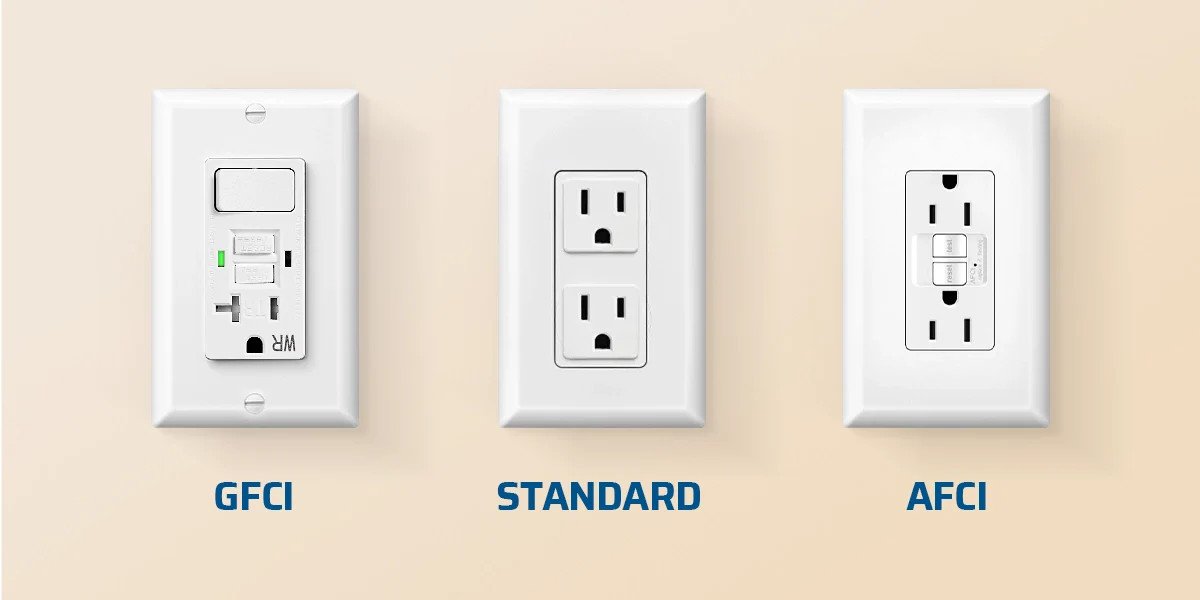

This guide compares GFCI outlet vs standard outlet — the difference between shock protection and none. The difference between a GFCI outlet and a standard outlet is that the GFCI will shut off power within 1/40 of a second if as little as 5 milliamps of current leaks to ground — through a person, through water, through a damaged cord — while the standard outlet will continue to deliver power until the circuit breaker trips, which happens at 15 or 20 amps, or 3,000 to 4,000 times the current that can stop a human heart. A standard outlet delivers electricity. A GFCI outlet delivers electricity with a safety net. The safety net is the internal circuit board that continuously monitors the current flowing through the hot and neutral wires. If the current on the hot wire differs from the current on the neutral wire by more than 5 milliamps — meaning current is leaking somewhere, possibly through you — the GFCI trips. The power cuts out. The shock that would have been delivered by a standard outlet is prevented by the GFCI. The shock is the difference. The prevention is the GFCI.
The standard outlet costs $1 to $3. The GFCI outlet costs $15 to $30. The standard outlet is adequate for any location where a ground fault is unlikely — a bedroom, a living room, a hallway. The GFCI outlet is required, by the National Electrical Code, in any location where water and electricity are in close proximity: bathrooms, kitchens, laundry rooms, garages, crawl spaces, unfinished basements, and outdoors. The requirement is not arbitrary. The requirement is written in the autopsy reports of people who were electrocuted by a hair dryer that fell into a sink, a toaster that fell into a dishpan, an extension cord that lay in a puddle on the garage floor. The GFCI would have tripped. The standard outlet did not. The GFCI is the difference. The difference is $15. The difference is also the person who is alive because the GFCI tripped. The $15 is the cost of the safety net. The safety net is the difference between a shock and an electrocution. The difference is the GFCI, shares RPM Reliant solutions.
GFCI vs. Standard Outlet, Complete Comparison
| Feature | GFCI Outlet | Standard Outlet |
| Cost (outlet only) | $15 – $30 | $1 – $3 |
| Installed cost (professional) | $120 – $250 | $120 – $250 |
| Shock protection | Yes, trips at 5 milliamps within 1/40 second | No, circuit breaker trips at 15-20 amps (3,000-4,000× higher) |
| Internal test button | Yes, TEST and RESET buttons | No |
| Required locations per NEC | Bathrooms, kitchens, laundry, garage, outdoors, basement, crawl space, within 6 ft of sink | Bedrooms, living rooms, hallways, dining rooms, dry locations |
| Can protect downstream outlets | Yes, when wired to LOAD terminals | No |
| Lifespan | 10 – 15 years (electronics degrade) | 30+ years (mechanical components only) |
| Appearance | Two buttons (TEST and RESET) plus an LED indicator | Two rectangular slots plus a round ground hole |
How a GFCI Outlet Protects You, the Physics
A GFCI outlet contains a small toroidal coil, a doughnut-shaped transformer, through which both the hot and neutral wires pass. Under normal conditions, the current flowing through the hot wire equals the current returning through the neutral wire. The magnetic fields generated by the two currents are equal and opposite, they cancel each other out. The toroidal coil senses zero net current. The GFCI stays closed. Power flows normally.
When a ground fault occurs, a person touches a live wire while standing on a wet floor, a hair dryer falls into a sink, some of the current that leaves the hot wire does not return through the neutral wire. It returns through the person to the wet floor, to the ground. The hot current and the neutral current are no longer equal. The toroidal coil now senses a net current, the difference between what left on the hot wire and what returned on the neutral wire. The difference is the fault current. If the fault current exceeds 5 milliamps, the GFCI’s internal circuitry triggers a solenoid that opens the contacts, cutting power to the outlet and to any outlets downstream. The entire process, sensing the imbalance, triggering the solenoid, and opening the contacts, occurs in 1/40 of a second. The shock that would have continued for as long as the person was in contact with the live wire is limited to a fraction of a second. The shock is felt, a tingle, a muscle contraction, but it is not sustained long enough to stop the heart. The heart continues to beat. The person is alive. The GFCI tripped. The GFCI did its job.
The U.S. Consumer Product Safety Commission (CPSC) estimates that GFCIs have reduced electrocutions from consumer products by roughly 70% since the requirements were phased in beginning in the 1970s. The $15 GFCI outlet that is installed in every new bathroom and kitchen in America is responsible for that 70% reduction. The reduction is the lives that were not lost. The lives are the people who dropped a hair dryer in the sink and felt a brief tingle and a click, and nothing more. The click was the GFCI. The click was the difference. The click was $15. The click was the 70%.
One GFCI Can Protect Every Outlet on the Circuit
A single GFCI outlet can protect every standard outlet downstream on the same circuit when it is wired correctly. The GFCI has two sets of terminals on the back: LINE and LOAD. The LINE terminals receive power from the circuit breaker. The LOAD terminals feed power to the downstream outlets. If the downstream outlets are connected to the LOAD terminals, the GFCI monitors the current flowing through those outlets as well. A ground fault at any downstream outlet trips the GFCI at the first outlet in the chain. One GFCI at the beginning of the circuit protects every outlet after it.
This is the most cost-efficient way to add GFCI protection to a bathroom or a kitchen. The GFCI is installed at the first outlet on the circuit, the one closest to the circuit breaker, and the downstream standard outlets are connected to the LOAD terminals. The downstream outlets function as standard outlets but are protected by the upstream GFCI. The downstream outlets must be labeled with the “GFCI Protected” stickers that come with the GFCI. The labels tell a future homeowner or an electrician that the outlet is not a GFCI itself but is protected by one upstream. The label is the communication. The communication prevents confusion. The confusion is an electrician testing a standard outlet and thinking it is unprotected because there is no GFCI in sight. The label says the GFCI is elsewhere. The label is the information. The information is the safety.
When a Standard Outlet Must Be Upgraded to GFCI
Any existing standard outlet in a location that is currently required by code to have GFCI protection, bathrooms, kitchens, laundry rooms, garages, crawl spaces, unfinished basements, outdoors, is grandfathered under the code that was in effect when the outlet was installed. The homeowner is not required to upgrade existing outlets. The shock hazard is unchanged by the grandfather clause. The outlet that is not protected by a GFCI is the same shock hazard in 2024 that it was in 1974. The code changed. The hazard did not. The upgrade from a standard outlet to a GFCI in a bathroom costs $120 to $250 per outlet. The upgrade is the cost of bringing the outlet up to the current safety standard. The safety standard is the GFCI. The GFCI prevents electrocution. The standard outlet does not. The $150 upgrade is the difference between the safety standard of 1974 and the safety standard of 2024. The 2024 standard is better. The 2024 standard is $150 better. The $150 is the cost of the safety net. The safety net is the GFCI. The GFCI is the upgrade.
Frequently Asked Questions
What is the difference between a GFCI outlet and a regular standard outlet?
A GFCI outlet has built-in electronics that detect ground faults, current leaking to ground through a person or water, and shuts off power within 1/40 of a second at a threshold of 5 milliamps. A standard outlet has no such protection, it delivers power continuously until the circuit breaker trips at 15 to 20 amps. The GFCI prevents electrocution. The standard outlet does not. The GFCI costs $15 to $30. The standard outlet costs $1 to $3.
Where are GFCI outlets required by the National Electrical Code?
GFCIs are required in bathrooms, kitchens, all countertop receptacles, laundry rooms, garages, crawl spaces, unfinished basements, outdoor outlets, and any outlet within 6 feet of a sink, bathtub, or shower. The requirement covers all 125-volt, 15- and 20-amp receptacles in these locations.
Can I replace a standard outlet with a GFCI myself?
Yes, if the electrical box has a neutral wire and you are comfortable turning off the breaker, identifying the LINE and LOAD wires, and connecting them correctly. The most common DIY mistake is reversing the LINE and LOAD connections, the GFCI will not deliver power or will not provide protection. The installation takes 15 to 30 minutes. If the box does not have a neutral wire, a GFCI is still code-compliant as a replacement for a two-prong outlet and will provide shock protection without a ground. The outlet must be labeled “No Equipment Ground.”
How often should GFCI outlets be tested?
Test every GFCI outlet monthly, press the TEST button, confirm the RESET button pops out and power is cut to the outlet, then press RESET. A GFCI that does not trip when TEST is pressed has failed and must be replaced. The TEST button verifies the internal circuitry. The monthly test is the verification that the protection is still active. The protection that is not tested may not be present. The TEST button is the only way to know.
Can one GFCI outlet protect multiple regular outlets on the same circuit?
Yes, a single GFCI outlet wired at the beginning of a circuit can protect all standard outlets downstream when they are connected to the LOAD terminals. The downstream outlets must be labeled with the “GFCI Protected” stickers. The single GFCI at the first outlet is the most cost-efficient configuration for a bathroom or a kitchen where multiple outlets on the same circuit need protection.
Do GFCI outlets wear out over time?
Yes, the electronic components inside a GFCI degrade over 10 to 15 years. A GFCI that is near the end of its service life may trip randomly even when no ground fault exists, or may fail to trip when the TEST button is pressed. The failure to trip on TEST is the definitive sign that the GFCI has failed. The random tripping is the early warning. Replace a GFCI that is more than 10 years old, that trips randomly, or that fails the TEST button test. The replacement costs $120 to $250 installed.
The Outlet That Saves Lives
A GFCI outlet costs $15. A standard outlet costs $2. The GFCI trips when 5 milliamps of current leak to ground. The standard outlet delivers current until the 15-amp breaker trips, 3,000 times the current that can stop a heart. The GFCI is required in every location where water and electricity coexist. The standard outlet is adequate for every location where they do not. The difference is the location. The location determines the requirement. The requirement determines which outlet is installed. The outlet determines the safety. The safety is the GFCI in the bathroom, the kitchen, the laundry room, the garage, and outdoors. The safety is the TEST button that you press every month. The TEST button that pops the RESET button is the outlet working. The TEST button that does nothing is the outlet that has failed. Replace the failed outlet. The replacement costs $15 for the outlet and $150 for the electrician. The $150 is the cost of restoring the protection. The protection was absent. The failed GFCI was a standard outlet in a GFCI housing. The housing looked the same. The protection was gone. The test revealed the absence. The replacement restored the presence. The presence is the protection. The protection is the GFCI. The GFCI is the outlet that saves lives. The outlet saves lives one TEST button press per month. Press the TEST button. The button is the life. The button is the test. The test is the verification. The verification is the safety. The safety is the GFCI. Ever pressed the TEST button on a bathroom outlet that was installed when the house was built — a button you had never pressed in the ten years you lived there — and watched the RESET button refuse to pop out? The GFCI had been dead for years. You did not know because nothing bad had happened. The outlet had been delivering power without protection. The protection was absent. The TEST button revealed the absence. The new GFCI cost $18. The electrician cost $150. The $168 restored the protection. The protection is invisible when it works. The protection is invisible when it does not. The TEST button is the only way to know the difference. The difference is the click of the RESET button popping out. The click is the sound of the protection working. The silence is the sound of the protection absent. Press the TEST button. Listen for the click. The click is the safety. The silence is the warning. The warning is free. The replacement is $168. The electrocution is permanent.