
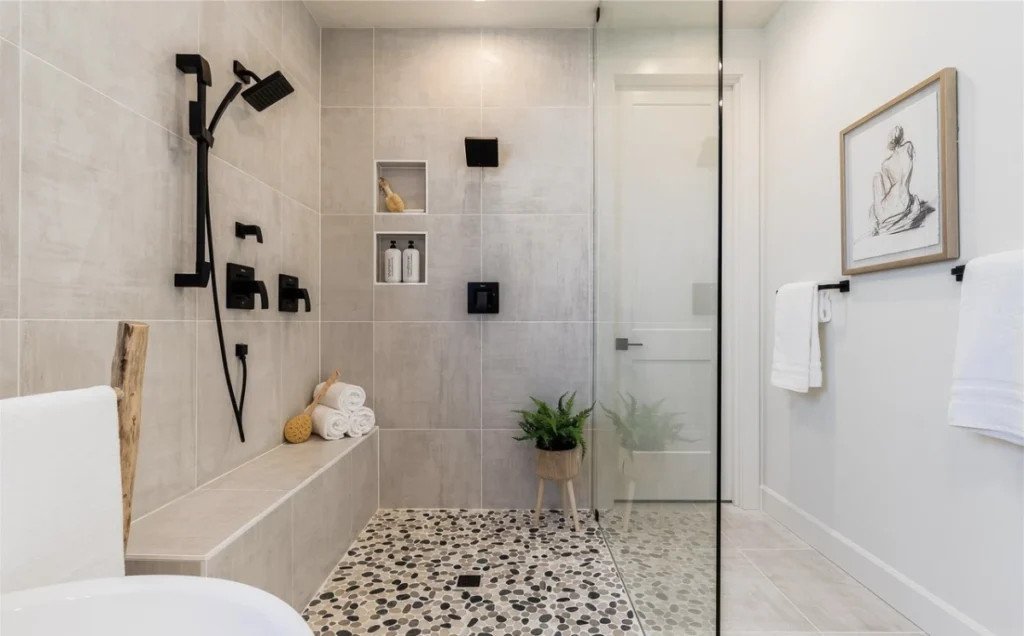

The best tile for a walk-in shower floor is a porcelain tile with a matte or textured finish and a DCOF — dynamic coefficient of friction — rating of 0.42 or higher. A porcelain tile with a polished, glossy surface on a shower floor is a slip hazard when wet. The glossy tile looks beautiful on the wall. The glossy tile is dangerous underfoot. The shower floor is the wettest surface in the house. The tile that goes on the shower floor must provide grip when the surface is wet and soapy. The grip is the DCOF rating. The DCOF rating of 0.42 or higher is the industry standard for slip resistance on a wet surface. The rating is printed on the tile box. The rating is the safety. The safety is the texture. The texture is the matte finish, the honed surface, or the small-format tile with many grout lines that provide grip. The grout lines are the grip. The texture is the grip. The gloss is the slip. The slip is the fall. The fall is the injury. The DCOF rating of 0.42 prevents the fall. The glossy tile at DCOF 0.30 does not. The DCOF is the number. The number is the decision.
The best tile for a walk-in shower wall is a large-format porcelain or ceramic tile — 12 by 24 inches or larger — in a matte or satin finish. The large format minimizes grout lines. The fewer the grout lines, the less area that needs to be scrubbed and sealed. The large-format tile creates a calm, architectural surface — the shower walls read as planes of material rather than a grid of individual tiles. The large-format tile on the wall is the modern aesthetic. The large-format tile is heavier, more expensive to install, $15 to $30 per square foot for labor, and requires a perfectly flat substrate. The substrate preparation is the cost of the large format. The result is a shower with minimal grout lines and maximum visual calm. The calm is the modern shower. Here is the complete guide to selecting tile for a walk-in shower.
Walk-In Shower Floor Tile, Slip Resistance Is Everything
The shower floor tile must provide grip when wet. The DCOF rating of 0.42 or higher is the standard. Porcelain mosaic — small tiles with many grout lines — is the safest choice.
| Tile Type | Slip Resistance | Grout Lines | Cost Per Sq Ft | Best For |
| Porcelain mosaic (1×1 to 2×2 inch) | Excellent, many grout lines | High | $5 – $15 | Best overall shower floor choice; sheets are easy to slope |
| Porcelain hexagon mosaic (2-inch) | Excellent, many grout lines | High | $6 – $18 | Classic look; conforms to sloped floor |
| Porcelain penny round mosaic | Excellent, many grout lines | Very high | $8 – $20 | Maximum slip resistance; retro aesthetic |
| Porcelain matte-finish large-format (12×24) | Good, DCOF ≥0.42 required | Low | $5 – $15 | Modern look; requires linear drain with single-plane slope |
| Natural stone, honed marble or travertine | Good, honed finish | Low to medium | $10 – $30 | Luxury aesthetic; requires sealing and maintenance |
| Ceramic mosaic (1×1 to 2×2 inch) | Good, many grout lines | High | $3 – $10 | Budget option; less durable than porcelain |
Walk-In Shower Wall Tile, Large Format for Minimal Grout
Shower wall tile is about minimizing grout lines for easier maintenance and a calm, modern look. Large-format porcelain — 12 by 24 inches or larger — is the standard.
| Tile Type | Grout Maintenance | Aesthetic | Cost Per Sq Ft | Best For |
| Porcelain large-format (12×24 to 24×48) | Minimal, few grout lines | Modern, architectural | $5 – $20 (tile only) | Best overall shower wall choice |
| Porcelain slab (¼-inch thick, up to 5×10 feet) | Near-zero, one seam per wall | Seamless, ultra-modern | $15 – $30 (tile only) | Premium; requires specialized installation |
| Ceramic subway (3×6 inch) | Moderate, many grout lines | Classic, timeless | $2 – $8 (tile only) | Budget-friendly classic; horizontal or vertical stack |
| Glass tile (accent strip, not full wall) | Moderate | Reflective, decorative | $10 – $40 | Accent only, not recommended for full shower walls |
| Natural stone, marble or travertine | Moderate, requires sealing | Luxury, natural variation | $8 – $30 | Luxury aesthetic; maintenance commitment required |
Porcelain vs. Ceramic, the Material Decision
Porcelain tile is the better choice for a walk-in shower, floor and walls. Porcelain is fired at a higher temperature, 2,200 to 2,500 degrees Fahrenheit versus 1,800 to 2,000 for ceramic, making it denser, harder, and less porous. Porcelain absorbs less than 0.5% of its weight in water. Ceramic absorbs more, up to 3% to 7% depending on the grade. The lower absorption of porcelain means it is more resistant to cracking in freeze-thaw conditions, relevant for an exterior shower, and it is more dimensionally stable. Ceramic is adequate for shower walls but not ideal for shower floors. The higher water absorption of ceramic can lead to cracking if water penetrates the glaze and freezes, not relevant in a heated bathroom, but the lower density of ceramic also makes it less impact-resistant. A dropped shampoo bottle is unlikely to crack either material. A dropped cast-iron pan, in a kitchen, not a bathroom, cracks ceramic before it cracks porcelain. In a shower, both materials perform adequately on the walls. Porcelain is the better choice for the floor. Porcelain costs $1 to $5 more per square foot than ceramic. The premium is the density. The density is the durability. The durability is the porcelain.
The National Association of Home Builders (NAHB) identifies bathroom design as a key factor in buyer preference. The shower tile is the most visible surface in the bathroom. The tile choice, size, material, finish, and color, determines the character of the entire room. The large-format porcelain tile in a matte finish is the current standard for a modern walk-in shower. The standard is the large format. The large format is the modern aesthetic. The modern aesthetic is the calm, uncluttered surface. The calm surface is the shower you want to spend time in. The shower you want to spend time in is the shower that was designed, not just built.
Grout, the Dirty Secret of Tile Showers
The grout between the tiles is the most labor-intensive surface in the shower to maintain. The grout is porous. The grout absorbs water, soap scum, body oils, and mold spores. The grout must be sealed annually, a wipe-on, wipe-off process that takes 30 minutes for a typical shower. The sealer prevents water and contaminants from penetrating the grout. The sealer is the protection. The protection is annual. The protection is 30 minutes per year. The grade of the grout determines the maintenance. Cement-based grout, the standard type, requires annual sealing. Epoxy grout, a two-part resin-and-hardener system, is non-porous, stain-resistant, and never requires sealing. Epoxy grout costs $2 to $5 per square foot more than cement-based grout, $200 to $500 more for a typical shower. The $300 premium is the cost of never sealing the grout for the life of the shower. The cement-based grout costs $10 per year in sealer and 30 minutes of labor. Over 20 years, the sealing costs $200 and 10 hours. The epoxy grout costs $300 more upfront and zero for the next 20 years. The epoxy grout is the lower-maintenance choice. The epoxy grout is the choice for the homeowner who will not remember to seal the grout annually. The homeowner who will not remember should buy the epoxy grout. The homeowner who will remember can buy either. The decision is the maintenance tolerance. The tolerance is the annual sealing. The epoxy eliminates the tolerance requirement.
Frequently Asked Questions
What is the safest tile for a walk-in shower floor?
A porcelain mosaic tile, 1-by-1-inch to 2-by-2-inch squares on mesh sheets, is the safest shower floor tile. The many grout lines provide grip underfoot when the surface is wet and soapy. The mosaic format conforms to the sloped shower floor, the sheets bend to follow the bowl-shaped slope toward the drain. A DCOF rating of 0.42 or higher is required for slip resistance. The mosaic provides the grip. The DCOF provides the verification.
Can I use large-format tile on a walk-in shower floor?
Yes, if the shower floor is sloped in a single plane toward a linear drain, observes Hialeah Property Management. A standard shower floor slopes in four planes toward a center drain, like a shallow bowl. Large-format tile cannot conform to the bowl shape without lippage or cutting. A linear drain at one end of the shower allows the floor to slope in a single plane. The large-format tile can be installed on the single plane without cutting. The linear drain costs $200 to $500 more than a center drain. The large-format tile on the shower floor is the premium modern option. The premium is the linear drain. The linear drain enables the large format. The large format is the aesthetic.
Is porcelain tile better than ceramic tile for a shower?
Porcelain is better than ceramic for a shower floor, it is denser, harder, and less porous. Porcelain absorbs less than 0.5% water versus up to 7% for ceramic. Porcelain is more impact-resistant and more durable over decades of use. Ceramic is adequate for shower walls and costs $1 to $5 less per square foot. For the shower floor, choose porcelain. For the shower walls, either is acceptable. For the entire shower, porcelain is the better investment.
What is the best grout for a walk-in shower?
Epoxy grout is the best grout for a walk-in shower. It is non-porous, stain-resistant, mold-resistant, and never requires sealing. It costs $2 to $5 per square foot more than cement-based grout, $200 to $500 for a typical shower. The premium is the elimination of annual sealing and the superior resistance to mold and staining. Cement-based grout requires annual sealing and is more prone to staining. Epoxy grout is the permanent solution. Cement-based grout is the budget solution that requires maintenance.
How do I clean shower tile and grout without damaging them?
Use a pH-neutral tile cleaner, not vinegar, not bleach, not abrasive scrubbers. Vinegar etches natural stone and can degrade cement-based grout over time. Bleach can discolor colored grout. Abrasive scrubbers scratch the tile surface. The pH-neutral cleaner costs $10 to $15 per bottle and cleans without damaging. Apply the cleaner, let it dwell for 5 to 10 minutes, scrub with a soft-bristle brush, and rinse with warm water. The cleaning is weekly for glass enclosures, monthly for tile and grout. The cleaning is the maintenance. The maintenance is the longevity.
Can I tile a walk-in shower myself, or should I hire a professional?
Tiling a walk-in shower is not a beginner DIY project. The waterproofing, the substrate preparation, the tile layout, the cutting around the drain and the fixtures, and the grouting are all skills that take practice to develop. A shower that is tiled incorrectly will leak. The leak will cause $3,000 to $8,000 in water damage before it is discovered. The professional tile setter costs $15 to $30 per square foot in labor, $1,500 to $4,500 for a typical shower. The professional installation is the insurance against the leak. The insurance is the labor cost. The leak is the cost of the DIY learning curve. The learning curve is expensive in a shower. The learning curve is appropriate for a backsplash or a laundry room floor. The shower is the final exam. Pass the earlier exams before attempting the shower.
The Tile That Makes the Shower
A porcelain mosaic floor, 2-by-2-inch hexagons on mesh sheets, DCOF of 0.42 or higher, conforming to the sloped floor toward the center drain. Large-format porcelain walls, 12 by 24 inches, matte finish, installed vertically to draw the eye upward. Epoxy grout everywhere, no sealing, no staining, no annual maintenance. The tile costs $5 to $15 per square foot. The installation costs $15 to $30 per square foot. The total cost is $2,000 to $5,000 for a typical 60-square-foot shower. The shower will last 30 to 50 years. The shower will not leak, if the waterproofing membrane behind the tile is installed correctly. The tile is the surface. The membrane is the waterproofing. The tile is the beauty. The membrane is the function. Both are required. The tile choice is the aesthetic. The tile choice is the slip resistance. The tile choice is the maintenance. The tile choice is the shower experience. The experience is standing on a textured floor that grips your feet, surrounded by walls of calm porcelain that reflect the light from the shower head. The light is the sun through the window or the LED in the ceiling. The light reflects off the matte tile without glare. The matte tile is the surface. The surface is the shower. The shower is the room where the day starts. The day starts on a floor that does not slip. The floor is the porcelain mosaic. The porcelain mosaic is the choice. The choice is the safety. The safety is the DCOF. The DCOF is the number. The number is 0.42. The number is on the box. Check the box. The box is the proof. The proof is the safety. The safety is the shower. Ever stepped onto a glossy tile shower floor with wet feet and felt that momentary slide — the half-second when your foot moves before your brain can react, and your hand shoots out to grab the wall? The tile was beautiful. The tile was wrong. The tile was glossy porcelain with a DCOF of 0.30. The difference is the DCOF. The difference is the half-second. The mosaic floor prevents the slip. The DCOF rating is the number. The number is on the box. Read the box. The box is the safety.