
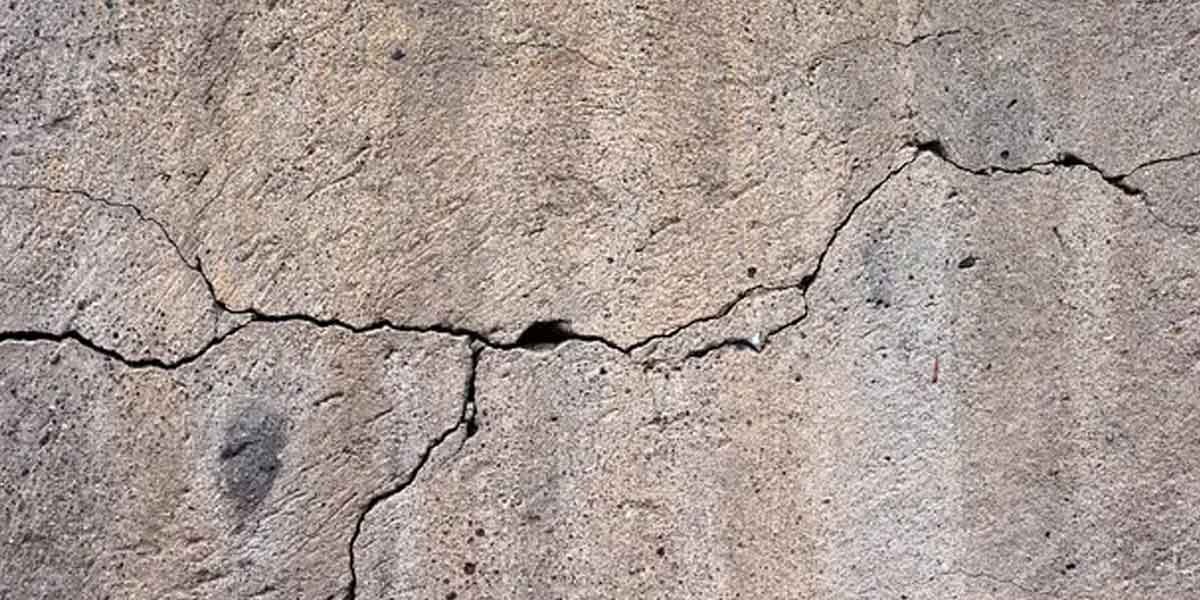

Concrete slabs crack from shrinkage, thermal movement, and a subgrade that moves. Those three concrete slab crack causes account for most of the cracks a homeowner will ever kneel down to measure.
A crack is not proof that someone poured badly. What decides whether it matters is whether the two sides are still level, how far the opening has grown, and whether water now reaches the base. Sorting concrete slab crack causes starts with the pattern, because each mechanism leaves a different shape behind.
Water Content Drives Most Shrinkage Cracking
Drying shrinkage is the most common cause of cracking in slabs on ground, and total water content controls how much a slab shrinks. The Portland Cement Association’s IS177 puts the movement at about 1/16 inch for every 10 feet of length.
Concrete does not shrink the way a board dries.
The cement paste loses volume as water leaves the pore structure and as hydration consumes it, while the aggregate keeps its size, so the paste has to absorb the whole mismatch.
More mix water means more paste to lose.
PCA’s IS177 reports that raising cement content barely changes shrinkage inside normal ranges unless the water content rises with it, which is why the water-cement ratio, not the bag count, is the number that decides.
The field version of this problem is water added on site to get concrete down the chute or around a rebar mat. NRMCA’s CIP 4 caps practical slump at 5 inches (125 mm) for slab work and lists high-slump mixes, jobsite water, missing joints, and skipped curing among the leading causes of cracked surfaces.
Calcium chloride accelerators work against you as well, because they increase drying shrinkage (PCA IS177).
Plastic shrinkage cracks appear while the concrete is still wet
Plastic shrinkage cracks form in the first hours, before the slab has set. The surface loses water faster than bleed water can rise to replace it, the top layer tries to shrink against a still-plastic interior, and the tension tears it open.
These cracks lie roughly parallel, a foot or two apart, stay shallow, and stop short of the slab edge. NRMCA’s CIP 5 uses exactly those features to separate them from later cracking.
The trigger has a number attached to it. FHWA’s guide for curing concrete pavements sets the action level at 1.0 kg/m²/h of evaporation, flags 0.5 kg/m²/h for caution, and warns that wind blowing straight onto a fresh surface can roughly double the water loss the ACI nomograph predicts (FHWA-HRT-05-038).
Wind above 5 mph, hot air, low humidity, and mixes with little bleed water push a slab toward this failure, and silica fume concrete is the clearest case (NRMCA CIP 5).
Drying shrinkage cracks show up weeks later
Cracks that arrive weeks or months after the pour come from moisture still leaving the slab. They tend to cross the middle of a panel or connect one joint to the next, which is the signature of a joint plan that left panels too long.
Those cracks keep working for months. As the slab continues to dry and cool, the opening widens and starts to collect grit and water.
Thermal Contraction Cracks Show Up After Dark
Concrete placed on a hot afternoon contracts as it cools overnight, and that movement is large enough to crack a restrained slab. PCA’s IS177 gives the coefficient of thermal expansion at about 10 x 10⁻⁶ per °C, which works out to roughly 0.03 inch of contraction in a 10-foot section over a 40°F day-to-night swing.
A driveway poured at 2 p.m. in August stands in full sun and 90-degree air. By sunrise the surface has shed forty degrees, and the slab has pulled against the garage floor and the curb with no joint to relieve it. The crack shows up the next morning, opening at the corner.
Restraint is what turns thermal movement into a crack.
Walls, piers, footings, and abutting slabs all hold the concrete in place while it tries to shorten, and isolation joints at those interfaces are the standard remedy (NRMCA CIP 6).
Cracks That Follow the Base, Not the Concrete
Uneven support lets one part of a slab settle or lift while the rest stays where it was, and the slab bends until it cracks. A crack that tracks a utility trench, a footing line, or the stump of a removed tree points at the base more than at the mix.
Four sources show up again and again: backfill over a service trench that was never compacted, roots that rotted and left voids, expansive clay that swells as it wets, and frost heave in cold climates.
NRMCA’s CIP 4 expects the base to be stripped of topsoil and soft spots, compacted in lifts, sloped for drainage, and never frozen at the time of placement.
One preparation step cuts both ways. A plastic vapor retarder laid directly under a slab increases bleeding and raises cracking risk, especially with high-slump concrete, and both NRMCA and PCA recommend covering the sheet with about 4 inches of compactable, drainable fill instead of pouring straight onto it (CIP 4, IS177).
Joint Spacing and Placement Mistakes That Force Cracks
Joints are planned cracks, and the rules for them are numeric. NRMCA’s CIP 4 and CIP 6 put contraction joint spacing at 24 to 36 times the slab thickness, capped at 15 feet, with panels kept square and no longer than 1.5 times their width.
A 4-inch slab therefore gets joints about 10 feet apart (CIP 6). At that spacing the slab cracks where the saw cut told it to, and at 20 feet it picks its own line.
Depth and timing matter as much as spacing.
The groove needs to reach a quarter to a third of the slab thickness and never less than 1 inch, conventional saw cuts belong 4 to 12 hours after finishing, and early-entry cuts go in 1 to 4 hours after finishing (NRMCA CIP 6).
Isolation joints separate the slab from walls, columns, footings, and adjoining flatwork so each piece can move on its own (CIP 6).
Reinforcement is the most common misreading here. Wire mesh and rebar in a slab on grade do not prevent cracking, as CIP 4 states plainly, and they only hold a crack tighter once it forms; steel placed at the wrong depth can even create the plane a settlement crack follows.
Cover over steel matters for a different reason.
Rust occupies more volume than the steel it replaces, and at least 2 inches of concrete over the bar keeps salt and moisture off it (NRMCA CIP 4).
What the Crack Pattern Tells You
Geometry narrows the cause list faster than any test you can run at home. Length, direction, spacing, and whether the crack reaches the slab edge separate the main concrete slab crack causes more reliably than width does.
So which one is yours?
- Parallel cracks, a foot or two apart, shallow, stopping short of the edge: plastic shrinkage in the first hours (NRMCA CIP 5).
- A long straight crack through a panel center, or from one joint to the next: drying shrinkage where joint spacing was too generous (PCA IS177).
- A 45-degree crack off a corner, with the two sides no longer level: settlement or heave under that corner.
- A crack that follows a trench line, a footing, or a row of trees: the base moved beneath one part of the slab.
- A fine map pattern with no single direction: crazing, a surface effect from early drying that PCA’s IS177 calls not structurally serious.
- A straight crack sitting over reinforcement on an exterior slab: rust expansion, which is why CIP 4 asks for 2 inches of cover.
The Four Signals of a Structural Crack
A structural crack changes over time, displaces the slab vertically, or sits where the slab carries load. Width on its own is a weak signal, and a crack that has opened noticeably since your last measurement is a far better one.
NRMCA’s CIP 4 is direct about the baseline: most random cracks that appear at an early age, although unsightly, rarely affect the structural integrity or the service life of concrete.
Four signals deserve an engineer or a foundation contractor: the two sides are offset instead of level, the crack runs the full depth of the slab, water disappears into it and the base below has washed away, or several cracks have joined into a ring around a settled area.
Two sides level? Keep watching. Two sides offset? That is a support problem. A crack that keeps widening past the first year is worth the same attention, since most shrinkage movement is spent by then.
How Wide Is Acceptable, and When to Repair
Random visible cracking is expected even on floors that were designed and built well. ASCC Position Statement #29 quotes ACI 302.1R-04 stating that random visible cracks might reasonably be expected in 0 to 3 percent of the slab panels formed by saw cuts and construction joints.
The foreword of that same document is worth reading in full for anyone who just paid for flatwork: “Even with the best floor designs and proper construction, it is unrealistic to expect crack-free and curl-free floors.”
ASCC adds a caution that contractors rarely say out loud. Crack repair products and methods do not hide a crack, and they can make it more visible, so when appearance is the only concern, a use-as-is decision is often the better one.
Repair is warranted when the crack affects performance: spalling along the edges under hard-wheeled traffic, faulting where one side has dropped, or an opening wide enough to admit water that reaches the steel (ASCC PS#29).
Repair or wait: a one-page rule
Measure the widest point of the crack, write the date beside the number, and check the same spot in a year. An opening that has not changed, does not cross a path carrying vehicles or water, and stays under about 1/8 inch belongs in a maintenance list.
Contractors who do not carry a gauge use a coin instead: two quarters laid flat across the opening span roughly 1/8 inch, and anything narrower than that pair tends to get watched instead of filled.
Anything that has widened, dropped on one side, or runs under a door toward the base belongs on a repair schedule. In freeze-thaw climates the timeline moves earlier, because water sitting in an open crack freezes and widens it further.
Sealers, epoxy injection, and repair mortars are not interchangeable, and choosing badly is why some repairs fail inside a season. Matching the filler to the crack comes before the first tube is opened.
Concrete Slab Crack Causes: Frequently Asked Questions
Is it normal for a concrete slab to crack?
Yes. A slab on ground shrinks as it cures, moves with temperature, and rests on a base that is never perfectly uniform, so some cracking is normal even where design and construction follow the recommendations (ACI 302.1R-04).
What types of cracks can you not ignore?
Any crack whose two sides are no longer level, any crack that has widened since your last measurement, and any crack carrying water into the base or down to the reinforcement. Repair or a professional review is also warranted where crack edges spall under vehicle traffic (ASCC Position Statement #29).
How do you stop a concrete slab from cracking?
You cannot stop it entirely, but the mix, the joints, and the curing control how much cracking you get (NRMCA CIP 4). Keep mix water low and slump near 5 inches, space contraction joints at 24 to 36 times the slab thickness and no more than 15 feet apart, cut them within 4 to 12 hours of finishing, compact the base, and keep the surface moist for at least three days (CIP 4, CIP 5, CIP 6).
What are the most common concrete slab crack causes?
Shrinkage inside the cement paste leads the list, followed by thermal contraction and movement in the base. Water content, joint spacing, and curing decide which of the three does the damage (NRMCA CIP 4, PCA IS177).
Are hairline cracks in concrete normal, and what causes them?
Hairline cracks are normal and come from plastic shrinkage in the first hours or drying shrinkage in the months that follow. The concrete slab crack causes behind them are moisture loss and temperature movement, not a bad batch, and crazing, the fine map pattern on a troweled surface, does not indicate structural trouble (PCA IS177).
Measure the widest opening, date it, and check the same spot next spring. Most concrete slab crack causes spend themselves in the first year, so a crack that reads the same twelve months later and stays under about 1/8 inch belongs in a maintenance file, not on a repair schedule.