
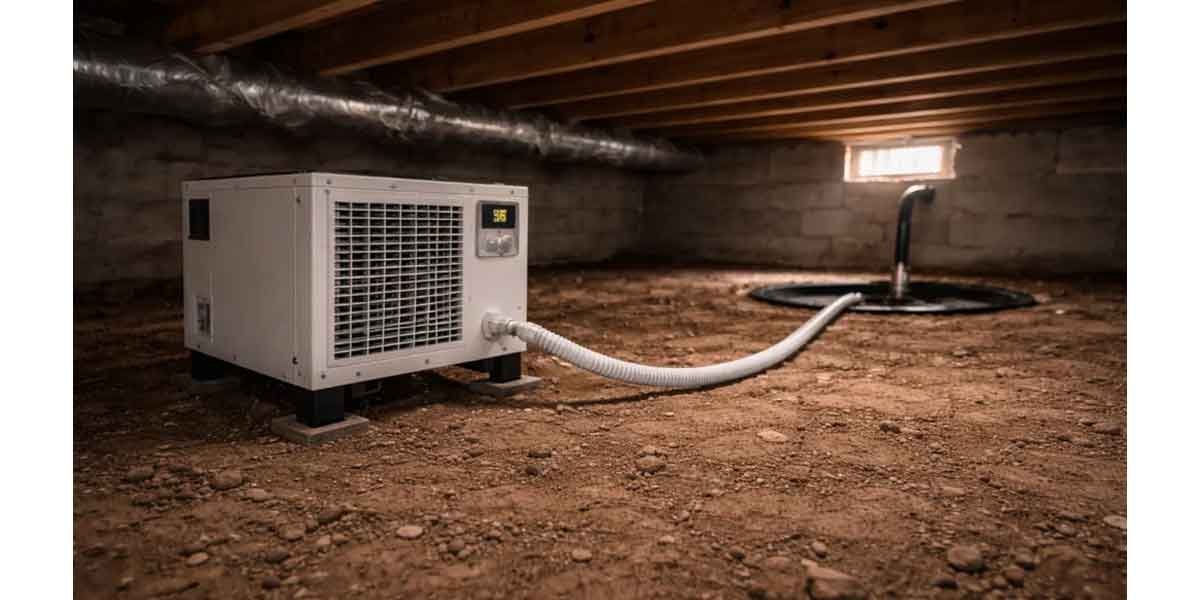

Buy the pump when condensate has to climb. A crawl space dehumidifier with pump costs more than the same machine without one, and the difference buys a single capability: getting water to a drain that sits higher than the unit’s outlet.
If the discharge point already falls below that outlet, the pump is a spare part on standby. One more float to foul, one more line to freeze, one more component to check after a power blink.
The arithmetic is worth doing before checkout rather than in the half hour after a wet pan. It takes a level, a tape measure, and ten minutes under the house.
What a Crawl Space Dehumidifier With Pump Actually Changes
A condensate pump moves water and does not remove more moisture from the air. A float switch trips a small motor that pushes collected condensate through a discharge line, which frees the dehumidifier from having to sit over a drain.
Two mechanisms share the housing and fail on their own schedules. The refrigeration loop condenses vapor into a pan; the pump empties that pan. Retail spec cards keep them in separate fields for exactly that reason, with moisture removal capacity on one line and internal condensate pump listed as a yes or no on the next. Placement is the quieter benefit, because airflow under a house is uneven and the dampest corner is rarely the corner with a drain. A pumped unit can live at the access hatch, at the far end of a long footprint, or beside the lowest seam of a vapor barrier, and let the discharge line carry the condensate from there.
The motor cycles in short bursts, a few seconds at a time, whenever the rising water level trips the float. That rhythm becomes the diagnostic later, when a partly blocked line starts stretching each cycle longer.
Cold spaces add a second source of condensate. A unit running below the point where its coil frosts cycles through defrost, and the melt water from that cycle lands in the same pan the pump empties. The pump ends up handling water from two processes instead of one, which is part of why a low-temperature rating and an integrated pump travel together in this category.
The Target the Pump Is Chasing
EPA’s mold course sets the indoor ceiling at 60 percent relative humidity and calls 30 to 50 percent the ideal band. That range, not zero, is the number a crawl space humidistat works toward, and holding it is what the pump drains for.
Bare soil keeps feeding vapor into the air through capillary wicking, and the same EPA lesson describes crawl spaces with earth floors as common sites of hidden mold growth. Chasing a target below the ideal band runs the compressor harder against a source that never stops, and moisture that gathers under the house can travel into living areas through cracks in the floor overhead.
A humidity meter hung a foot above the soil reports the condition where mold actually establishes itself, and EPA prices the instrument under $50. That reading settles arguments that no feature list can.
When You Actually Need the Pump
The pump earns its price when the discharge point sits higher than the outlet, when the horizontal run is long, or when the machine has to sit low for airflow. Let a gravity destination stay below the outlet and the pump becomes optional.
Gravity drainage has the best reliability record in the building because nothing in it moves. Run a level along the intended path and check the fall. If the endpoint holds lower across the whole length, condensate leaves on its own.
Height offers an easy second test. A machine without a pump needs its outlet above the water it empties into, and one concrete block buys that clearance in a space with any headroom at all. Raise the unit, recheck the level, and the pump stops being a requirement.
Long horizontal runs are the third case, and the one buyers underestimate. A line that crosses half the footprint to reach a sump pit is not the same job as a line that drops two feet. Pumps get rated for the climb while the distance quietly adds friction to every cycle.
Then come the destinations that make a pump unavoidable: a utility sink on the main floor, a laundry standpipe, or a discharge point outside the foundation at grade.
Each of those requires the condensate to rise.
Where the discharge lands matters as much as how high it climbs. Water dumped against the footing soaks the same soil the crawl space sits on, and the loop that creates costs more in run time than a longer line to a point that drains downhill.
Sizing belongs to the machine, not to the pump. Pints of removal, low-temperature operation, and expected service life are settled by the space and the climate, and the trade-offs there run through the crawl space dehumidifier sizing and lifespan guide. A pump changes none of those numbers, which is why a cheap pumped unit still dries a cold space badly.
Reading the Pump Spec Before You Buy
Pump specifications come down to three things: rated vertical lift, pan volume with overflow protection, and whether the unit can be set perfectly level. The rest of the card describes the dehumidifier around it.
Lift is quoted as vertical head, and the horizontal distance is what buyers forget. Water pushed through a long run with a small rise meets more resistance than the same pump lifting straight up, so a pump doing both works longer and hotter on every cycle. Size for the worst path you can build.
Pan volume sets how much forgiveness the install has. A shallow pan where the float has to rise before the motor starts leaves a narrow window between a normal cycle and water on the ground, and an overflow switch closes that window. Lineups vary here, including within one brand’s range, so read the pan and the switch separately from the pump rating.
A check valve belongs in the discharge line. Without one, the column standing in the vertical section slides back down when the motor stops, and the next cycle re-pumps water the pump already moved.
Level placement is the item most installs get wrong. A float switch is mechanical and reads water depth at one point, so a machine on sloped dirt reports a depth that is not there. Bring a spirit level and shim the unit until the pan reads true.
Power deserves a mention. A crawl space outlet feeding a unit that runs all summer belongs on a ground-fault-protected circuit, which is a question for whoever wired the space and a detail inspectors look at.
Remote monitoring earns its place for the same reason the pump does. A controller that reports humidity and fault codes to a phone saves the trip through the hatch, and a stalled pump is the kind of fault it can flag before the pan overflows.
Noise ranks lower here than in a living space, with one exception. A pump burst carries a sharper edge than the fan, and it arrives through the floor over a bedroom at whatever hour the house is quietest.
How a Pumped Install Fails
Pumped setups fail in four predictable places: a float coated in biofilm, a discharge line that sags, a line that freezes, and a pump that runs without moving water. Compressor failure is rarely among them.
The float rests in a well that stays wet all summer, and a wet well grows a slick film. That film builds on the float and its pivot until the float rides high without ever tripping the switch. The pan then fills in silence, and the first sign is a dark edge spreading across the ground at six in the morning.
A sagging line is the second failure, and it looks innocent on installation day. Any dip below the outlet holds a slug of condensate, and standing water is where biofilm begins. The bore narrows through the season until each cycle runs twice as long.
Freezing catches the installs that discharge outdoors. A line that leaves the foundation at grade and crosses open air holds water between cycles once the weather turns. Ice closes the bore, the pump pushes against a blocked path, and the pan becomes the only place left for condensate to go.
The last failure is a pump that runs and moves nothing. An air lock, a closed valve, or a check valve stuck shut all sound alike from the hatch. When the motor keeps running past the point where the pan should be empty, shut the unit down and trace the line before the next cycle.
Built-In Pump or Add-On
A built-in pump removes an external part, a power cord, and a mounting decision from the project. An add-on pump opens the door to a cheaper unit now and a pump later, and it adds one hose connection.
Crawl-space-rated machines tend to include the pump as standard equipment, while oversized consumer units usually ship with a bucket or a gravity line and nothing else. The pump is not uniform by brand either. Santa Fe, AprilAire, and AlorAir all sell units aimed at these spaces, and the internal condensate pump line on the spec card is what separates two otherwise similar machines. Add-on pumps sit between the two groups and fit any dehumidifier that has a drain outlet.
An add-on pump carries a requirement that built-ins hide: its reservoir has to sit lower than the dehumidifier’s outlet, so gravity still moves the condensate a few feet before the motor takes over. Mount it correctly, and the rest of the work is a discharge line, a check valve, and a line item on the annual maintenance list.
The service side tilts the other way. An add-on pump is a separate box that comes out and gets replaced on its own, while a built-in pump means opening the machine when the motor quits. Neither arrangement is wrong. The question is whether you would rather maintain one box or two.
Questions That Decide the Purchase
How to drain a dehumidifier in a crawl space?
A crawl space dehumidifier with pump can discharge to a gravity drain, a sump pit, or a point outside the foundation. Keep the line falling in one direction, add a check valve, and pour a quart of water through the whole path before closing the hatch.
Can you put a dehumidifier in a crawl space without encapsulation?
Yes, but it fights open vents the entire time. Each vent pulls humid outside air back into the space, so an unsealed crawl space needs a larger unit and more run hours for the same result, and the humidistat rarely holds a target through a change in weather.
What size dehumidifier do I need for 2,000 square feet?
Size by moisture load, which is not the same thing as floor area. A damp crawl space under a 2,000-square-foot house is set by its worst month, and the square-footage ratings printed on a box assume a ceiling height that a crawl space does not have.
Is a crawl space dehumidifier with pump worth it in a warm, dry space?
Warm, dry spaces rarely need one. Gravity drainage is easy to arrange there and the moisture load is light, so a pumped unit mostly adds a part that never runs. The pump earns its keep in tight, cool, encapsulated spaces where the machine cannot sit near the only drain.