
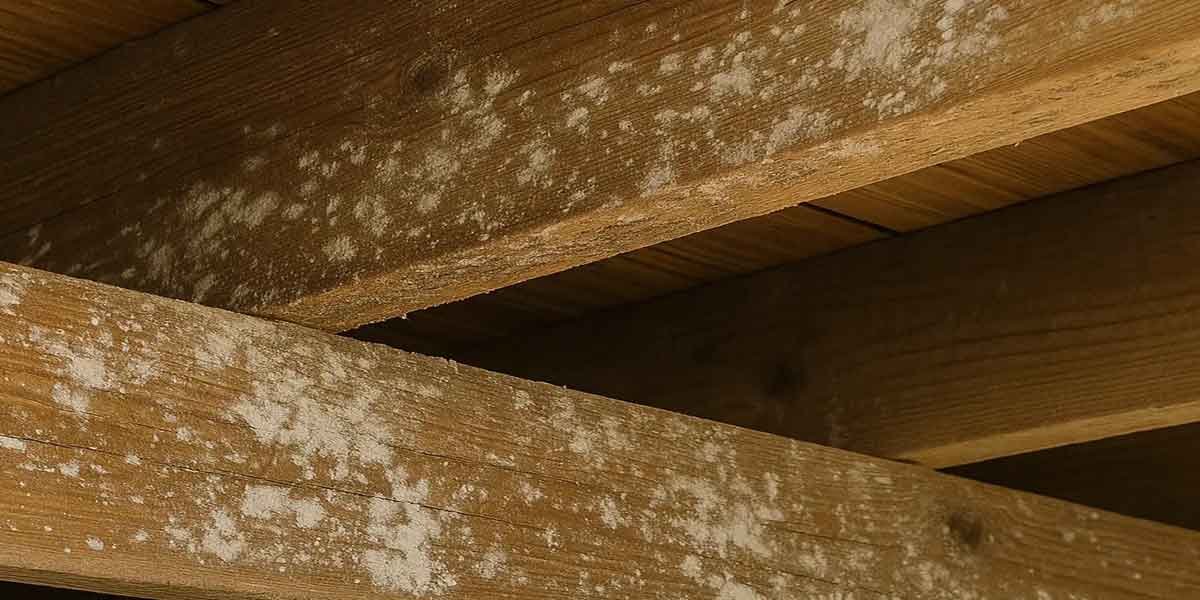

Crawl space mold remediation cost usually lands between $1,000 and $3,000 for a single vented space. It climbs once framing and insulation have to come out, and the spread between two bids tracks measured surface area and the containment class a crew works under.
Quotes rarely show that arithmetic. They arrive as one lump sum, which makes two bids for the same house impossible to compare. Ask for three separate lines instead: decontamination, material replacement, and the moisture control that is supposed to keep the growth from returning.
Kneel in the access hatch with a tape and count joist bays by hand, and the gap between the cheapest bid and the highest one stops being mysterious.
What a Crawl Space Quote Is Actually Pricing
A remediation quote prices affected surface area, not the floor plan of the house. Joist sides, subfloor underside, block walls and contaminated insulation all count, and each band of area carries its own containment and labor rules.
Run the geometry once and the numbers stop being abstract. At 16 inches on center, every linear foot of joist sits over 1.33 square feet of ground, and a 2×10 joist exposes 1.54 square feet of face across both sides. That ratio is 1.16, so a 1,200-square-foot footprint carries roughly 1,390 square feet of joist side surface overhead before anything else is measured.
Add the subfloor underside where growth has reached it, plus the perimeter block walls at 3 to 4 feet of height. The same 1,200-square-foot house can present 2,600 square feet of surface that a crew has to wipe, wire-brush or cut out. The area band then sets the containment, and containment sets labor hours. EPA’s Table 2 in Mold Remediation in Schools and Commercial Buildings (EPA 402-K-01-001) lists the three bands and the equipment each one carries:
| Affected surface | EPA class | Containment | What it does to a bid |
|---|---|---|---|
| Less than 10 sq ft | Small | None required | One technician, one visit, no plastic |
| 10 to 100 sq ft | Medium | Limited | Poly barriers, negative air, a return visit to verify |
| Over 100 sq ft | Large | Full | Sealed containment, air scrubbing, bagged waste and a disposal chain |
The same table raises personal protection from an N95 respirator, gloves and goggles at the small end to full containment at the large end. EPA adds that hidden growth inside an HVAC system or behind an assembly pushes a job toward the cautious side regardless of the measured area. Crawl space work hits that clause often, because the ducts and the joist bays are where growth hides.
So how do two crews quote the same 400-square-foot space far apart on price? The higher one measured the bays, found the subfloor wet, and priced full containment. The cheaper one priced the floor.
What Crawl Space Mold Remediation Costs in Practice
Most homeowners pay $1,200 to $3,750 for professional mold remediation, with reported averages near $2,300 to $2,400. Crawl space jobs sit at the low end when growth is surface-only and climb past the general average once insulation, vapor barrier and damaged framing are replaced.
The per-unit rate is the most stable figure in the market. Per-square-foot pricing for mold work runs $10 to $25 across the rate cards published by Palm Build Restoration, ATI Restoration and This Old House, and Fixr puts the spread at $10 to $30 for the same work. Use those rates as a check on a stated square footage, not as a bid.
Fixr’s area table shows how the bands scale: 50 square feet at $500 to $1,500, 100 square feet at $1,000 to $3,000, 300 square feet at $3,000 to $9,000.
Fixr also reports a $3,500 national average and a $1,500 to $9,000 average range, which sits well above the $2,368 average SERVPRO attributes to HomeAdvisor data. Both figures are real, and the difference comes down to sample size and scope.
HomeAdvisor’s number leans on smaller residential jobs, while Fixr’s $3,500 covers projects that include material replacement and duct cleaning. Plan against the lower average on a job that needs new insulation and you will be short by the time the truck leaves.
Crawl space work also carries costs that general mold pricing hides. An inspection runs $100 to $300, basic space cleaning $500 to $4,000, and mold removal inside the space $1,000 to $3,000, per Capitol Duct Cleaning’s published ranges. Three numbers from three vendors, and none of them describes the same scope.
Where the Bill Climbs
Replacement materials move the number more than the cleaning does. Contaminated insulation, a torn vapor barrier and any joist that has lost section are line items a cleaning-only bid never includes.
Insulation is the largest of them, because fiberglass that has been wet and grown mold cannot be cleaned and has to be bagged and hauled. A vapor barrier costs little by comparison and gets quoted as its own line. That split is what makes the same job show up as a cleaning-only number from one contractor and nearly double from a full-service crew.
Framing damage is the line nobody wants to find. Where a joist end has softened, sistering or a new hanger goes into the scope. That work moves the job from remediation into structural repair, which brings a different license, a permit in most jurisdictions, and a different price sheet.
Ducts inside the crawl space change the job classification. EPA’s Table 2 note sends hidden growth in an HVAC system toward the cautious end of the guidelines, so a crew that finds mold on flex duct will price containment, air scrubbing and possibly duct replacement.
Clearance is labor.
A 24-inch space takes roughly twice the hours of a 48-inch space for the same measured area. No rate card shows that multiplier.
Ventilation or Encapsulation After Cleanup
A vented crawl space dries itself with outside air, and that strategy fails wherever summer dew points sit higher than the ground and framing temperatures. Encapsulation closes the space and treats it as part of the conditioned house instead.
The test is climate, not preference. Where outdoor air in July carries more moisture than the space can hold without condensing on joists, foundation vents deliver water instead of removing it. Sealing the vents, covering the ground and adding a dehumidifier treats the space as indoor volume.
EPA’s residential guidance puts the target below 60 percent relative humidity, ideally between 30 and 50 percent, measured with an inexpensive meter. A vented space in a humid climate cannot hold that band through summer.
Read the sequence in order before adding encapsulation to a quote: source repair, drying, remediation, then the decision on how the space stays dry. Managing humidity in a crawl space covers the order of operations in more detail.
Encapsulation is usually a separate contract quoted by perimeter length and ground area, so it never appears in a remediation bid. Budget for it on its own line and ask the remediation contractor what they assume about it.
When the Adjuster Approves the Dry-Out Only
Home policies pay for mold when it follows a covered water loss; chronic seepage and deferred maintenance fall outside the policy. Many policies also cap the mold portion with a sub-limit, so that clause decides how much of the bid survives review.
A burst supply line that floods the space and grows mold in four days is a claim. A slow ground seep that has fed growth for three seasons is maintenance, and no adjuster will fund it. The documentation that matters is the date of the water event and photographs taken before the crew starts.
Expect an approved scope to cover drying and decontamination and to leave out the encapsulation that would prevent a repeat. That omission is the most common reason a homeowner pays for the same work twice.
When 10 Square Feet Is Your Whole Job
EPA puts the owner-doable threshold near 10 square feet, roughly a 3-foot by 3-foot patch of visible growth. In a crawl space that patch is smaller than it sounds once joist faces are unfolded and counted.
Ten square feet of floor is a patch you can see from the hatch. Ten square feet of affected surface across joist sides, subfloor and block wall is a different job, and the owner-work threshold applies to the second measurement. Measure the patch the way the standard measures it, because a bay that reads as two square feet of floor carries more than double that once both joist faces are counted.
Work at that scale with an N95 respirator, gloves and goggles, and fix the moisture source before cleaning. EPA is explicit that cleaning without fixing the source brings the growth back, and that heavy water damage or growth past the 10-square-foot mark calls for the professional workflow.
By the second hour on your knees in a 30-inch space, in a Tyvek suit, with a headlamp showing a joist bay you have not reached yet, the math on hiring a crew stops being about money.
Frequently Asked Questions
Can mold be removed from a crawl space?
Yes. Growth comes off joists, subfloor, block walls and duct surfaces with HEPA vacuuming, wire brushing and detergent washing, and porous material that has grown through is bagged and replaced. Removal is not sterilization, and growth returns wherever wood moisture climbs back above the level that supports it.
How much does crawl space mold remediation cost?
Crawl space mold remediation cost runs $1,000 to $3,000 for surface growth inside the space, and moves toward the top of the $1,200 to $3,750 general range and beyond once insulation, vapor barrier and framing are replaced. The rate behind those figures is $10 to $25 per square foot of affected surface, and containment class decides which end of the band a bid lands on.
Is mold in a crawl space covered by insurance?
It is covered when the mold follows a covered water loss such as a burst pipe or an appliance failure, and excluded when it follows long-term seepage or neglected maintenance. Most policies also apply a mold sub-limit, so the payout can stop well below the remediation quote.
How common is mold in a crawl space?
No federal agency counts affected homes, and anyone quoting a percentage is estimating. The mechanism explains the frequency: exposed soil supplies vapor, foundation vents admit humid air, and joist surfaces sit below the dew point for weeks at a time across most of the country.
Ask for the three lines in writing before the crew unloads, and measure the bays yourself before you sign.
