
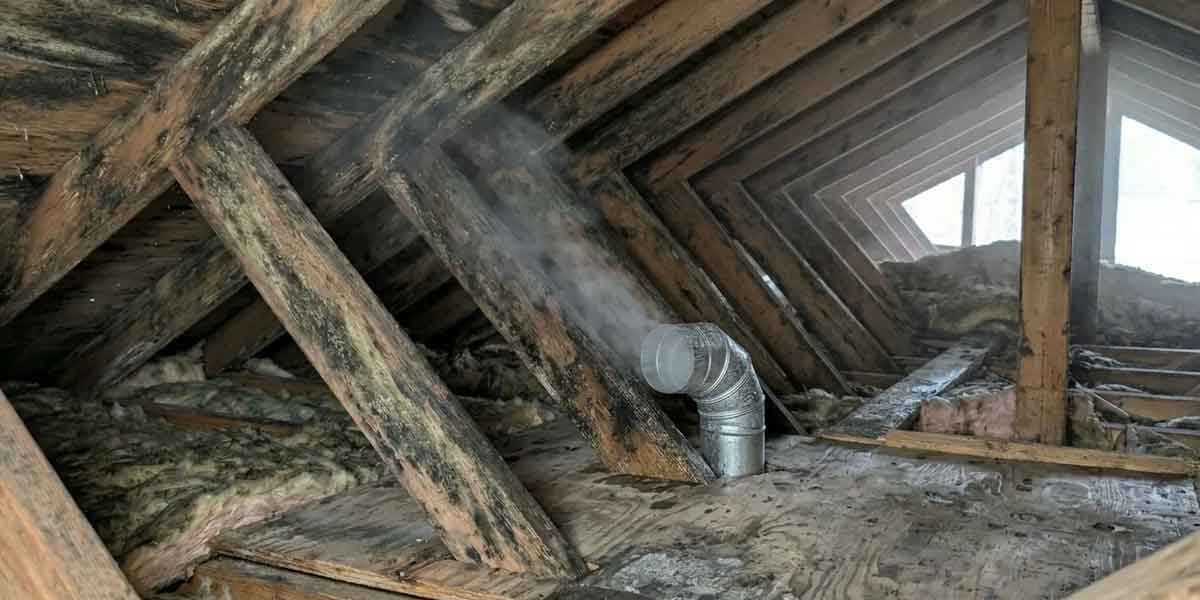

Attic mold removal costs $1,000 to $4,000 for most houses.
That bracket comes from HomeAdvisor’s national data by way of SERVPRO’s cost page, and Bob Vila’s guide prints the same attic range. Two different denominators wear the same label: the floor you stand on, and the sheathing over your head. Neither crew is wrong, and their bids can land 40% apart before anyone discusses mold.
The Typical Range Is a Bracket, Not a Number
HomeAdvisor data puts attic remediation at $1,000 to $4,000. Buk Restoration’s 2025 attic guide prices the same work at $3.50 to $7.50 a square foot instead, or $1,800 to $8,000 for a typical house, with severe jobs past $10,000.
The two figures describe one market at two altitudes. SERVPRO’s location table credits HomeAdvisor with the $1,000 to $4,000 attic bracket against a $2,368 national average for mold work of any kind. Buk Restoration, a Boise remediation firm, reports its national attic average climbing from $3.25 in 2023 to $3.40 in 2024 and $3.60 in 2025.
Small, medium, and large, priced apart
Buk splits attic projects into three buckets, and the per-foot price barely moves between them while the total swings by a factor of ten. A job at or under 150 sq ft lands between $900 and $2,200. The 151 to 300 sq ft tier costs $2,000 to $5,000. Anything past 300 sq ft starts at $4,500 and can pass $10,000.
Read that scale against a normal house. A 1,200 sq ft ranch carries roughly 1,100 to 1,400 sq ft of roof deck, so most single-family attics fall in the largest bucket even when the visible growth looks like a thin wash.
Deck Area Versus Floor Area: The Number Behind the Number
A sloped roof deck carries more area than the attic floor beneath it, so the same attic measures larger when a crew prices sheathing. At 6/12 pitch the deck is about 12% bigger than the floor; at 12/12 it is about 41% bigger.
Roof pitch is rise over run, so the deck plane equals floor area divided by the cosine of the pitch angle. At 4/12 that factor is 1.05. At 12/12 it reaches 1.41. Why would a crew measure the deck at all? Because the deck is the plane that gets HEPA-vacuumed, sanded, and sealed, and the floor between joists is usually buried under insulation.
| Roof pitch | Deck area per 100 sq ft of attic floor | Extra area billed at $4 per sq ft |
|---|---|---|
| 4/12 | 105 sq ft | $20 |
| 6/12 | 112 sq ft | $48 |
| 8/12 | 120 sq ft | $80 |
| 12/12 | 141 sq ft | $164 |
Scale that to a 1,200 sq ft attic at 8/12 pitch and the gap is 240 sq ft, or $960 at $4 a square foot. Same contamination, same crew hours, $960 more on the invoice.
So the first question on an attic bid is which area was measured, and whether the sheet says so. A quote for 1,344 sq ft of deck at $4.25 compares cleanly against one for 1,200 sq ft of floor at $4.75. A quote with no area on the paper compares to nothing, and that is the version to send back.
Why a 100 Sq Ft Attic Job Reads $18 a Square Foot
Minimum job charges dominate small areas. Start with a $1,500 floor and $3.50 a square foot: 100 sq ft quotes at $18.50 a square foot, 400 sq ft at $7.25, and 1,000 sq ft at $5.
That arithmetic explains how a Florida restoration company can list attic mold at $20 to $40 a square foot while a Boise firm lists $3.50 to $7.50. TotalCare Restoration’s own note under that table says the per-foot figure applies to the contaminated area, not the whole house. Small jobs carry the fixed cost of a truck, containment plastic, respirators, scrubbers, and a clearance sample across very few feet. Fixed costs stay put while the patch shrinks.
Neither company is padding a bill. They are pricing different amounts of fixed overhead per treated foot, and the minimum is where that difference shows up hardest.
Three Price Tags in One Attic Job
One attic can honestly price at $350, $3,000, or $25,000 depending on the scope sitting behind the number: a surface clean, a contained remediation, or a tear-out that replaces insulation and sheathing.
The $350 end is real. HomeWyse totals a 125 sq ft “clean mold” task at $287 to $350, and that line covers wiping, chemical treatment, and a rinse. It does not cover containment, HEPA filtration, or disposal, because that is not the task being priced.
The middle tag is the one HomeAdvisor measures. Containment, negative air, HEPA vacuuming, fungicide, and one or two clearance samples land in the $1,000 to $4,000 attic bracket, with Buk Restoration’s typical whole-house attic quote at $1,800 to $8,000.
The top tag appears the moment porous material has to leave. TotalCare Restoration prices a full attic with insulation replacement at $10,000 to $25,000. Buk puts decking replacement over a single slope at $2,000 to $4,000, and full roof replacement past $10,000.
Three words on a bid tell you which tag you are looking at: remove and replace. Insulation and drywall cannot be cleaned well enough to pass a clearance test, so they get bagged and hauled, and that is the step that moves an attic from four figures to five.
What Moves an Attic Quote More Than Square Footage
Access, insulation condition, sheathing damage, and the moisture source move an attic bid more than a few hundred square feet of deck do.
Access is the first shock. Buk reports 15% to 40% more labor hours where crews cannot stand upright, where hip roofs and low pitches block movement, and where dense batts have to be crossed. Cutting an access panel through finished ceiling adds $300 to $800 for demolition and patching.
Then come the repairs that decide whether the cleanup holds. A roof cap reseal costs $250 to $600. Replacing rotted sheathing, or rerouting a bath fan that dumps humid air into the attic, costs $2,000 to $4,000. Buk’s guidance is blunt about why those line items belong in the proposal: clearance testing fails if wood moisture stays above 16%.
Region sets the floor under all of it. Buk’s regional averages are $3.00 to $6.00 a square foot in the West, $3.75 to $7.75 in the humid South, and $4.25 to $8.50 in the Northeast, with sample metro averages of $4,200 in Boise, $4,600 in Dallas, and $5,300 in Boston.
Where DIY Stops Above the Hatch
The EPA’s cleanup guide draws the do-it-yourself line at about 10 square feet, roughly a 3 ft by 3 ft patch. Above an attic hatch that patch rarely exists alone, since sheathing stains spread across whole bays.
The hatch is typically 22 by 30 inches. You go up sideways, knee on a joist, and the flashlight beam hits the deck at a shallow angle. From that angle a light dusting reads as a wash of gray-green paint across the entire slope.
That wash is usually bigger than 10 sq ft before anyone touches it. With rafters at 24 inches on center, a single bay between two of them holds about 16 sq ft of deck over an 8 ft run, so two adjacent bays put a homeowner past the EPA’s self-cleanup threshold before the scrubbing starts.
The equipment math points the same way. A hardware-store mold kit costs about $150. Renting a HEPA air scrubber costs $85 to $110 a day, and disposable suits, gloves, and respirator cartridges add $40 to $60 per person per day, per Buk’s line items. One person, one weekend, one scrubber rental: the savings are thin, and the mess on the joists is the part most people underestimate.
None of that touches the reason the growth appeared. A fungicide knocks down what is visible and leaves the wet sheathing that fed it.
Insurance, Clearance Testing, and the Second Invoice
Homeowners policies generally pay for mold only after a sudden, accidental water event, so a slow roof leak usually lands on the owner. Clearance samples add $150 to $300 each, and most attics need two.
Buk’s read on coverage matches what adjusters say in practice: a burst supply line is a claim, a roof that seeped for two seasons is maintenance. Even on a covered loss the deductible comes off the top, commonly $500 to $2,500, and a claim can raise premiums later.
Clearance testing is where attic jobs split into two invoices. Two samples at $150 to $300 each confirm the work, and they fail if the moisture source is still wet. That is the same ceiling that shows up across wet-basement work, where the drying scope decides the price more than the visible growth does; our basement mold remediation cost breakdown walks the same split.
Pay for the source repair first. The remediation then passes once.
Comparing Three Attic Bids Without Calling Anyone a Crook
Convert every bid to dollars per square foot of deck area, then check four line items: containment, insulation disposal, clearance sampling, and the moisture repair. Bids that survive that conversion can be compared honestly.
The four checks, in the order they change a total:
- Measured area and plane. Look for a number and the word deck or floor. No number, no comparison.
- Containment and negative air. Poly barriers, zip walls, and a scrubber should appear as scope, not as an allowance.
- Insulation handling. Removal, bagging, and disposal get priced separately, at $1.00 to $1.50 a square foot for removal and $1.20 to $2.00 for new blown-in material.
- Clearance samples and warranty. How many samples, which lab, and how long the warranty holds. Two-year terms are standard; extended coverage adds $150 to $400.
Stack the converted numbers and the spread usually narrows to a few hundred dollars. When it does not, the difference is almost always insulation or sheathing sitting on one bid and missing from the other.
Attic Mold Removal Cost FAQ
How much does attic mold removal cost per square foot?
Attic mold removal costs about $3.50 to $7.50 a square foot of treated area for standard work, and $10 or more where sheathing replacement enters. Jobs under 150 sq ft read higher per foot because minimum charges do not scale down with the patch.
Is black mold in an attic more expensive to remove?
Black mold in an attic usually costs more. Stachybotrys and Chaetomium work needs lab identification at $75 to $125 a sample plus double-layer containment, which Buk Restoration says pushes attic pricing past $10 a square foot.
Does homeowners insurance cover attic mold removal?
Insurance covers attic mold removal only when a sudden, accidental water event caused it. A roof that leaked across two seasons is typically excluded, and the deductible still applies before any payout.
How much does it cost to remove mold from a ceiling?
Ceiling mold is attic sheathing seen from below, so attic pricing applies: $1,000 to $4,000 when crews work from above, and more when finished drywall has to come down and be patched.
Can attic mold be removed completely?
Surface growth can be cleaned and sealed, but the colony returns wherever wood moisture stays high. Buk Restoration flags 16% wood moisture as the level where clearance testing fails.
