

Downspout drains underground carry roof water through buried 4-inch pipe to a pop-up emitter or drain 10 feet or more from the house, with the pipe set 12 to 18 inches deep at a 1-to-2-percent slope, point out Keyrenter Folsom experts. Done with smooth-wall PVC, a leaf filter, and a cleanout, the line works for decades; skip those three parts and it silts shut.
Burying the downspout is usually worth it. A single downspout can drain hundreds of square feet of roof, and dumping that at the foundation is how basements get wet; the buried line moves the same water past the danger zone invisibly, with nothing to trip over or mow around. The two asterisks are maintenance access and, in a minority of municipalities, whether burial is allowed at all.
Clog-Proofing: The Three Parts That Are Not Optional
Buried downspout lines have one enemy: roof debris with no way out. Leaves, shingle grit, and seed pods wash off every roof, and a buried pipe collects them at the elbow where the downspout turns underground. Tradespeople see the same failure on repeat:
“I run a gutter installation and repair business (not a plumber) and I’m constantly running into the same issue: customers with underground downspout extensions that get clogged, usually where the pipe connects at the bottom of the downspout or somewhere along the buried run. Right now I just tell them I can come look, but I don’t have the right tools to actually clear a blocked line. This comes up often enough that I’m wondering if it’s worth investing in equipment (a drain rod, a small sewer j…”
– r/askaplumber, July 2026 (9 upvotes)
Three parts prevent the service call. A leaf filter or debris trap at the downspout-to-pipe connection stops the material before it goes underground. A cleanout fitting at that same corner gives a hose or auger a straight shot down the line when something gets past. And a pop-up emitter at the far end opens under water pressure, passes what arrives, and closes flat to the lawn, keeping rodents and backfill out of the pipe’s mouth.
Pipe: Smooth PVC Beats Corrugated Underground
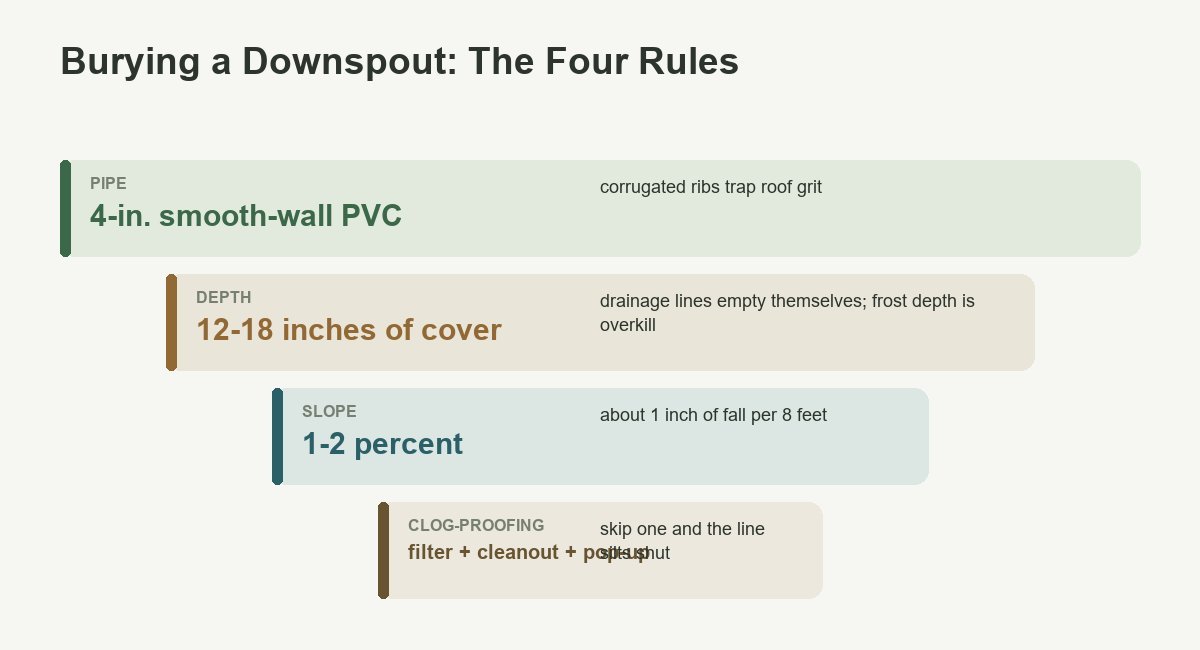
The black corrugated tubing sold beside the downspout adapters costs less and bends around obstacles, and its ribbed interior is where grit settles and snags. Smooth-wall 4-inch PVC, at a few dollars per 10-foot stick, self-scours at the same slope, glues into positive joints that roots resist, and takes an auger without shredding when a clog does form. For a line meant to be buried once and forgotten, the PVC premium across a 20-foot run is the price of two coffees.
Size up, not down. A 4-inch line swallows anything a residential roof delivers; the 3-inch adapters exist because they are cheap, and an undersized line backs up into the gutter during exactly the cloudburst it was buried for.
Depth: 12 to 18 Inches, and the Frost-Line Myth
Bury the line with 12 to 18 inches of cover: enough to shrug off aeration, mowers, and shovel work, shallow enough to keep the trench a weekend job. The often-repeated rule that drainage pipe must sit below frost depth confuses it with water supply lines; a properly sloped drainage line is empty except while raining, so there is no standing water to freeze.
The slope is the real spec: 1 to 2 percent, about an inch of fall every 8 feet, held continuously from the downspout to the outlet. The outlet belongs at least 10 feet from the foundation and downhill of it, with the emitter’s small anti-freeze weep hole letting the last cupful seep away after each storm. In hard-freeze climates the failure point is an emitter iced shut during a mid-winter thaw, which the weep hole plus a slightly proud emitter placement prevents.
Legality and Cost: Check One Rule, Then Dig
Two legal lines matter. Connecting roof water to a sanitary sewer is prohibited nearly everywhere, and some municipalities go further, restricting buried downspout lines entirely or dictating where they may discharge; homeowners find out at gutter-replacement time:
“Hi all, I got our gutters replaced and had to choose locations for our downspouts. The downspouts were previously leading underground, which isn’t allowed in our city. These were the best locations we could think of working with the contractor, but there is a lot of pooling in the back corners of our house, mainly the one over the walkway. I bought a flexible extender for now to mitigate the pooling at the back, but it doesn’t really solve the problem and we have to walk over it. Just FYI, we l…”
– r/Home, April 2026 (195 upvotes)
One call to the building department and one call to 811 for utility marking settle both questions free. With the green light, a DIY run prices at roughly $100 to $250 per downspout: pipe, fittings, filter, cleanout, emitter, and a trenching weekend. Professional installs commonly land at $300 to $800 per line, or $1,500 to $3,000 for a whole-house set with the trenching machine doing the digging.
Where the Water Ends Up: Four Destinations
The pop-up emitter on the lawn is the default ending, and three alternatives fit specific yards. A dry well takes the discharge where no downhill route exists, in soil sandy enough to soak it between storms. A rain garden turns the outlet into a planted basin that drinks the roof water, the prettiest legal endpoint a flat yard gets. And a permitted storm-drain connection is the urban option where the municipality offers one.
Whichever ending, the test is the same: run a hose full-bore into the downspout for ten minutes and watch the outlet keep up. A destination that backs up in a hose test will back up in the first real storm, at the gutter, above your front door.
Underground Downspout FAQ
Can a downspout drain underground?
Yes; a buried solid pipe from the downspout to a pop-up emitter or drain is a standard residential drainage detail. The requirements are continuous slope, a debris filter at the inlet, a legal discharge point, and a municipality that permits the burial.
Can I connect a downspout to the sewer?
Not to a sanitary sewer; roof water overwhelms treatment systems and the connection is illegal in nearly every jurisdiction. Some cities allow permitted connections to storm sewers; the building department answer decides it, not the previous owner’s plumbing.
How far from the house should the line discharge?
Ten feet is the working minimum, farther where grade allows, and always to a spot that slopes away from both your foundation and the property line. Discharging at 3 or 4 feet moves the puddle, not the problem.
How do you unclog a buried downspout line?
Open the cleanout at the downspout corner and run a garden hose at full pressure, then a drain auger for what the hose cannot move. A line that clogs repeatedly without a filter upstream is telling you which part it is missing, and corrugated lines that clog deep are commonly replaced with PVC rather than fought.