
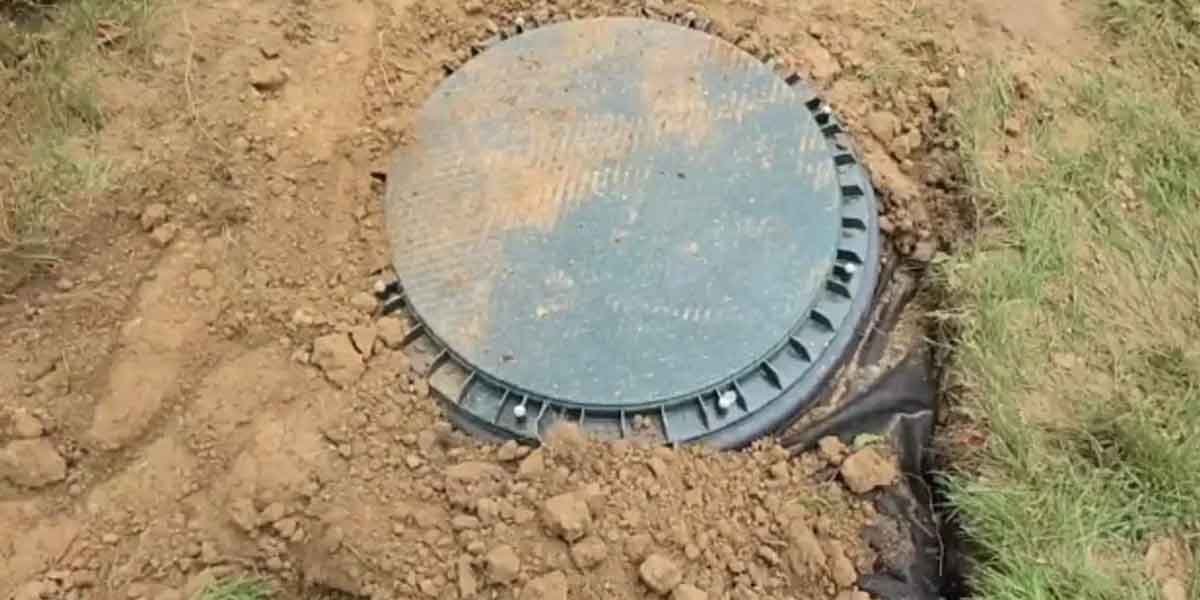

A dry well for sump pump discharge works when the pit swallows one pump cycle before the next one starts. Pits that fail were usually sized against rainfall averages and dug into soil that never had the intake rate to finish the job.
The pump is the fixed half of that pair. A one-third horsepower submersible moves a set number of gallons per minute every time the float trips, regardless of how wet the ground already is, and during a February thaw it will trip all night. Soil is the half that varies. It drains at a rate you can measure in inches per hour, and every dimension of the pit follows from that one number.
Measure first, do the arithmetic, then order stone.
What the pit actually does with pumped water
A dry well for sump pump discharge is a buried pit of clean stone, or a hollow plastic or concrete chamber, that holds water briefly while the soil around it takes that water away. Storage buys time. The soil does the disposal, and no pit disposes of anything on its own.
Two designs sit under that definition, and they store very different amounts of water in the same hole. The Pennsylvania Housing Research Center puts the void space in a clean-stone pit at about 40 percent of the excavated volume, so a designer divides the water volume by 0.40 to get the stone volume. A prefabricated chamber is hollow, so it is sized at the water volume itself.
That is a 2.5x difference in the number a designer starts from. A pit 4 feet across and 4 feet deep is just over 50 cubic feet of excavation. Filled with stone it holds near 20 cubic feet of water, about 150 gallons. A chamber placed in that same excavation still needs backfill packed around its body, so the gain is not the full 30 cubic feet, but the sizing math never asks the chamber to pay the 40 percent penalty.
A stormwater dry well and a septic dry well share a name and nothing else. The second is a seepage pit taking effluent from a septic tank, a regulated sewage facility with its own permits and setbacks. The pit here takes roof runoff, footing drain water, and pump discharge.
Sizing a dry well for sump pump discharge to the pump
Size a pit for pump discharge by converting pump flow into stored volume: gallons per minute multiplied by minutes of run time, then divided by 0.40 if the pit is stone. Rainfall math still matters, because downspouts and footing drains often feed the same pit, but the pump sets the peak.
Start with what a residential pump actually moves. Pentair publishes 2,400 gallons per hour at 10 feet of lift for its one-third horsepower Simer 2164, which is 40 gallons a minute. Ten minutes of continuous running in a wet spring is 400 gallons, or 53 cubic feet of water. Divide by the 40 percent void ratio and the stone volume comes to about 133 cubic feet, a pit 5 feet square and over 5 feet deep.
Now compare the pit most people actually build: 4 feet across, 4 feet deep, one yard of stone dumped in. It stores 150 gallons, and at 40 gallons a minute the pump fills it in under four minutes.
Why does that pit keep getting built? Stone is cheap, and the arithmetic that says it holds 150 gallons never happens on a Saturday morning.
Soil cannot match that rate, and this is where the design either works or does not. Wetted faces on a pit that size add up to roughly 60 square feet once the sides and bottom are counted. Sandy soil taking an inch per hour moves about 5 cubic feet through those faces in an hour, so emptying 20 cubic feet of stored water takes somewhere near four hours.
Four minutes in, four hours out.
The pit sits full through most of a storm and depends on an overflow path to survive the rest of it. That gap is why the PHRC design window allows 72 hours to empty, and why an undersized pit shows water pooling over the stone minutes into a real storm.
Roof runoff and footing drain water often feed the same pit, so run both calculations and size to the larger result. The percolation test that produces the intake rate, and the worked volume example, are in dry well sizing, perc test, and when a dry well fails.
Stone, fabric, and what the pump puts in the pit
Use clean, washed, uniformly graded stone around 1 to 2 inches across (AASHTO No. 3) with roughly 40 percent void space, wrapped in non-woven geotextile. Stone with fines in it, including pea gravel and crusher run, packs tight and stores almost no water.
The Pennsylvania Stormwater BMP Manual is more specific than most retail advice: 1-inch to 2-inch uniformly graded coarse aggregate, wash loss of no more than 0.5 percent, and voids at 40 percent measured by ASTM C29. AASHTO No. 57, the half-inch to one-and-a-half-inch washed rock sold as drain rock, also works where the pit is small.
Pea gravel keeps showing up in homeowner builds because it is cheap, easy to shovel, and looks like gravel. Its fines fill the gaps between particles, and the 40 percent void space that the whole design rests on disappears.
Sump water is dirtier than roof water. It arrives from the footing drain under the slab, which means it carries fine sand, silt, and the rust-colored biological slime that grows where water sits in the dark. Those particles sit squarely in the size range that lodges in the gaps between clean stone.
The PHRC is blunt about what that means over time: the only way to clean a clogged gravel pit is to remove the stone and replace it. A pre-treatment sump ahead of the pit, with a removable hatch, is what turns that job from a rebuild into an afternoon with a shovel.
“a neighbor of mine used a 55 gallon open top (without lid) heavy plastic drum, drilled MANY holes (1/2″) in it, then filled it with round stones about 3/4″ to 1 1/2″ dia. … The hole was about 10″ bigger all around then the barrel, and it was filled with pea stone. He has never had a problem with it … My neighbor’s drywell has been installed for 8 years without a freeze-up or problem.”
Solar1, DoItYourself.com forum thread on dry well construction, September 2004
His neighbor got away with round stone because the drum held the storage volume and the stone around it only had to pass water through. The pea stone backfill is the part that ages badly, since fine aggregate silts up first and slows everything arriving behind it.
Plastic drums and liners deform under saturated backfill, and if the hole is not dug wider than the tank, the backfill bridges and the tank shifts as the ground settles. Digging the hole a foot wider on every side is what keeps a tank round.
The winter failure nobody sizes for
In cold climates the first failure usually appears in the discharge line, not in the pit. Pipe that holds standing water freezes, the pump runs against a blocked outlet, and water finds the lowest joint inside the house instead of the lawn.
Pump duty also climbs in winter. Frost heave, melting snow, and a seasonally high water table push far more water into the footing drain than a dry August does, right when the ground around the pit has the least capacity to absorb it.
Burying the discharge works, with three conditions.
The line has to fall steadily with no sag where water can sit, it has to exit below the local frost depth, and it has to end somewhere legal. The City of Aspen’s dry well policy, written for a mountain climate, requires the pit to sit below the frost line in addition to the 10-foot foundation setback, a fair proxy for what cold-climate code officials expect. A line that daylights at the surface is the cheap version, and it creates ice on a driveway or a walkway every January, which is one reason most jurisdictions prohibit routing sump discharge into a sanitary sewer.
When the site says no
Four conditions rule out a dry well for sump pump discharge, and any one of them turns the project into a different design. None costs anything to check before a machine arrives on site.
- Soil intake under about half an inch per hour. A pit in clay fills and stays full, and water surfaces around the rim within a season.
- Seasonal high water table within two feet of the pit bottom. The PHRC wants two feet of separation above the water table or bedrock, which rules out low ground near a creek.
- No room for 10 feet of separation from the foundation. Closer than that, the design calls for an impermeable liner on the building side of the pit.
- Greywater instead of groundwater. Washing machine, sink, and water softener discharge belongs in the sanitary system or a permitted greywater design.
Cost is the last piece, and it varies more than the stone does. Angi and HomeAdvisor both publish 2025 ranges for dry well installation that start near $1,300, run to about $5,200 at the top, and average a little over $3,100. A gravel pit built by the homeowner sits far below that, mostly excavation rental, stone, fabric, and pipe. What drives the quote up is depth, machine access, and whether the pit is a plastic basin, concrete rings, or a custom stone bed.
Where the soil test fails but the grade still runs downhill, a French drain ending at a daylight outlet does the same job without needing the ground to absorb anything. Where the grade runs uphill from every wet spot, a pit without a pump or an outlet cannot be built at all.
Sump pump dry well questions
What is the best type of stone for a dry well?
Clean, washed, uniformly graded stone at 1 to 2 inches, which is AASHTO No. 3, with about 40 percent void space and wrapped in non-woven geotextile. AASHTO No. 57 drain rock works in smaller pits. Pea gravel, crusher run, and anything sold as minus or screened fill do not, because their fines eliminate the void space the pit depends on.
Can I bury my sump pump discharge?
Yes, into a dry well for sump pump discharge or a daylight outlet, provided the line falls steadily without sags, exits below the frost depth, and stays clear of the sanitary sewer. Ten feet of separation from the foundation keeps that water from seeping back into the drain it just came out of.
How long can a sump pump run dry?
It should not run dry at all. Pentair’s Myers manual states that the shaft seal depends on water for lubrication and cooling, and that the seal can be damaged if the pump runs without water. Thermal protectors cut the motor out and reset on their own, but they are a backup, not a license to leave a pump cycling in an empty pit.
How big does a dry well for sump pump discharge need to be?
Big enough to store one pump run: gallons per minute times minutes, then divided by 0.40 for a stone pit. A one-third horsepower pump at 40 gallons a minute for ten minutes needs about 133 cubic feet of stone, which is a pit 5 feet square and over 5 feet deep.
Do I need a permit for a dry well?
Often, yes. Permits and inspection fees are usually modest, in the tens to low hundreds of dollars, and some jurisdictions limit where a pit may sit relative to wells, property lines, and foundations. The PHRC recommends confirming the approach with the county conservation district or the municipal engineer before anyone digs, and that call is free.
A pit fed by a pump is a soil test and a volume calculation, and the arithmetic is unforgiving in both directions. If the intake rate is short or the stored volume is short, better gravel fixes neither, and the pump will not slow down for the weather.