
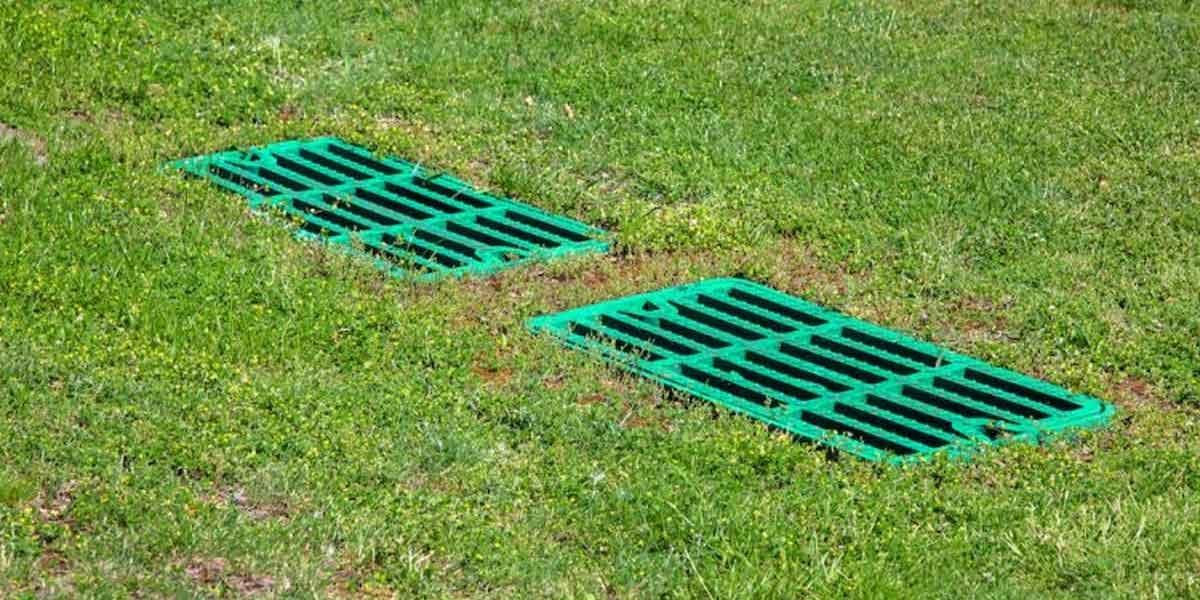

A dry well soaks water in place; a french drain moves it away. Those two clauses cover the physical difference, and the dry well vs french drain decision turns on which one your lot can support.
Most properties already have somewhere lower for storm runoff to go. Fewer have ground that swallows water fast enough to make a buried pit worth digging.
Rarely both.
The Outlet Decides First, Not the Price
A french drain needs a discharge point lower than the water it collects, and a dry well needs ground that absorbs that water at a useful rate. Whichever condition your lot already satisfies is the system you can build, and the second is the rarer of the two.
A french drain is a gravel trench and a perforated pipe collecting along its length; a dry well is a buried chamber collecting at a single point. The rest of the difference follows from that geometry.
Trenches work because water falls. LSU AgCenter’s drainage guide builds its whole profile around that idea: a trench 12 to 18 inches wide and 18 to 24 inches deep, washed stone around a 4-inch perforated pipe, and an outlet lower than the flooded ground. HouseLogic puts the grade near 1 percent, about an inch of fall every 8 to 10 feet.
One flat stretch strands everything upstream of it.
Pipe orientation matters for the same reason. Perforations face down, so groundwater rises into the pipe from the stone beneath it instead of waiting for the trench to fill.
Fabric is not optional either. A geotextile liner around the stone keeps silt out of the pore space that does the actual work.
Skip the liner and the drain silts from the top of the run down.
Pipe choice matters less than bedding, though LSU AgCenter prefers rigid PVC over flexible corrugated for crush resistance and cleanouts that can be rodded.
A dry well has no outlet by definition.
It takes piped inflow, holds it briefly, and waits for the surrounding soil to take it away. Where a trench is buildable at all, the outlet is one of four things:
- Daylight, where the ground falls toward a slope or a ditch
- A pop-up emitter, set where the pipe finally reaches the surface at the lawn’s edge
- A curb or storm inlet, where the municipality permits the connection
- A sump and pump, when the lot has no fall at all
Each carries its own price and its own permission.
A lawn I walked last spring held a boot print until the third day after rain. Nothing about that yard looked wrong, and nothing about it would have passed an infiltration test. Sizing arithmetic for a single well, plus the point where ground refuses the job, is worked through in dry well sizing and perc testing.
Depth and destination set the labor.
A shallow yard drain can be dug by hand over a weekend, while a foundation drain follows the footing.
Excavation hours, not pipe, carry that bill.
Yards with a low spot that never dries and a slope toward the street want the trench. Yards with no slope, sandy soil, and a municipality that refuses roof water into its storm sewer are left with a well.
A graded swale or a rain garden moves the same runoff above ground, and neither asks the soil to pass an infiltration test.
Every lot sets a floor and a ceiling on how deep that well can go. Greenville County’s residential infiltration guidance asks for at least two feet of separation between the facility bottom and the seasonal high water table, plus ten feet of clearance from the foundation.
Winter is the stricter test. A pit that clears the summer water table can sit submerged in March, and a submerged pit has nowhere to put the next storm.
Two Price Sheets That Never Compare
A dry well is priced as a unit sized by stored volume; a french drain is priced by the linear foot. Angi’s 2026 cost data puts one installed well between $1,344 and $5,167, near $3,100 on average, and most trenching at $20 to $50 a foot.
| System | Priced by | Installed figure | Source |
|---|---|---|---|
| Dry well, single unit | Unit, sized by stored volume | $1,344 to $5,167, near $3,100 on average | Angi, 2026 |
| Dry well, prefabricated chamber | Unit | $1,150 to $4,350 | Forbes Home |
| French drain, exterior run | Linear foot | $20 to $50 per foot | Angi, 2026 |
| French drain, spread across markets | Linear foot | $10 to $100 per foot | Forbes Home |
| Full yard drainage project | Project | $2,500 to $8,000, averaging $3,570 | Forbes Home |
Most dry well vs french drain arguments start with price and end with the outlet, which is backwards for work that runs on gravity and soil. Those figures describe different quantities. One measures trench length, the other measures stored water.
Conversion takes one multiplication. A hundred-foot trench with a one-foot-wide gravel section holds 100 cubic feet of stone, and open-graded stone at the 0.40 void ratio specified in Los Angeles County’s LID manual leaves about 40 cubic feet of pore space, or roughly 300 gallons.
Three hundred gallons is a small well.
A prefabricated chamber sidesteps that void-ratio problem. The chamber is hollow, so nearly the whole buried volume stores water, and a compact pit holds what a much larger stone-filled hole holds.
A long trench and a modest buried chamber hold comparable volumes, so the two systems compete for different problems. The shape of the flooding picks the winner.
Water arriving at a single point, a downspout or a low corner beside a walk, suits a well or a short piped run.
Water arriving along a line, a foundation wall or the uphill edge of a patio, suits the trench. A well at one end of a thirty-foot wall never sees the inflow that enters at the other end.
That is how a yard ends up with a new well and the same puddle.
Short jobs invert the ranking.
Crews charge a minimum for showing up, so a twenty-foot trench rarely bills a fifth of a hundred-foot price.
That gap is where a single well competes on cost.
Trench quotes often exclude lawn repair, haul-off of spoil, and the outfall itself.
Those three lines can move a bid more than the per-foot rate does.
Ground conditions explain more of the spread than hardware does. Rocky soil, tight access for a machine, and a long haul for spoil push either system toward the top of its published band.
The Paperwork Behind Dry Well vs French Drain
A dry well counts as a Class V injection well under the Safe Drinking Water Act, and anything beyond a single-family home’s roof runoff usually has to be inventoried with the state or EPA UIC program.
That step does not appear in a typical bid.
The federal definition of a well is broader than the pit in the ground. It reaches a subsurface fluid distribution system, the engineering description of perforated pipe in stone, so an infiltration trench can land in the same category as a chamber-based well.
Most stormwater wells run under a rule-based authorization with no individual permit, and registration with the UIC agency is still expected before construction. EPA’s Class V program page sets out which systems fall inside the category and which agency runs the program in each state.
Single-family roof runoff is the common exemption. Washington State’s Department of Ecology states it plainly in its UIC guidance: a well that takes roof runoff from one house is not a Class V well.
A system that also collects driveway or business runoff loses that protection.
State floors can sit above the federal one. New Hampshire’s Env-Wq 1508.07 bars infiltration where the measured rate is below 0.5 inches per hour, and New York’s stormwater design manual pairs the same 0.5 figure with a cap of 20 percent clay content.
The trench side has paperwork too, and it sits at the outlet. Where runoff may legally go, a curb, a storm sewer, an irrigation ditch, or a swale, is a local decision.
An outfall aimed at a neighbor’s lot turns a drainage repair into a complaint.
None of this changes the physics of either system.
It changes the schedule, since registration generally comes before excavation.
An owner who learns about the registration afterward pays for the wait.
Which One Fails First, and How You Learn About It
A dry well fails from the inside as silt packs the stone or the chamber floor, while a french drain fails from the outside as the trench loses grade or its fabric clogs.
One hides under a lawn; the other shows up as a wet stripe.
An EPA-funded study of dry wells in Millburn, New Jersey, found standing water and slow drainage at multiple sites and put those failures on clogging and poor soils.
The same work found that wells receiving runoff from a whole property clog earlier than wells fed only by roofs.
A french drain’s routine failure traces to its liner. Washed stone without a geotextile wrap becomes a silt trap within a few seasons.
The symptom is a drain that works at the top of the run and does nothing at the bottom.
Soil sets the hard limit on the well option.
Most state manuals require at least 0.5 inches per hour of infiltration, and Montgomery County, Maryland’s micro-infiltration guidance shows what that buys: a 0.5 inch-per-hour soil drains 24 inches of stored water in 48 hours, which caps usable depth near five feet once the 40 percent pore volume is counted.
Ground below that rate cannot be fixed by buying a larger well. The pit fills during the storm and returns the water over days.
That is a slower version of the puddle the yard started with.
Both systems ask for one chore a year. Clear the inlet screen or the emitter cap after the leaves are down, and the silt that reaches the stone drops for the rest of the season.
Why does the same design work two streets over and fail here? Soil, depth to groundwater, and the silt load in the runoff decide it. A trench that quits announces that in the next rain, and a well that quits looks like a working well until the lawn floods again.
When They Run Together
A french drain can discharge into a dry well, and the pair holds only when both halves are sized against the same storm. The trench collects by length while the well absorbs by volume, so two correct sizes can still overflow together.
Two rules keep the combination working. The well’s inlet stays below the trench outlet, and the stored volume is figured for the full runoff the trench delivers over a design storm.
The well also has to sit at the low end of the property, which is often where the neighbor’s fence line runs. Not impossible, just close.
Questions Owners Ask Before Digging
Is a dry well or a french drain better?
Neither wins in general. A french drain is better wherever a legal outlet sits lower than the flooded ground, and a dry well is better where the lot offers no outlet and the soil drains faster than 0.5 inches per hour.
How do you calculate dry well capacity?
Multiply the pit volume in cubic feet by the stone’s void ratio, commonly 0.40, then by 7.48 gallons per cubic foot. A 100-cubic-foot pit of open-graded stone stores about 300 gallons.
Can a french drain replace a dry well?
It can replace the job of a well only when the trench reaches a legal outlet lower than the water it collects. Without that outlet a trench becomes storage, and a stone-filled trench stores only the gaps between stones, the same limitation a stone-filled well has.
Dry well vs french drain: which costs less?
The dry well vs french drain cost gap tracks the length of the work. A single well usually costs less than a long french drain and more than a short one, with Angi’s 2026 figures putting an installed well near $3,100 against trenching at $20 to $50 per foot.
Build the access before the sod goes down. A well needs its inlet and filter reachable from the surface, and a trench needs cleanouts at both ends.
Where an outlet exists, the trench is the cheaper and longer-lived answer.
