
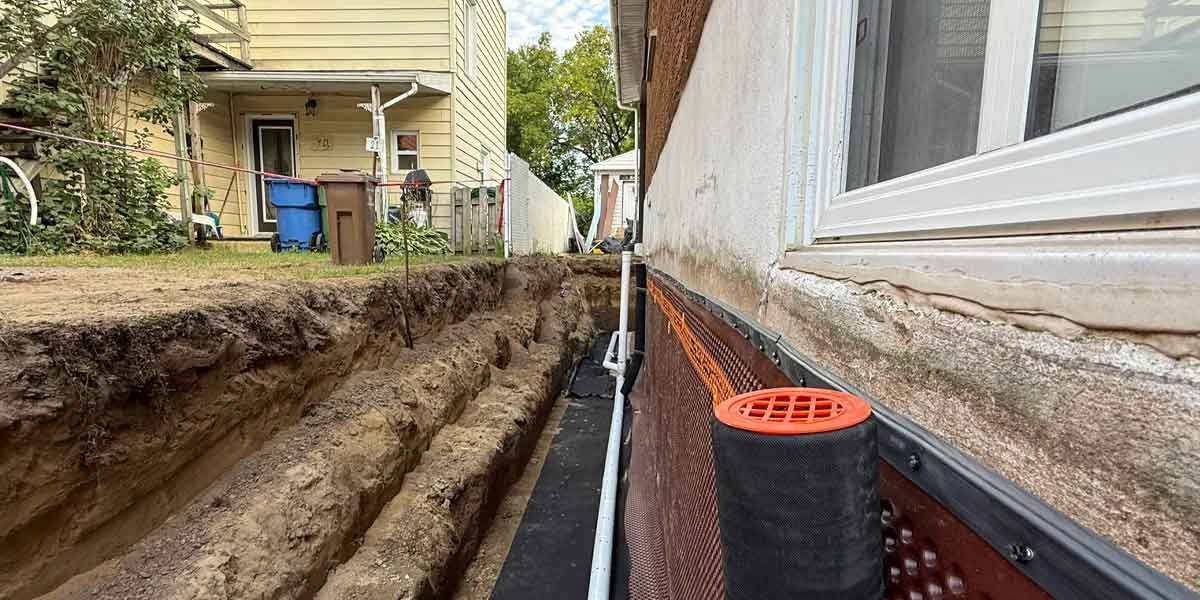

French drain cost per foot lands between $10 and $50 outside a foundation and $40 to $100 beneath a basement slab.
Neither figure is wrong, and neither one prices a job. The same 100-foot trench in the same yard can come back at $1,000 or at $6,500, depending on what each contractor counted.
A per-foot rate is a quoting convention, a way to price work whose length nobody knows until someone walks the property.
It becomes useful the moment you know which parts of the work it covers.
What a Linear Foot Costs in 2026
Exterior drainage prices from $10 to $50 per linear foot, interior work from $40 to $100, and ProMatcher’s national report puts exterior installation at $16 to $47 a foot, averaging $22.32.
Those bands do not line up because the surveys behind them collect from different contractors. Angi’s 2026 cost data, drawn from 2,203 verified projects, reports a national average of $4,633 for yard drainage, with most systems landing in the $10 to $50 per foot range.
The band moves with the type of drain and where it runs.
| Drain type | Where it runs | Cost per linear foot | Source |
|---|---|---|---|
| Curtain drain | Shallow, handles surface water | $10–$25 | Bob Vila |
| Exterior | Yard or foundation perimeter | $10–$50 | Angi; Bob Vila |
| Yard trench | Trenching into a finished lawn | $30–$90 | Bob Vila |
| Deep drain | High water table | $30–$70 | Bob Vila |
| Patio edge | Around a paved patio | $30–$40 | DSLD Land Management |
| Driveway | Beside or under paving | $45–$55 | DSLD Land Management |
| Interior | Beneath a basement slab | $40–$100 | Angi; Bob Vila; Glanz Buffat |
| Basement system | Full perimeter, quoted as a job | $4,000–$15,000 total | Glanz Buffat |
A per-foot figure describes a medium-sized job. Most yard drainage runs $2,147 to $7,173 on Angi’s numbers, Glanz Buffat puts a full French drain install at $2,800 to $6,500, and Bob Vila’s own range for the work stretches from $500 to $18,000 once repairs, retaining walls, and discharge work enter the picture.
The location matters as much as the drain type. DSLD Land Management quotes yard drains at $20 to $30 a foot, patio drains at $30 to $40, and driveway drains at $45 to $55, because paving has to come up and go back down.
Basement drains sit at the top of that scale, from $70 a foot upward, and access explains that price better than the length of the run does.
Hillside properties add a second invoice before the drain starts. Bob Vila prices a retaining wall at $3,500 to $9,400, plus $25 to $50 per linear foot to run a French drain behind it and relieve the water pressure that would otherwise push the wall over.
Why One Yard Gets Bids at $10 and $65 a Foot
Most of a per-foot price buys digging, hauling, and backfill. On a 100-foot exterior drain, the perforated pipe averages $50 to $200 and the gravel $500 to $1,000, while the same run billed at $22.32 a foot comes to $2,232.
Bob Vila’s breakdown of a 100-foot drain runs the perforated pipe at $0.50 to $3 a linear foot, sleeved or bare, and the material tables reviewed here widen that to $5 once diameter and wall thickness come into it.
Gravel retails for $30 to $60 a ton, so a 100-foot run carries somewhere between $550 and $1,200 of material. The rest of the invoice pays for excavation, backfill, site cleanup, and the contractor’s margin, which is why one trench supports so many different prices.
Labor is billed by the hour. Angi’s 2026 pricing puts crews at $50 to $150 per hour, and rocky ground, tree roots, and tight access all turn into hours rather than feet.
Geography moves the number further than any other single variable.
ProMatcher lists Charlotte at $18.55 to $20.32 per linear foot and New York at $43.12 to $47.24 for the same scope, a spread of roughly 2.3 times, with Chicago at $23.26 to $25.48, Los Angeles at $27.18 to $29.78, and Seattle at $24.16 to $26.47 sitting between them.
A national average cannot budget a local job.
Depth does the rest. A typical exterior trench runs about 3 feet deep and interior work goes deeper still, so a system that has to sit below a frost line or under a high water table costs more per foot while the visible design stays identical.
Glanz Buffat, a Louisville plumbing contractor, prices a 100-foot drain anywhere from $1,000 to over $6,500 depending on depth and excavation.
What a French Drain Cost Per Foot Quote Leaves Out
Per-foot pricing typically covers trench excavation, perforated pipe, gravel backfill, and equipment rental. Everything else arrives as a separate line, which is where two bids on one yard stop being comparable.
ProMatcher’s cost notes spell out what stays out of the per-foot figure:
- Yard restoration after the trench closes
- Sump pump, unit and installation
- Dry well construction
- Permits and inspections
- Dirt and debris haul-off
- Decorative grates and catch basins
- Regrading to reach a discharge point
Two of those lines carry real money. A sump pump costs $150 to $300 for the unit and installation in Bob Vila’s breakdown, while Angi puts a full sump installation with wiring at $500 to $2,000, and a 700-gallon concrete dry well runs $2,015 to $5,451 in ProMatcher’s regional reports.
Site preparation adds $300 to $1,000, and regrading ground to reach a storm drain or a ditch adds $0.50 to $1 per square foot.
Permits are the quiet one. ProMatcher’s notes put a permit requirement on some jurisdictions and leave the fee to the homeowner, so a bid that looks $400 cheaper can sit on top of paperwork the other bidder already included.
A frame of reference helps here. Angi’s 2026 table prices a trench drain at $30 to $70 per linear foot and Bob Vila prices a channel drain at $30 to $150, both above a plain pipe in gravel, so a French drain quote in the high teens is not automatically the cheap version of the job.
The per-foot comparison only holds when both bids price the same list. Ask for the exclusions in writing, add the missing lines back in, and the true cost per foot usually moves by more than the bids differed.
Why Interior Runs Cost Three Times the Exterior Rate
Interior installation starts with breaking out the slab. Concrete comes up, the spoil leaves the house, the trench runs deeper, and the work happens at a finished ceiling height, which is how $40 to $100 a foot replaces $10 to $50.
Bob Vila’s breakdown attributes the difference to the concrete work, not to pipe or gravel; the material list barely changes on either side of the foundation.
Interior drains also collect costs that do not scale with length. A sump pump is a fixed item, and a basement system quoted as a package lands at $4,000 to $15,000 before any waterproofing goes onto the walls.
Those two budgets get decided together more often than not. Sealing a wall and draining beneath it overlap in ways separate quotes tend to keep apart, and the cost build-up behind a basement waterproofing quote belongs on the same spreadsheet as the drain line.
Window wells and membrane work sit in the same column. Bob Vila prices a window well at $1,000 to $2,500 and puts additional basement waterproofing at $2,300 to $7,575, both of which are normally quoted separately from the drain itself.
DSLD Land Management, writing from Birmingham, quotes basement drains from $70 a foot upward, the top of the interior band.
Where the Water Ends Up Changes the Price
A pipe in gravel is only half a system, and the half that costs the most is often the outlet. A 700-gallon concrete dry well runs $2,015 to $5,451 installed, a small well runs $50 to $700 as a part, and regrading ground to reach a storm drain adds $0.50 to $1 per square foot.
Community rules decide which of those you are allowed to build. Bob Vila’s guide notes that discharging to a storm drain, an irrigation ditch, or a dry well depends on local rules, and a yard that can only use a dry well pays for excavation twice.
That is where quotes separate most sharply. Two contractors can agree on the trench, the pipe, and the gravel and still differ by thousands on where the water goes.
Ask for the outlet as its own line item, with the distance and the destination written down.
Short Runs Break the Per-Foot Math
A 20-foot drain does not cost a fifth of a 100-foot drain. Mobilization, permits, and minimum labor land on every job, so the rate climbs as the run gets shorter.
ProMatcher’s line items include an “unused minimum labor” charge, the balance of a two-hour minimum a contractor can apply to other work on site.
Angi puts the floor of a simple drainage fix at $800, and Bob Vila’s low end for a French drain is $500.
Run the arithmetic. At a flat $22.32 a foot, a 100-foot drain bills at $2,232 and a 20-foot drain at $446; against a $500 to $800 minimum, that short run really costs $25 to $40 a foot.
Long runs move the other way. Most of a large job’s bill is labor and equipment overhead, and those hours spread across more feet, which can pull the quoted rate below what a 50-foot repair commands.
Digging it yourself changes the ratio in both directions. An owner who handles the trench saves the $50 to $100 per hour Bob Vila attributes to each worker, but the pipe, gravel, filter fabric, and machine rental still bill at full price, so the saving shows up as a percentage of a small job and almost nothing on a long one.
Judge a short job on the total and a long one on the rate.
The Lifetime Cost of Each Foot
Maintenance runs $50 to $200 a year for an owner doing the work, and $100 to $400 per visit for a professional, against a drain that Bob Vila expects to last 30 to 40 years when it is built correctly.
On a 100-foot drain, $100 a year is $1 per foot per year, and three decades of that adds $3,000 to an install bill that may have been $2,000.
Drains set in rocky or hard ground clog sooner, which is the routine failure, and a fabric sleeve over the perforated pipe keeps sediment out of the openings for a small amount per foot.
A bid that saves $1,000 up front can cost more per foot if the system silts up in twelve years.
French Drain Cost: Frequently Asked Questions
How much does a French drain cost per foot?
A French drain costs $10 to $50 per linear foot outside and $40 to $100 per linear foot beneath a basement slab, and a complete installation runs $500 to $18,000 depending on scope, with most projects landing between $2,000 and $7,000.
What is the lifespan of a French drain?
A correctly built French drain should last 30 to 40 years, and slope, gravel size, filter fabric, and soil decide where in that range yours falls, with drains in rocky ground clogging sooner.
How much drop per foot does a French drain need?
The fall comes from local code and the height of the discharge point, so no single figure applies everywhere. The hard constraint is depth: 18 to 24 inches below the area being drained at minimum, reached at the uphill end so the pipe can keep falling.
What are the cheaper alternatives to a French drain?
Regrading a yard costs $500 to $3,000 and gutter and downspout work $150 to $350, both below a full drain. A small dry well runs $50 to $700, a 700-gallon concrete one $2,015 to $5,451, and a swale handles surface water wherever the ground already slopes.
Is a French drain worth the cost?
Water already reaching a foundation or pooling in the yard is the condition that justifies the spend, and Glanz Buffat’s guide names yard flooding and a damp basement as the two cases it is built for. The maintenance line of $50 to $200 a year is what keeps that protection working.
Two french drain cost per foot figures can describe the same trench. The number earns its place when it arrives with a list attached: what is included, what is excluded, and who repairs the lawn.