

Most basement waterproofing jobs land between $2,461 and $8,203, with the average near $5,242, according to Angi’s basement waterproofing cost data.
A basement is priced by the linear foot of drain, the number of cracks that get injected, and the pump that lifts the water out.
Two contractors can quote the same room $3,000 apart without either one lying to you.
The published guides sell a per-square-foot number. The crews bill by the foot of wall.
What the Published Basement Waterproofing Cost Numbers Cover
National cost guides put basement waterproofing at $5,242 on average, with most homeowners paying $2,461 to $8,203. Minor work, like sealing a single foundation crack, can come in as low as $600, and a complete perimeter system reaches $15,000.
Basement waterproofing costs move with the size of the space, and two independent guides draw nearly the same table.
| Basement size | Published cost range |
|---|---|
| 500 square feet | $1,500 to $5,000 |
| 750 square feet | $2,300 to $7,500 |
| 1,000 square feet | $3,000 to $10,000 |
| 1,250 square feet | $3,800 to $12,500 |
| 1,500 square feet | $4,500 to $15,000 |
| 2,000 square feet | $6,000 to $20,000 |
Fixr publishes the same ladder with the same shape and a $5,000 headline average, close enough to Angi’s $5,242 to be read as one market.
A 1,000-square-foot basement reads as $3,000 to $10,000, and that is the figure most homeowners carry into the first phone call. It is accurate for the work the table describes, which is a narrower job than the one most wet basements demand.
A damp corner, white mineral staining on block, or water along the joint where the wall meets the floor after a hard rain rarely clears with a sealer. Those symptoms point to water arriving under pressure, and moving it out takes a drain, a pit, and a pump.
Once a system is in the bid, the estimate stops following the floor area.
Why a Per-Square-Foot Estimate Misses the Job
Interior drainage is priced by the linear foot of wall, not by the square foot of floor. A weeping tile system is a perforated pipe laid in gravel along the inside edge of the footing, and it drains to a sump pit. Angi lists weeping tile and interior French drains at $60 to $120 per linear foot, and Fixr puts the same work at $40 to $120 per linear foot.
Perimeter is the number that matters, and it does not scale with area the way a per-square-foot price implies. A 1,000-square-foot basement drawn at 25 by 40 feet has 130 linear feet of outside wall. At $60 to $120 per foot, the drain alone is $7,800 to $15,600, before a sump pump at $1,200 to $2,500.
The same 1,000 square feet in a 20 by 50 layout gives 140 feet. A square 32 by 32 gives 128 feet. Identical floor area, a 9 percent spread in wall length, and the bill moves with it.
That arithmetic is where the tension over basement waterproofing cost in a walkthrough comes from. The 1,000-square-foot row lands at $3,000 to $10,000, and a full-perimeter system in the same footprint prices past the top of that row, because the bid counts 130 feet of trench and the table counts floor area.
The rest of the cost lives in line items that carry their own units. The figures below are Angi’s published unit prices, and Fixr lists the same units within similar ranges.
| Line item | Where it goes | Unit price |
|---|---|---|
| Waterproofing paint and sealant | Interior | $1 to $8 per square foot |
| Silicate concrete sealer | Interior | $3 to $9 per square foot |
| Foundation coating | Interior | $500 to $1,000 per job |
| Weeping tile or interior French drain | Interior | $60 to $120 per linear foot |
| Subfloor drain tile system | Interior | $25 to $55 per square foot |
| Baseboard channel | Interior | $30 per linear foot |
| Epoxy injection | Interior | $800 to $1,500 per crack |
| Sump pump, installed | Interior | $1,200 to $2,500 |
| Vapor barrier | Interior | $1,500 to $3,000 per job |
| Dehumidifier | Interior | $800 to $2,000 each |
| Exterior French drain | Exterior | $10 to $100 per linear foot |
| Excavation | Exterior | $50 to $200 per cubic yard |
| Liquid membrane | Exterior | $3 to $6 per square foot |
| Sheet membrane | Exterior | $1,500 to $3,000 per job |
| Yard grading | Exterior | $500 to $3,000 per job |
| Gutters and downspouts | Exterior | $4 to $40 per linear foot |
Two items on that list carry most of the spread between bids: the drain, quoted anywhere from $40 to $120 a foot, and the pump, quoted from $1,200 to $2,500 installed.
Crack injection shows the same pattern at a smaller scale. Angi prices epoxy injection at $800 to $1,500 per crack and Fixr prices it at $250 to $1,000. Neither range is a mistake, because injection is sold by the crack, and a hairline break and a wide one that weeps steadily take different amounts of resin and time.
Where the slab is opened across its whole area instead of around its edge, the unit changes a third time. A subfloor drain tile system is priced at $25 to $55 per square foot, which is the most expensive way to move water across a basement floor.
A finished basement adds a demolition line before any of that work starts. The bottom of the wall has to open for a perimeter drain, and Angi puts water damage repair at $1,360 to $6,290 with debris removal at $130 to $370.
Interior System or Exterior Excavation
An interior drainage system averages $3,000, and exterior waterproofing averages $7,000, per Angi.
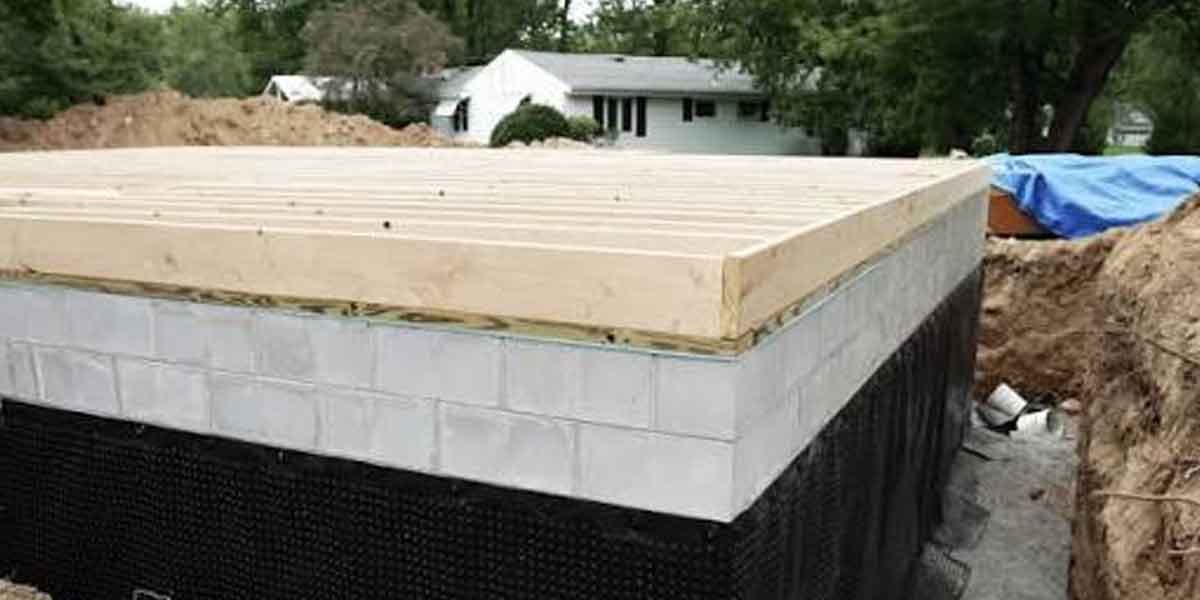
The difference buys a membrane on the outside face of the wall and the digging required to reach it.
Excavation is the expensive part of that trade, billed by volume at $50 to $200 per cubic yard. The work also pulls in line items an interior job never touches: sheet membrane at $1,500 to $3,000 or a liquid membrane at $3 to $6 per square foot, yard grading to put the ground back at $500 to $3,000, and permits at $75 to $500 where the dig is deep enough to require one.
Anything resting against the foundation moves first. Decks, steps, patios, and plantings come out before the excavator reaches the wall, and rebuilding them lands on your side of the ledger.
Positive-side waterproofing is a membrane applied to the outside face of the wall, where soil pressure pushes it tighter against the concrete. Exterior work intercepts water before it touches the wall, which is the only way to relieve pressure on that face. It is the standard answer when a wall is already bowing or when the foundation is masonry that will not tolerate repeated wetting. Interior work takes water after it has entered and hides behind a finished wall.
If the wall itself is failing, excavation is the only version that protects it from the wet side.
If the floor is what stays wet, a drain and a pump handle that from inside at $3,000 against $7,000.
What Is the Cheapest Way to Waterproof Basement Walls?
Damp-proofing is a coating that slows vapor, and waterproofing is a system that stops liquid water. Crack sealer and waterproofing paint are the cheapest materials on the list, at $1 to $8 per square foot, and their price reflects that job: both guides separate damp-proofing at $3 to $6 per square foot from waterproofing at $5 to $10.
That category has a hard boundary. A coating rolled onto the inside face of a wall blocks vapor and light seepage, and it does not stop water pushed against the wall by saturated soil. Coating a wet wall from the inside is the repair that fails first, usually within one or two wet seasons.
Surface water is cheaper to rule out than any system is to install. Yard grading runs $500 to $3,000, an underground downspout extension $200 to $2,000, and gutters $4 to $40 per linear foot. When the seepage shows up along the joint where the wall meets the floor only after a storm that dumps a roof’s worth of runoff next to the foundation, those line items settle it for less than a drainage system.
Will Insurance Cover Any of It?
Homeowners policies generally do not pay for groundwater seepage, and they do not pay for waterproofing itself. The losses they do cover cluster around burst pipes, appliance and fixture overflows, and freezing.
The Insurance Information Institute, working from ISO claim data, reports that 5.3 percent of insured homes filed a claim in 2023, down from 6.4 percent in 2020. Water damage and freezing accounted for about one in 60 insured homes between 2018 and 2022, with an average payout of $15,400 per claim. That category includes mold damage when a policy covers it.
What falls outside is the part most basement budgets are built around. Water arriving through a foundation wall from saturated ground is treated as a maintenance or surface-water problem, and flooding is covered only under a separate policy.
A declarations page is the part of a policy that lists what is covered and what is excluded. Policy language decides this, and it varies by carrier and state, so the answer for a specific house comes from that page.
Is the Spend Worth It?
The comparison that decides it is a one-time system against a repair bill that keeps coming back. Water damage repair runs $1,360 to $6,290, mold remediation $500 to $3,500, and ongoing basement maintenance $200 to $400 a year, per Angi.
A drain and pump job at the low end of the interior market costs about what one round of water damage repair costs, and it does not recur every time the water table rises. The system carries its own upkeep after that: about $200 to $400 a year, and a reseal around $1,000 every five to ten years on the coatings that need it.
The spend is worth less when water is a symptom of structure. Bowing walls, stair-step cracking in block, and doors that no longer close point to movement in the foundation, and waterproofing a wall that is moving spends money on the wrong problem. Foundation repair averages $5,000, and structural damage repair runs $2,500 to $25,000, per Fixr.
A basement with high humidity and no standing water is the other case where a full system gets oversold. A dehumidifier at $800 to $2,000 and a vapor barrier at $1,500 to $3,000 address moisture without opening a slab.
The number to ask for is the one that makes basement waterproofing cost comparable between bids: a price per linear foot of drain, the pump broken out on its own line, and the prep work itemized. Two bids in that shape take five minutes to read against each other.
Basement Waterproofing Cost FAQ
How much does basement waterproofing cost for a 1,000 square foot basement?
A 1,000-square-foot basement is quoted at $3,000 to $10,000 in published tables that price the work by floor area. A full-perimeter interior drain is priced by wall length instead, and that footprint carries about 130 linear feet of outside wall, putting the drain alone at $7,800 to $15,600 before the pump.
Is waterproofing a basement worth it?
It usually is once water reaches the floor. One interior drainage system costs about what a single round of water damage repair costs, and the damage repeats every wet season until the source is diverted.
Will insurance pay for basement waterproofing?
No. Standard homeowners policies exclude the cost of waterproofing and the groundwater seepage that usually prompts it. Flood damage needs a separate policy, while sudden bursts and overflows are the claims insurers pay.
What is the cheapest way to waterproof basement walls?
Paint and sealant at $1 to $8 per square foot are the cheapest products, and they suit walls carrying vapor rather than water. Seepage under pressure needs a drain and a pump, which is the more expensive answer.