
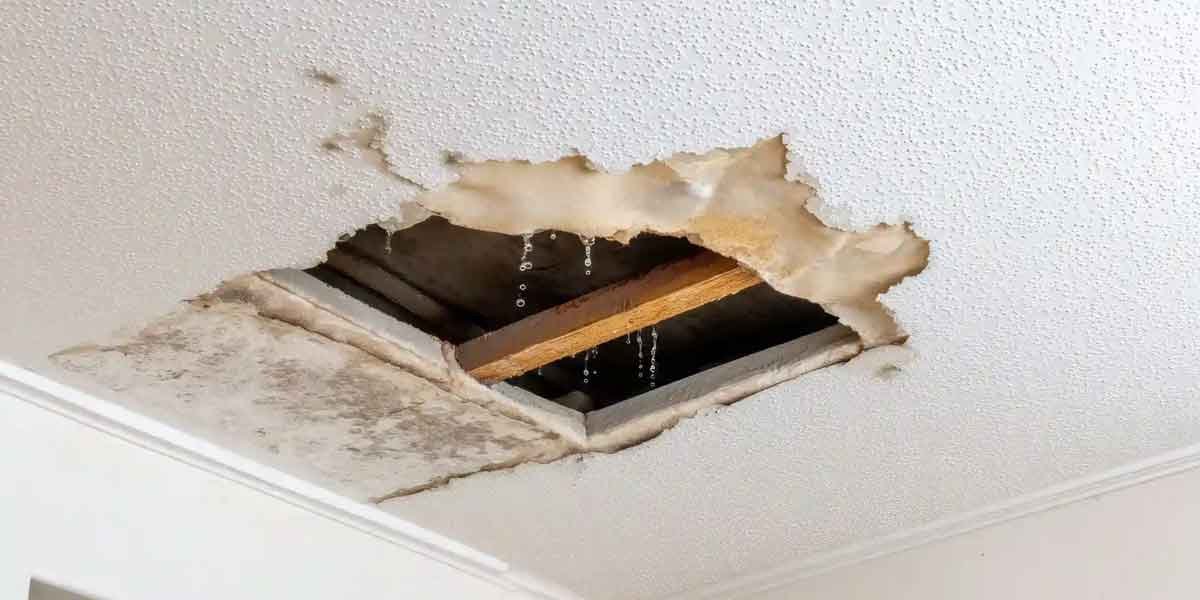

Garage ceiling leaks start above the ceiling.
Water crosses a roof deck, a plumbing line, or a condensate pan first, then travels along the framing and the back of the drywall until it finds a place to drip.
The stain is the last stop on that route. Photograph it, write down what sits directly above it, and note the date, because the record of how long water has been arriving disappears the moment someone patches and paints the board, points out Evolve Real Estate & Property Management.
Why the stain sits away from the leak
The wet patch is unreliable as a pointer. Water follows the easiest route across joists, insulation, and the paper face of gypsum board, so it can enter near an exterior wall or a railing post and drip two joist bays over. Work upward and sideways from the stain.
Gypsum board wicks.
Once the paper face is wet, water spreads sideways inside the board, which is why a small entry at a top plate can stain a strip several feet wide.
Fiberglass batts overhead make the diagnosis harder. They hold water against the framing long after the drip stops, and when you finally pull a piece out it comes away heavy and gray, still damp inside, weeks after the ceiling felt dry to the touch.
Garages dry slowly. Most are unconditioned, with no dehumidifier and no air handler moving air through the space, so a cavity that would dry in a day inside the house can stay wet far longer. EPA’s mold course lists the back side of drywall and the roof materials above ceiling tiles among the places hidden mold usually grows, and a garage ceiling is both at once.
A brown ring. A slight sag between two joists. A musty smell on humid mornings that fades by noon.
What sits above the garage decides the shortlist. A garage under open roof structure has one suspect. A garage with a bathroom, laundry, or kitchen above it has four, because supply lines, drains, and appliance hoses all run through that same ceiling assembly.
Match the garage ceiling leak to its source
Timing narrows the field faster than inspection does. Rain-only drips point to roofing or flashing, drips that follow a shower or a laundry load point to drains, and drips that ignore both the weather and the fixtures point to a pressurized supply line or a pan that is overflowing.
| When the water shows up | Path that fits | First check |
|---|---|---|
| Only during or hours after rain, worst in wind-driven storms | Roof covering, step flashing, railing post penetrations, or the metal at a wall-to-deck junction | Work from the drip edge upward above the stain; look for lifted shingle tabs, opened sealant, or a dark streak running below a penetration |
| Only after someone uses the bathroom, laundry, or kitchen above | Drain line, tub overflow, toilet seal, or a washing machine hose | Run the fixture 10 to 15 minutes with a flashlight on the ceiling; a drain leak usually answers within minutes |
| Steady, whatever the weather, with no fixtures in use | Pressurized supply line, or a condensate pan that has gone into overflow | Read the water meter with every fixture off, wait 15 to 30 minutes, read it again; a moving dial means supply side |
| Only in cooling season, heaviest in the afternoon | Condensate drain line, trap, or pan from an air handler above or beside the garage | Trace the drain line to where it discharges and check whether the pan is holding water |
| Around a chimney, vent stack, or furnace flue | Failed flashing collar or a cracked crown | Inspect the collar and the roof surface around the stack, not the stack itself |
Wind-driven rain is the pattern people misread most. Water pushed past a railing post base or a length of lifted step flashing can enter well above the ceiling without ever touching the living space, so a rain-only drip in a garage usually points to a deck or balcony overhead. The metal that keeps water out from behind a ledger board is a specific repair with its own rules, set out in this deck flashing repair breakdown, and it fails quietly: the decking looks fine while the seal behind it has been open for years.
The three upstream paths, checked in order
Every garage ceiling leak resolves to one of three upstream paths: the roof and its flashing, a plumbing line or appliance above the garage, or an HVAC condensate line. Check them from the outside in, because the roof takes ten minutes to rule out and the plumbing may take an afternoon.
1. Roof and flashing
Start above the stain and work from the drip edge upward. Lifted shingles, an open ridge, a cracked pipe boot, a flashing collar that has pulled away from the masonry, and a gutter that backs up under the drip edge all put water into a joist bay, where it runs before it drops.
A roof over a garage is often the oldest surface on the property, and small breaches there stay invisible from the driveway. A cracked boot looks like nothing from twenty feet away and delivers water for months. Deck and railing penetrations deserve their own pass, especially on a garage that carries a balcony, because each post base is a hole through the roof surface and the seal around it is a maintenance item with a limited service life.
2. Plumbing and appliances above the garage
Ask what shares the floor above.
A bathroom, laundry, kitchen, or water heater over the garage turns the ceiling below into a drip pan for supply lines, drains, tub overflows, and appliance hoses.
The meter test separates a pressurized leak from everything else. Turn off every fixture and appliance that uses water, confirm nothing is running, read the meter, then read it again 15 to 30 minutes later. A moving dial means water is escaping a supply line, which is the one failure mode that will never fix itself.
For drains, color helps. Drop food coloring into a toilet tank or a tub drain, run water into the fixture above, and watch the ceiling with a flashlight. Hoses are the underrated entry on this list: a braided supply hose to a washer fails without warning, and the first sign is usually the stain below it.
3. HVAC condensate
An air handler above or beside a garage produces condensate all summer, and its disposal path is the least inspected part of the system. A pan that has drifted, a drain line clogged with biological growth, or a trap that has lost its prime will put water through a ceiling in a steady, weather-independent drip that mimics a plumbing leak. Ten minutes with a wet-dry vacuum on the drain line and a flush of the trap covers most of these call-outs. It is routine maintenance, and the federal guidance is explicit about it: keep air conditioning drip pans clean and the drain lines unobstructed and flowing properly (EPA, Mold, Moisture and Your Home).
A dryer venting into the garage rather than outdoors adds moisture to the same cavity all year, and EPA’s mold course lists that arrangement as a recognized moisture problem.
If the vent hose ends inside the space, the ceiling stays humid even when nothing is leaking.
Dry it out before you close it up
The drying window matters more than the repair choice. EPA puts it at 24 to 48 hours: when wet materials are dried inside that period, mold usually does not grow. Miss the window and you are not repainting a ceiling, you are removing one.
Pull the wet insulation out and bag it. It carries no structural load, it will not dry in place, and it keeps the board wet from above while you are trying to dry it from below. Then move air. A box fan aimed at the open cavity and a dehumidifier in the garage do more than any heater, and running the house air conditioning only helps if the garage sits inside the conditioned envelope, which it usually does not.
EPA suggests keeping indoor humidity below 60 percent, ideally between 30 and 50, and notes that a moisture meter costs about $10 to $50 at a hardware store. That meter tells you when to stop: compare the reading on the wet board and framing against a dry section of the same ceiling, and do not close anything up until the two numbers are close.
Dry to the touch is not a measurement.
Sometimes the board can stay. A one-time overflow that has been stopped, a stain that is dry to the touch, and a meter reading that matches the dry area around it add up to a ceiling you can seal and repaint. Saturated insulation, a board that sags or crumbles at the edge of the stain, mold visible on the paper face, or a meter that keeps reading high by the second morning of air movement all mean the board comes down, cut back to sound material.
Stains need a sealer before paint. A stain-blocking primer over a dried, sealed patch keeps the brown ring from bleeding through two coats of ceiling paint, which is the usual reason a repaired ceiling still looks repaired.
If the source is still unknown after the meter test and the fixture tests, stop. A leak that has run long enough to stain a ceiling has usually run long enough to reach the framing, and a moisture survey with a thermal camera answers in an hour what a month of guessing will not.
The board is the cheapest material in this job.
Replace it once, after the water has been stopped and the cavity has actually dried, or replace it twice.
Frequently asked questions
How do you stop water dripping from a garage ceiling?
Stop the water at its source before repairing the ceiling. If a rain-only pattern points to the roof, roofing repair comes first; if the meter test shows a moving dial, the supply line does. A ceiling repaired over an active leak stains again within weeks.
Why does my garage ceiling only leak when it rains?
Weather-linked drips point to the roof or to flashing at a wall, post, or chimney above the garage. Plumbing and condensate leaks do not check the forecast, so water that arrives with storms is getting past a roof surface or a penetration seal.
Will homeowners insurance pay for a garage ceiling leak?
Coverage turns on cause and timing, and the policy wording decides. A burst supply line or storm damage to the roof is usually handled as a sudden loss, while a leak that built up over months is often treated as maintenance, so read the water and deterioration exclusions before filing anything.
Do I have to replace the garage ceiling drywall?
A stain that is dry to the touch, in a ceiling whose meter readings match the dry area nearby, can usually be sealed and repainted. Sagging board, saturated insulation above it, or mold on the paper face means cutting the damaged section out back to sound material.
How much does a garage ceiling leak repair cost?
Cost splits into two bills: stopping the water and rebuilding the ceiling. The source determines the first, and the area of wet board plus the insulation above it determines the second. Cutting a small inspection hole before you collect quotes keeps both numbers honest, since the person pricing the work can then see the cavity.