
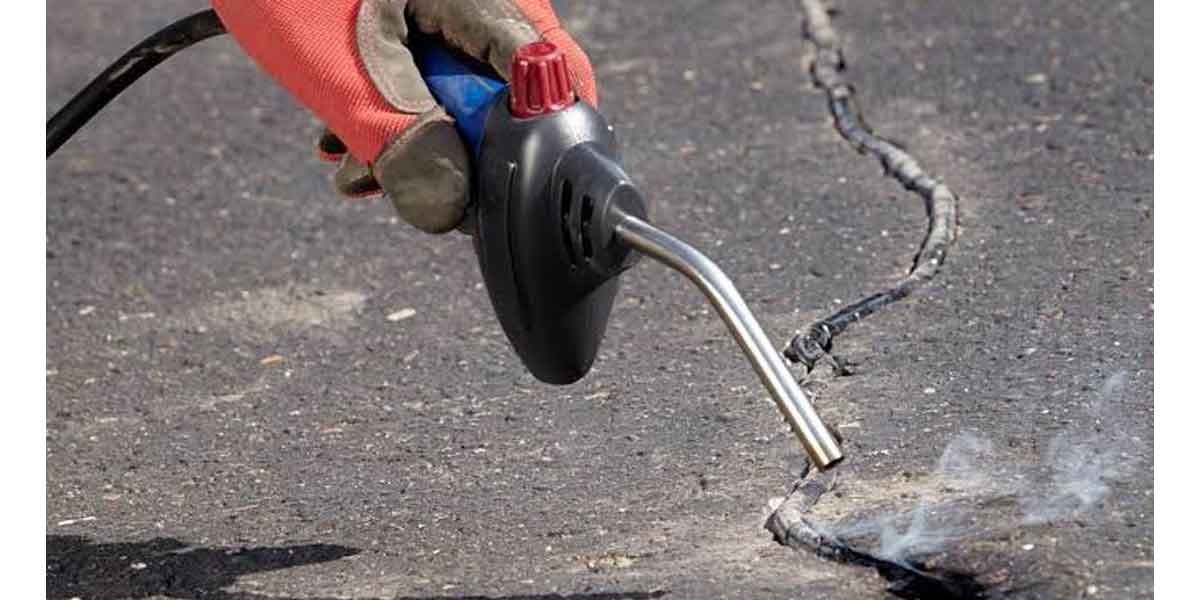

According to Orange Property Management Company, a typical driveway repair cost runs $150 to $600 per visit. That covers crack filling, a sealcoat and one or two patched potholes on a standard two-car driveway, and it explains how the same surface can also collect a $2,400 bid without anyone lying about it. The total moves on three things: the unit a rate multiplies, the depth of material being replaced, and a trip charge that does not shrink because the job is small.
What Drives a Driveway Repair Bid
Material, damage type and depth decide a driveway repair cost long before the contractor’s rate enters the picture. Material sets the unit, because asphalt is patched in strips and concrete is patched in panels. Damage type separates maintenance from structure. Depth decides whether a crew is filling a gap or rebuilding the layer underneath it.
RemodelCostCalc’s 2026 asphalt price guide lists crack filling at $1 to $3 per linear foot for openings under half an inch, hot-pour crack sealing at $2 to $5 per linear foot for cracks between half an inch and an inch, and a hot-mix patch at $50 to $200 per pothole. Sealcoating the whole surface runs $0.20 to $0.50 per square foot. On a 600-square-foot driveway, that works out to $50 to $150 for fifty feet of cracks and $120 to $300 to seal the surface afterward.
Cold patch from a hardware store costs $15 to $30 a bag and goes down in freezing weather, so it ends up on driveways in January. It also loosens and pushes out within a year or two. Hot mix is the material that holds, and it needs a dry surface and warm air to bond.
Concrete Bids Move on a Different Unit
Concrete contractors quote by the square foot because the repair is usually a panel, not a strip of filler. Texas Home Exteriors’ 2026 concrete repair guide, built on Angi project data, lists hairline crack filling at $0.50 to $3 per linear foot, surface patching at $3 to $5 per square foot, resurfacing at $3 to $7 per square foot, and slab replacement at $6 to $18 per square foot. A 400-square-foot driveway that has to come out entirely lands between $3,200 and $7,200.
A sunken panel is the one failure where the concrete itself is still sound. Lifting it with a cement slurry, mudjacking or slabjacking depending on who you call, is quoted around $3 to $9 per square foot across the 2026 guides, with job minimums most companies set between $300 and $700. SlabCalc prices a 200-square-foot driveway section at $800 to $1,800 and a full 450-square-foot driveway at $1,800 to $4,100. Polyurethane foam lifting runs two to three times the mudjacking rate and the slab is drivable the same afternoon.
The Unit Matters More Than the Rate
A driveway repair cost estimate is built from three units, and most of the distance between two contractors comes from mixing them. Cracks are priced by the linear foot. Surface work and slab work are priced by the square foot. Everything that does not fit either category falls under a flat trip or minimum charge.
That minimum is the least understood line on a residential bid. RemodelCostCalc puts the minimum service call for asphalt work at $150 to $250. Concrete contractors in the Texas Home Exteriors guide hold a minimum trip fee of $100 to $175. Neither fee shrinks because your driveway is smaller than the last one.
One visit should therefore carry several repairs. A crew already on site for crack sealing can patch a pothole for $50 to $200, and the same patch ordered by itself can carry the whole minimum. Five or more patches at once often come in at $20 to $50 each.
Depth is the second thing a thin bid hides. A surface patch over a failed base buys one season. Concrete removal and disposal adds $1 to $3 per square foot to any replacement job, soil stabilization runs $500 to $2,000 when the subbase has washed out, drainage corrections land between $300 and $3,000, and some municipalities charge $50 to $200 for a permit. Quotes that leave those lines out are shorter, not cheaper.
For a closer look at how damage type decides between patching, resurfacing and rebuilding, the driveway repair decision guide walks through the tiers in order.
Where Cheap Repairs Stop Working
Crack sealing is the cheapest durable repair on this list, and it stops paying once water has reached the base. Federal Highway Administration researchers put that line at 6 to 7 percent of the surface covered by wheelpath fatigue cracking.
Their LTPP analysis measured what happens past that point: base stiffness fell by 93 to 175 percent in wet-freeze climates, against 2 to 13 percent in dry-freeze climates. The report, Use of LTPP SMP Data to Quantify Moisture Impacts on Fatigue Cracking in Flexible Pavements, is public.
For a driveway, the arithmetic is blunt. A hairline crack filled in May costs $1 to $3 per linear foot. The same crack after two winters has widened and lifted, and the repair has moved from per-foot filling to $50 to $200 per pothole, or to a full-depth repair priced by the square foot. Water that reaches the gravel base does not leave on its own.
By February the crack at the apron has a lip on both sides where the plow caught it. Sand and de-icer sit in the opening. Melt water pools there after lunch and freezes again overnight, and by spring the edges have broken away into a hole roughly the size of a dinner plate.
Once about 25 to 30 percent of the surface has failed, patching stops being the economical answer and resurfacing or replacement takes over. Texas Home Exteriors uses a second, harder line: when a repair estimate exceeds half the cost of replacing the same area, replacement is the better investment.
Concrete adds one more boundary. Cracks wider than a quarter inch usually point to something happening below the slab, and filling that crack without addressing the cause only postpones the invoice. Where panels have settled but stayed intact, mudjacking is the cheap route. Where they have broken into pieces, replacement is the only fix that resets the clock.
A Quote You Can Check in Five Minutes
Take a 600-square-foot asphalt driveway with fifty linear feet of cracks and two potholes. Crack filling at $1 to $3 per foot is $50 to $150. Two hot-mix patches at $50 to $200 each add $100 to $400. The trip charge applies once, at $150 to $250. The realistic total sits between $200 and $500 for one visit, or up to about $800 if the surface is sealed while the crew is there.
Now read a $2,400 bid against that arithmetic. Six hundred square feet at $2 to $5 per square foot is $1,200 to $3,000, which is overlay pricing. That bid answers a different question than the patching quote does, and the gap between $300 and $2,400 is the difference between filling cracks and laying a new wearing surface over the whole driveway.
Three measurements make bids comparable. Run a tape along the cracks and add up the linear feet, count the potholes or failed panels, and multiply the length by the width of the paved surface. Ask each contractor to price those same quantities, and ask what the trip charge is on its own.
Driveway Repair Cost: Frequently Asked Questions
Should I fill cracks in my concrete driveway?
Fill hairline cracks, and expect a flexible polyurethane or epoxy filler to hold them for a few years. Professional filling runs $0.50 to $3 per linear foot, while a tube of filler costs $5 to $15 for weekend work.
Cracks wider than a quarter inch are the exception. At that width the crack usually has a cause under the slab, and filling it hides the symptom.
What does driveway repair cost per square foot?
Asphalt patching and overlay run $2 to $5 per square foot. Concrete surface patching runs $3 to $5, resurfacing $3 to $7, and full slab replacement $6 to $18.
Square footage only applies to work spread across a surface. Cracks are priced by the linear foot, and small jobs are priced by the trip charge.
What is the cheapest way to fix a worn driveway?
Seal the cracks before water reaches the base, then sealcoat the surface every two to three years at $0.20 to $0.50 per square foot. Filling fifty feet of cracks costs $50 to $150, which is a fraction of any surface repair.
That advice stops applying once cracking has spread into a connected web. Nothing short of replacement holds on a base that has already failed.
How do I price out a driveway?
Price the work in the units a contractor uses: linear feet of crack, the number of patches or failed panels, and square feet of surface. Ask for the trip charge separately, then collect three bids against the same quantities.
Most driveway repair cost estimates from three local companies spread by 30 to 50 percent on identical scope, which is wide enough that one quote tells you very little about the going rate.
Is resurfacing a concrete driveway a good idea?
Resurfacing pays on a slab that is sound and level, and it costs about half of replacement: $3 to $7 per square foot against $6 to $18 for a new slab. Expect 8 to 15 more years from a proper overlay.
Two conditions have to hold first. Cracks get filled before the new layer goes down, or the overlay fails within a season or two. And the panels stay intact underneath, because an overlay poured over concrete that has already broken into pieces inherits the same movement.
What does a 20×20 driveway cost to repair?
A 20 by 20 driveway is 400 square feet. Surface patching at $3 to $5 per square foot runs $1,200 to $2,000, and cracks are priced separately by the linear foot at $0.50 to $3.
If the slab has to come out, the same 400 square feet costs $3,200 to $7,200 at $8 to $18 per square foot. That ratio, not the size of the crack, is what moves a homeowner from repair to replacement.