
According to Keyrenter Naperville Management team, a standard radon mitigation cost runs $805 to $1,326 in 2026, with a national average of $1,043 across 1,184 completed projects tracked by Angi. The EPA’s 2025 cost model budgets $1,826 for the same installation, stated in 2023 dollars, and the agency’s public page for homeowners carries no figure at all, offering only that most homes can be fixed for about the cost of other common repairs. Every one of those descriptions is correct. They count different things, and knowing which one a bid belongs to decides whether it looks high or simply describes a harder house.
Three physical facts move the number further than house size does: how many suction points the soil and foundation call for, where the vent pipe can exit, and whether a crawl space has to be sealed before any of it works. A bid that leaves those three out cannot be compared with one that states them.
What Radon Mitigation Costs in 2026
A professionally installed active soil depressurization system costs $805 to $1,326 nationwide in 2026, averaging $1,043, before testing at $150 to $700 and permits at $25 to $150. A straightforward single-point job therefore reaches roughly $1,200 out the door.
Angi’s figure comes from 1,184 verified projects, which makes it the closest thing to a market price for a plain installation. The EPA’s figure answers a different question. It exists so the agency can weigh mitigation spending against avoided medical costs, and it carries assumptions no contractor quote will ever contain: a starting level of 4.0 picocuries per liter, 1.0 after the work, and an assumed intervention life of 74 years. The same model assumes 85 percent of homes above the action level mitigate at all.
| Reference | Figure | What it actually measures |
|---|---|---|
| Angi, 2026 installs | $805 to $1,326, average $1,043 | 1,184 verified projects by network contractors |
| Angi, 2026 testing | $150 to $700 | Home test kits and professional testing |
| EPA model, ASD installation | $1,826 | Policy input, 2023 dollars |
| EPA model, testing with retest | $169 | Two tests: before the work and after it |
| EPA model, operating cost | $206 per year | Electricity for a continuously running fan |
| EPA model, fan replacement | $476 every 10 years | Amortized equipment replacement |
| EPA model, warning device | $151 at year 3 | Monitor replacement, not installation |
The EPA figures above come from Table 1 of the agency’s analysis of the benefits and costs of radon reduction strategies, where the dollars are labeled as 2023 amounts. Nothing in that table was written as a consumer price, which is why lining it up beside a $1,043 average confuses people: one is a sample of finished work, the other a national model that includes homes far harder than yours.
The $783 between those two numbers is mostly the retest, the warning device and the fan replacement that an installation line does not include.
Radon Mitigation Cost by Method
Method sets the baseline before site conditions enter the picture. Active suction soil depressurization, the standard choice for basements and slab foundations, runs $1,000 to $3,000. Passive depressurization uses the same pipe without a fan and runs $500 to $2,500, and it only holds up where radon levels are modest.
Angi’s 2026 method data prices the rest of the field like this:
- Sealing the basement alone: $400 to $4,600. Angi rates sealing at about half the effectiveness of suction, with repeat resealing likely.
- Wall-based systems: $500 to $3,000, where a block wall creates the collection space.
- Ventilation systems: $1,300 to $2,500, exchanging indoor air with two fans instead of depressurizing soil.
- Water mitigation: $1,200 to $5,000, for radon carried into a house by well water rather than soil gas.
Two of those lines decide a budget before a contractor ever visits. A passive system has no fan, no electrical circuit and no warning device, which is where $500 to $1,500 of the difference between passive and active sits. Sealing alone stays cheap and keeps failing, and the resealing it needs is why the low bid becomes the expensive one over a decade.
What a Quote Actually Pays For
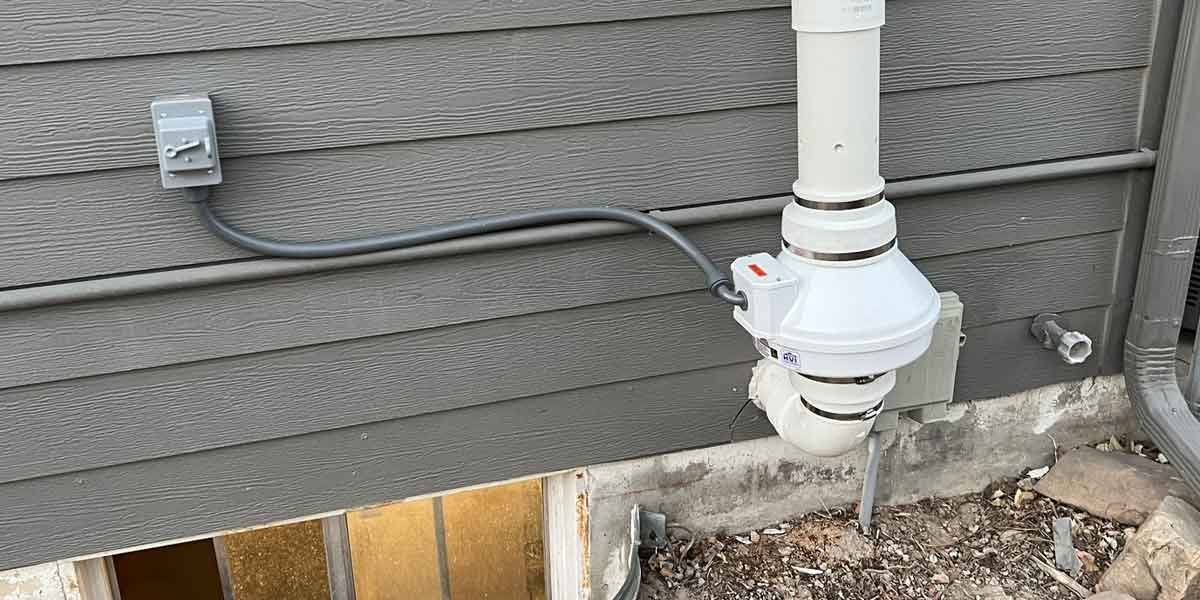
A professional installation pays for diagnosis, one or more suction points through the slab or membrane, the vent pipe and its exterior termination, a rated fan, the electrical connection, sealing of major openings, and a document showing the system works. Labor is the largest share, and it varies most between towns.
Angi’s cost factors price the parts that sit outside the base job: larger homes add $500 to $1,500, electrical work runs $50 to $100 per hour, a crawl space without a slab can need encapsulation at $1,500 to $15,000, and an extended warranty costs $200 to $500. Permits stay small at $25 to $150. An unfinished basement that needs both sealing and a ventilation system is priced at $4,600 in the same data set, which is what a crawl space or a broken slab looks like before any suction point is drilled.
Houses being built right now get priced on their own line. The EPA model puts radon-resistant new construction at $619 for passive measures, $56 for the first test, and $476 to add a fan later if the passive stack does not hold the level down. That is the lowest radon mitigation cost in the table, and it exists only before the slab is poured.
The Two Line Items Most Estimates Skip
The EPA model puts a post-mitigation retest inside its $169 testing line, and it replaces the system warning device at year three for $151. Neither usually appears on a residential estimate, and both matter more than their size suggests.
The retest is what proves the system worked. A fan that spins only proves the motor works. The pressure field it creates is what lowers radon indoors, and confirming that field exists means measuring the air again. The warning device is a small gauge that shows the fan is still pulling. When it fails, a fan can keep running while suction leaks away at a loose coupling, and a household notices nothing until the next test comes back high.
Ask for both in writing. A contractor who includes the retest in the quoted price is also the one most likely to return when the number stays high.
Why the Same House Gets Three Different Numbers
Suction point count, pipe route, foundation type and local labor rates cover most of the spread. Two contractors who agree on the method can still differ by hundreds of dollars over how they intend to reach the soil and where the pipe leaves the building.
A finished basement forces the pipe into a chase or along an exterior wall, and that routing adds hours of labor. A long vent run adds material and costs the fan usable pressure, which sometimes forces a larger fan. Crawl spaces need a sealed membrane before depressurization means anything, so a job that starts as mitigation can end as encapsulation. Geography adds its own layer: Angi’s city averages run from $700 in Kansas City to $2,000 in Los Angeles, with Boston at $1,000 and Chicago at $1,200. Local labor sets the radon mitigation cost floor for a region; the layout of the house decides what gets added on top of it.
The Square-Foot Question
Square footage enters radon pricing as an add-on rather than a unit. Angi prices larger homes at $500 to $1,500 more, and the installation itself is quoted as a system with one or more suction points. A 1,200-square-foot ranch with a sump and a clean slab can therefore land below a 900-square-foot split level whose pipe has to cross a finished ceiling.
Square-foot pricing gets applied to this work because nearly every other home repair is sold that way. It averages houses whose suction-point counts differ, so it describes somebody else’s project better than yours.
Ongoing Costs After the Fan Starts Running
An active system costs about $206 a year to run on the EPA’s model, plus roughly $476 for a fan every ten years and $151 for a warning device in year three. Angi’s data puts the annual electricity increase at $30 to $300, depending on fan size.
Those two operating estimates disagree usefully, so the arithmetic on Angi’s own numbers is worth a moment. The same source states that an average system uses about 876 kilowatt-hours a year and that the annual bill increase runs $30 to $300. For 876 kilowatt-hours to cost $30, power would have to sell near 3 cents per kilowatt-hour; for the same usage to reach $300, it would have to sell near 34 cents. Both ends describe equipment and utility rates at the extremes, which leaves the EPA’s $206 close to what a mid-size fan costs to run in a typical state.
Fan replacement is the bill households forget. Most systems run continuously for years, and the model treats the fan as a ten-year item. In a house without a working warning device, a failed fan announces nothing at all: the hum stops, and the soil gas starts coming back.
Retesting is what keeps a system honest. The post-installation test confirms the design worked; the tests that follow catch the coupling that loosened, the fan that lost pressure, and the renovation that reopened a path through the slab. Scheduling that second test costs little next to learning at resale that the fan stopped pulling a year ago.
Checking a Quote Before You Sign
Six items make two radon quotes comparable: the number and location of suction points, the pipe route and exit point, the fan model and warranty, whether post-installation testing is included, whether the warning device is included, and who handles the electrical work and the permit.
Ask for those in writing, then read the quote for what is missing rather than what is printed in bold. A fan and a pipe without a retest cannot be compared until the missing lines are priced. The retest is the line that proves the work happened, so it is the first absence worth pricing out.
One step comes before all of it. Mitigation only makes sense above the EPA action level of 4 picocuries per liter, and a household that tests first avoids buying a system it does not need. The radon testing guide covers how a test is run and what the result means.
EPA guidance directs homeowners to qualified mitigation contractors, which in practice means three questions: who will do the work, what certification or state license that person holds, and whether the finished system will be verified. The answers separate a company that installs radon systems from one that installs anything.
Radon Mitigation Cost: Frequently Asked Questions
How much should I expect to pay for a radon mitigation system?
Expect $805 to $1,326 for a standard active soil depressurization installation in 2026, averaging $1,043, plus $150 to $700 for testing and $25 to $150 for permits.
Complex homes go higher. Multiple suction points, a crawl space that needs a membrane, or a pipe route through finished space can carry a project past $3,000 without anything unusual in the pricing.
Does radon mitigation work well enough to justify the cost?
Yes. The EPA reports that some reduction systems cut indoor radon by up to 99 percent, and it describes mitigation as costing about what other common home repairs cost.
The evidence behind that figure is a 2019 systematic review by Khan and colleagues, cited in the EPA’s cost analysis, which found that active sub-slab and sump depressurization reduced radon by up to 99 percent in existing homes that started above reference levels. Results vary with soil, foundation and system design, and the EPA model assumes a drop from 4.0 to 1.0 picocuries per liter rather than to zero.
Can I install a radon mitigation system myself to save money?
The equipment is available, but the design work is the job. Angi’s guidance is flat that this is not a do-it-yourself project, because a system pulling air from the wrong place or exhausting too close to a window can leave a house no safer than before.
EPA guidance likewise points homeowners to qualified contractors. Sealing visible cracks and gaps before a crew arrives trims $100 to $500 in labor and material, and it does not replace the suction system.
What is missing from a typical radon mitigation quote?
Post-mitigation testing and the warning device usually are. The EPA model budgets $169 for testing including a retest and $151 for a warning device replaced at year three, and neither line shows up on most residential estimates.
Fan replacement is the third omission: $476 every ten years, in 2023 dollars, on the EPA’s schedule. Ask for all three by name. A quote that lists them can be set beside the next quote and read line by line.
Does a radon mitigation system lower home value?
No. Angi’s guidance is that a system neither lowers value nor makes a house harder to sell, and in areas with similar radon risk buyers often prefer a home that already has one.
The installation reads at resale as a documented improvement. Keep the installation paperwork and the post-mitigation test result, because a buyer’s inspector will ask for both.
Ask for the suction points, the pipe route and the retest in writing before comparing radon mitigation cost figures. A bid that lists all three can be read line by line; one that does not has to be re-quoted anyway.