
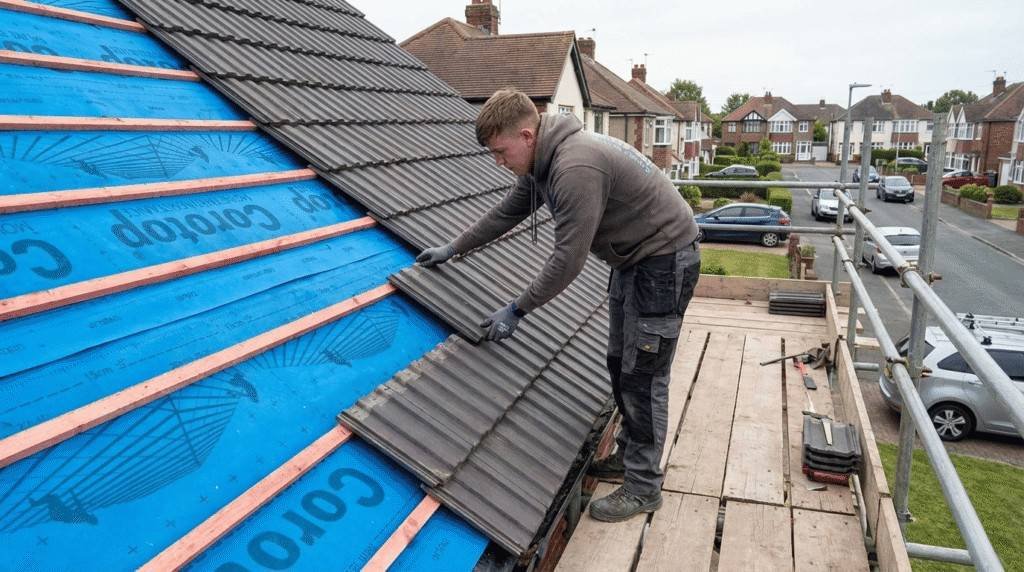

This roof replacement cost calculator walks you through the formula, the material costs, and a worked example, explains Centrailia property management. A roof replacement cost is calculated by multiplying the roof area in squares — one square equals 100 square feet — by the installed cost per square for the chosen material, then adding the cost of tear-off, decking repair, and any complexity multipliers.
Step 1: Measure Your Roof Area
The roof area is larger than the home’s footprint. The roof pitch, the overhangs, and the garage coverage add square footage beyond the living area. A 2,000-square-foot single-story home typically has a 2,400- to 2,800-square-foot roof — 24 to 28 squares. A 2,000-square-foot two-story home has a 1,200- to 1,600-square-foot roof, 12 to 16 squares. The number of stories determines the roof area. The larger the footprint relative to the living area, the larger the roof.
To estimate your roof area from the ground: multiply the footprint of the house, length times width, by a pitch factor. A low-slope roof with a 3:12 to 4:12 pitch has a pitch factor of 1.05 to 1.1, add 5% to 10% to the footprint area. A medium-slope roof with a 5:12 to 8:12 pitch has a pitch factor of 1.1 to 1.2, add 10% to 20%. A steep-slope roof with a 9:12 to 12:12 pitch has a factor of 1.2 to 1.4, add 20% to 40%. A 2,000-square-foot ranch house with a 6:12 pitch roof has an estimated roof area of 2,000 × 1.15 = 2,300 square feet, 23 squares. Add 10% for overhangs and waste, 25 squares. This is an estimate. The contractor will measure the actual roof area from the roof surface or from aerial imagery. The estimate is for budgeting. The actual measurement is for purchasing.
The National Roofing Contractors Association (NRCA) recommends obtaining at least three written estimates for any roof replacement. The estimates should specify the roof area in squares, the material type and grade, the underlayment, the flashing method, the tear-off cost, and the decking replacement rate. A quote that says “$12,000, full roof replacement” with no supporting detail is a placeholder, not a contract.
Step 2: Choose Your Material and Apply the Cost Per Square
| Material | Cost Per Square (Installed) | Cost Per Sq Ft (Installed) | 20-Square Roof Total |
| Asphalt 3-Tab | $350 – $450 | $3.50 – $4.50 | $7,000 – $9,000 |
| Architectural Asphalt | $450 – $750 | $4.50 – $7.50 | $9,000 – $15,000 |
| Steel Standing-Seam | $800 – $1,500 | $8.00 – $15.00 | $16,000 – $30,000 |
| Aluminum | $900 – $1,600 | $9.00 – $16.00 | $18,000 – $32,000 |
| Concrete Tile | $700 – $1,500 | $7.00 – $15.00 | $14,000 – $30,000 |
| Clay Tile | $1,000 – $2,000 | $10.00 – $20.00 | $20,000 – $40,000 |
| Natural Slate | $1,500 – $3,000 | $15.00 – $30.00 | $30,000 – $60,000 |
| Synthetic Composite | $600 – $1,100 | $6.00 – $11.00 | $12,000 – $22,000 |
The installed cost per square includes the roofing material, the underlayment, the flashing, the drip edge, the ridge caps, the labor, and the basic disposal for a single-layer tear-off on a walkable roof. It does not include decking replacement, multiple-layer tear-off, or complexity premiums for steep or complex roofs. Those are added separately.
Step 3: Add Tear-Off, Decking, and Complexity Multipliers
Tear-off: Removing one layer of old shingles costs $100 to $150 per square. Two layers cost twice as much. If the existing roof has two layers, a roof-over installed years ago, the tear-off cost doubles. A 20-square roof with one layer costs $2,000 to $3,000 for tear-off and disposal. Two layers cost $4,000 to $6,000.
Decking replacement: Once the old shingles come off, the crew inspects the plywood or OSB decking. Rotted, delaminated, or soft sections must be replaced. Decking replacement costs $2 to $4 per square foot, $200 to $400 per square. On a 20-square roof, 10% to 30% of the decking typically needs replacement, adding $400 to $2,400 to the total. Budget $1,000 to $2,000 for decking surprises. If the estimate comes back lower than other contractors by a wide margin, the missing line item is probably decking contingency.
Pitch multiplier: A roof with a pitch above 6:12 adds 15% to 25% to the labor cost because the crew works slower and requires safety equipment. Multiply the per-square labor cost, roughly $200 to $400 per square, by 1.15 to 1.25 for steep roofs. A low-slope roof below 3:12 also adds cost because it requires specialized underlayment and installation techniques. The cheapest roof to install is a 4:12 to 6:12 gable roof with no dormers, valleys, or skylights.
Complexity multiplier: Every valley, dormer, skylight, chimney, and vent pipe adds to the cost because each requires custom flashing and additional cutting. Add $200 to $600 per penetration beyond the basic flashings included in the per-square price. A complex roof with 6 valleys, 2 dormers, and a chimney adds $1,500 to $4,000.
Example Calculation: 25-Square Architectural Asphalt Roof
A 2,500-square-foot two-story colonial with an estimated roof area of 25 squares, a 6:12 pitch, a single layer of existing shingles, and moderate complexity, 2 valleys, 1 chimney, 2 vent pipes. Architectural asphalt shingles at $550 per square installed. Here is the calculation:
| Line Item | Calculation | Cost |
| Base roof (25 squares × $550) | 25 × $550 | $13,750 |
| Tear-off (25 squares × $125) | 25 × $125 | $3,125 |
| Decking contingency (15% × 25 squares × $300) | 0.15 × 25 × $300 | $1,125 |
| Pitch multiplier (25 squares × $350 labor × 0.0, none, 6:12 is standard) | $0 | $0 |
| Complexity (2 valleys × $400, 1 chimney × $500, 2 pipes × $200) | $800 + $500 + $400 | $1,700 |
| Permit | Flat fee | $300 |
| Total Estimated Cost | $20,000 |
The estimated cost is approximately $20,000. The actual cost will vary by contractor and by region. Get three quotes to establish the actual price in your area. The estimate is for budgeting. The quotes are for purchasing.
Frequently Asked Questions
How do I calculate my roof replacement cost?
Multiply your roof area in squares, length × width of home footprint × pitch factor, by the installed cost per square for your chosen material. Add tear-off, decking contingency, complexity, and permit fees. A 20-square architectural asphalt roof typically costs $9,000 to $15,000. The formula is: (squares × cost per square) + tear-off + decking + complexity + permit.
How many squares is my roof?
Multiply your home’s footprint, length × width, by a pitch factor of 1.05 to 1.4 depending on the roof steepness. A 2,000-square-foot ranch with a 6:12 pitch has roughly 2,300 square feet of roof area, 23 squares. Add 10% for overhangs and waste. A contractor will measure the actual roof area.
What is the cheapest roofing material to install?
Three-tab asphalt shingles are the cheapest at $350 to $450 per square installed, $7,000 to $9,000 for a 20-square roof. Architectural asphalt shingles cost $450 to $750 per square, $9,000 to $15,000. Architectural shingles last 10 years longer and are cheaper per year of service.
Does the roof area include the garage?
Yes. The roof area includes every square foot of the roof surface: the main house, the attached garage, the porches, and any covered areas. The contractor measures the total roof area. The total area determines the total cost.
Why do roof replacement estimates vary so much between contractors?
Estimates vary because of differences in labor rates, overhead, material quality, and what is included in the price. One contractor may include decking replacement at a flat rate per sheet. Another may exclude decking entirely and charge for it as a change order. One may use synthetic underlayment. Another may use felt. Get an itemized estimate from each contractor. Compare the line items, not just the total.
How accurate are online roof cost calculators?
Online calculators provide a rough estimate based on national averages. They do not account for local labor rates, roof complexity, decking condition, or material availability. The estimate is useful for budgeting. It is not a substitute for a written quote from a local contractor. The contractor’s quote is based on an actual measurement of your roof. The calculator’s estimate is based on averages. The average is not your roof.
The Number That Matters
Take your home’s footprint. Multiply by the pitch factor. Convert to squares. Multiply by the installed cost per square for your chosen material. Add tear-off. Add decking contingency, at least $1,000. Add complexity, $200 to $600 per valley, chimney, and skylight. Add the permit fee. The result is your estimated roof replacement cost. Get three quotes to confirm it. The formula is the estimate. The quotes are the purchase.
A 20-square architectural asphalt roof costs $9,000 to $15,000 for most homes. A 20-square metal roof costs $16,000 to $30,000. The formula does not change. The numbers change. The formula works for every material, every roof size, and every level of complexity. The formula is the calculator. The calculator is the starting point. The quotes are the destination. The destination is a new roof. The roof keeps the water out. The calculator tells you what it costs. The contractor tells you when they can start. Ever tried to estimate your roof cost using three different online calculators and got three different numbers, none of which matched the quotes you received? The calculators all used national averages. Your roof is not national. Your roof is in your zip code, with your local labor rates, your specific pitch, your number of valleys and chimneys, and your decking condition that no calculator can see from the internet. The calculator gave you a range. The quotes gave you a price. The range was $9,000 to $15,000. The quotes were $11,500, $12,800, and $10,900. The range was accurate. The quotes were real. The calculator is the first step. The quotes are the last step. The contractor is the step in between. The contractor is the step that matters.