
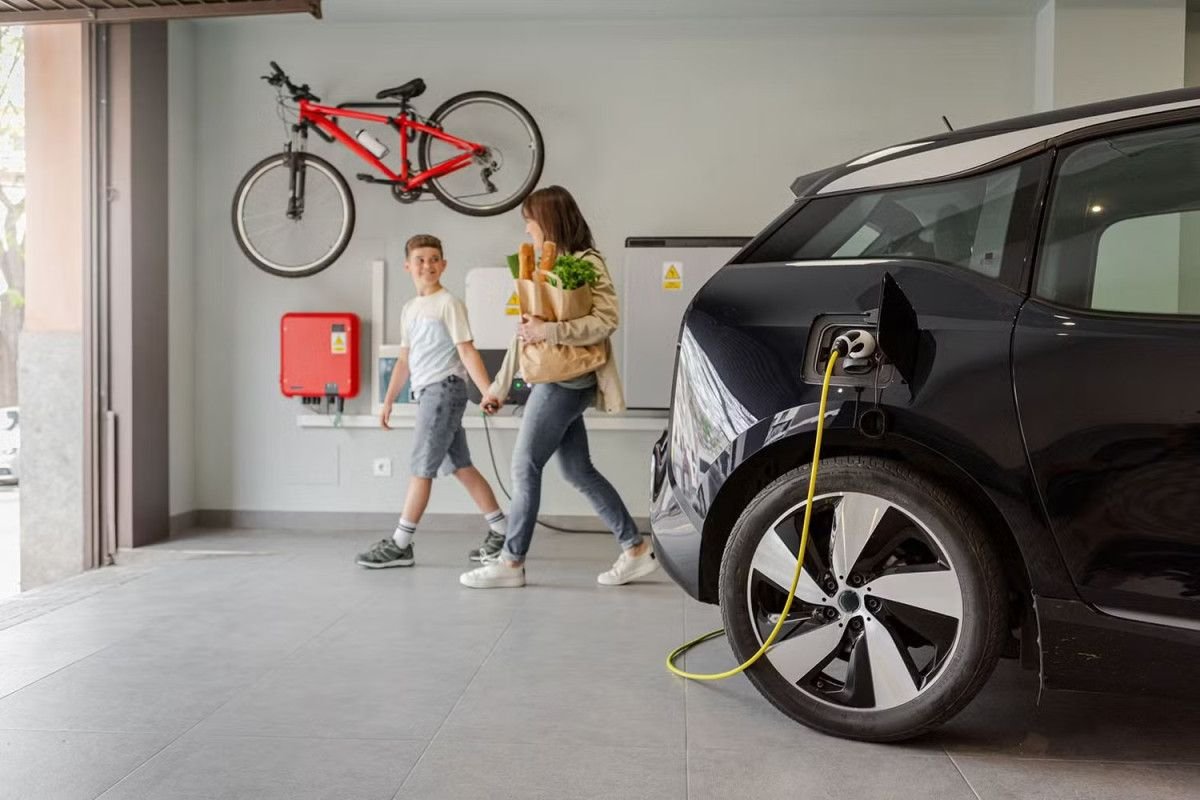

According to MVP Property Management experts, home EV charger installation costs between $500 and $2,500 in 2026, with the national average around $1,200 for a standard Level 2 charger installed in a garage with an existing 200-amp electrical panel. The charger itself costs $400 to $700. The installation labor and materials cost $300 to $1,800 depending on the distance from the electrical panel to the charging location and whether the panel needs to be upgraded.
The single largest cost variable is the distance between the electrical panel and the charging location. A charger installed on the wall directly next to the panel in the garage costs $500 to $800 total. A charger installed on the opposite side of the garage — or worse, on the exterior of the house, requiring conduit run through walls and across the exterior — costs $1,500 to $2,500 because the cable run is 50 to 100 feet instead of 5 feet. The wire is cheap. Routing it through finished spaces is not.
EV Charger Installation Cost Breakdown
A home EV charger installation breaks down into six cost components, from the charger itself at $400 to $700 to a full panel upgrade at $1,500 to $3,500 if the existing electrical panel lacks capacity. Here is how each component contributes to the total.
| Component | Cost Range | Notes |
| Level 2 charger (unit) | $400 – $700 | Standard 32-48 amp, NEMA 14-50 or hardwired |
| Circuit breaker (240V, 50A double-pole) | $30 – $80 | GFCI required by 2020 NEC for outlet installations |
| Wiring and conduit (per foot) | $8 – $15 | 6-gauge copper THHN, typically 2 hot + 1 ground |
| NEMA 14-50 outlet | $15 – $50 | Industrial-grade recommended over residential |
| Labor (standard installation) | $300 – $800 | Panel-adjacent garage install, 2-4 hours |
| Labor (long run or complex install) | $800 – $1,800 | 50-100 ft run, exterior conduit, finished walls |
| Electrical panel upgrade (if needed) | $1,500 – $3,500 | 100A to 200A upgrade — common in older homes |
Level 1 vs. Level 2, the Speed Difference
A Level 1 charger plugs into a standard 120-volt household outlet and adds 3 to 5 miles of range per hour of charging. It costs nothing to install beyond the charger that came with the car. It is adequate for a commuter who drives 30 to 40 miles per day and can leave the car plugged in for 10 to 12 hours overnight. It is not adequate for a longer commute, for multiple EVs sharing one charger, or for an EV that needs to be fully charged overnight after a long trip.
A Level 2 charger runs on a dedicated 240-volt circuit, the same voltage as an electric dryer or range, and adds 20 to 40 miles of range per hour. A typical EV with a 250-mile range charges from empty to full in 6 to 10 hours on a Level 2 charger. A Level 1 charger would take 50 to 80 hours to accomplish the same thing. The cost difference is $500 to $2,500 for a Level 2 installation versus $0 for Level 1. The practical difference is whether the car is ready to drive tomorrow morning or the morning after that.
Hardwired vs. Outlet Installation
A hardwired charger is connected directly to the electrical wiring with no plug and no outlet. It is the preferred installation method for chargers rated above 40 amps and for outdoor installations where an outlet is exposed to weather. A hardwired connection eliminates the outlet as a failure point, NEMA 14-50 outlets, particularly residential-grade ones, can overheat under continuous high-current loads, and allows the charger to be set to its maximum rated amperage without the 80% derating that applies to plug-connected chargers.
A plug-in charger uses a NEMA 14-50 outlet and is the preferred method for garage installations where the homeowner may want to take the charger when they move, unplug it, cap the outlet, and go. The 2020 NEC requires a GFCI breaker for any outlet installed for EV charging. A hardwired charger does not require a GFCI breaker because the charger itself provides ground-fault protection. The GFCI breaker adds $80 to $120 to an outlet installation and is the source of occasional nuisance tripping that some EV owners report. Hardwired installation avoids this entirely.
The U.S. Department of Energy provides guidance on EV charger installation, including electrical panel load calculations, permitting requirements, and available federal tax credits. The Inflation Reduction Act provides a federal tax credit of up to $1,000 for residential EV charger installation in eligible census tracts. The credit applies to the charger and the installation cost and is claimed on the homeowner’s federal tax return.
When a Panel Upgrade Is Required
A Level 2 EV charger draws 32 to 48 amps on a 240-volt circuit. A 100-amp electrical panel, common in homes built before 1990, may not have enough capacity to add a 50-amp circuit for an EV charger without overloading the panel. An electrician performs a load calculation, totaling the electrical draw of every appliance and circuit in the house, to determine whether the existing panel can support the charger. If the load calculation shows insufficient capacity, the panel must be upgraded.
A 100-amp to 200-amp panel upgrade costs $1,500 to $3,500 and takes one to two days. It adds capacity not just for the EV charger but for future electrification, a heat pump, an induction range, an electric water heater. If the panel upgrade is required for the EV charger, it is a mandatory cost, not an optional one. The charger cannot be installed without it. The panel upgrade also qualifies for the federal tax credit as part of the EV charger installation.
Permits and Code Requirements
EV charger installation requires an electrical permit in virtually every jurisdiction. The permit costs $50 to $200 and ensures the installation is inspected for code compliance, proper wire gauge, proper breaker rating, proper grounding, proper GFCI protection for outlet installations, and proper torque on the terminal connections. A licensed electrician pulls the permit as part of the installation. An unpermitted installation risks a failed home inspection during a future sale and may void the charger manufacturer’s warranty.
Frequently Asked Questions
How much does it cost to install a home EV charger?
Home EV charger installation costs $500 to $2,500. A standard installation, charger mounted next to the panel in the garage, costs $500 to $800. A long-run installation, 50 to 100 feet of wiring, exterior conduit, costs $1,500 to $2,500. The charger itself costs $400 to $700. A panel upgrade, if needed, adds $1,500 to $3,500.
Do I need a permit to install an EV charger?
Yes. EV charger installation requires an electrical permit in virtually every jurisdiction. The permit costs $50 to $200 and includes an inspection to verify code compliance. A licensed electrician will pull the permit. Unpermitted installations risk failed home inspections and voided warranties.
Is there a federal tax credit for home EV charger installation?
Yes. The Inflation Reduction Act provides a federal tax credit of up to $1,000, 30% of the total cost, for residential EV charger installation in eligible census tracts. The credit covers the charger and the installation labor. Check the DOE website or consult a tax professional to confirm your address qualifies.
Can I plug my EV into a regular household outlet?
Yes. A standard 120-volt outlet provides Level 1 charging at 3 to 5 miles of range per hour. It is adequate for a daily commute of 30 to 40 miles with overnight charging. It is not adequate for a longer commute, for charging multiple EVs, or for fully recharging a depleted battery overnight. Level 2 charging at 240 volts adds 20 to 40 miles of range per hour and is worth the installation cost for most EV owners.
Should I hardwire my EV charger or use a plug-in outlet?
Hardwire for outdoor installations and chargers rated above 40 amps. The hardwired connection eliminates the outlet as a failure point and avoids the GFCI breaker requirement. Use a NEMA 14-50 outlet for garage installations where you may want to take the charger when you move. If you use an outlet, install an industrial-grade receptacle, not a residential-grade one, because EV charging subjects the outlet to continuous high current for hours at a time.
Will my electrical panel support an EV charger?
A 200-amp panel can almost always support a Level 2 EV charger. A 100-amp panel may not, it depends on the existing electrical load from appliances, lighting, and other circuits. An electrician can perform a load calculation to determine whether your panel has adequate capacity. If it does not, a panel upgrade to 200 amps costs $1,500 to $3,500.
What Home Charging Costs
A Level 2 charger installed on the garage wall next to the electrical panel costs $500 to $800 and is one of the most satisfying home upgrades available. The car charges overnight. The battery is full every morning. The gas station becomes a place you drive past, not a place you stop. The cost of the installation is roughly equivalent to a year’s worth of gasoline for a typical commuter. The charger pays for itself in fuel savings within 12 to 18 months, then saves you money every year after.
If your panel needs an upgrade, the cost is real, $1,500 to $3,500, but the capacity you are adding supports not just the EV charger but the heat pump, the induction range, and the electric water heater that will eventually replace their gas-fired predecessors. The panel upgrade is a bet on the electrified future of the house. The EV charger is the first thing it powers. It will not be the last. Ever pulled into a gas station at 10 p.m. in February and stood there in the cold while the numbers climbed? That moment — freezing, impatient, paying for the privilege — is what a home charger replaces. The garage is warm. The car is charging. You are already inside. The cost of the installation is the price of never standing at a gas pump again. The math works. So does the feeling.