
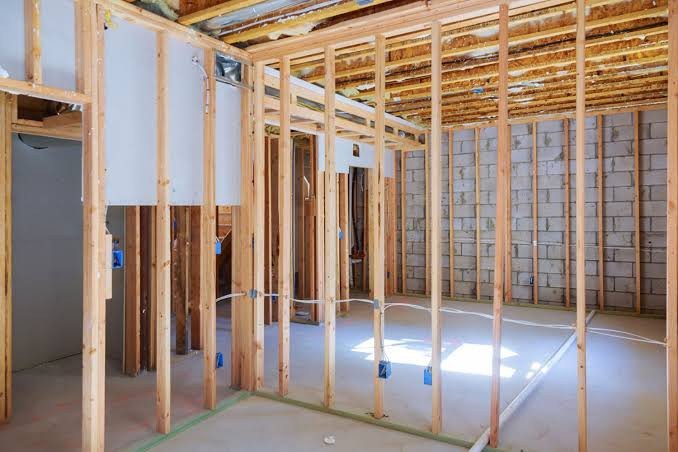

Framing and drywall are the two largest phases of a basement finish that a homeowner can legally perform without a license. Together, they account for roughly 40 to 50 percent of the total project cost. Framing builds the skeleton. Drywall puts skin on the bones. The two trades are bid together by many contractors because they are sequential and often performed by the same crew. This guide provides per-linear-foot and per-square-foot costs for both trades, combined and separately, for a typical basement, explains Keyrenter West Chicago experts.
Framing Costs: Per Linear Foot and Total
| Item | DIY Materials | Pro (Labor + Materials) |
| Per linear foot (standard 8-ft wall) | $4-7 | $12-27 |
| 100 linear feet (small basement, 1-2 rooms) | $400-700 | $1,200-2,700 |
| 150 linear feet (medium basement, 3-4 rooms) | $600-1,050 | $1,800-4,050 |
| 200 linear feet (large basement, 5+ rooms) | $800-1,400 | $2,400-5,400 |
Framing materials are priced per linear foot of 8-foot wall: pressure-treated bottom plate, standard top plate, studs at 16 inches on center, and fasteners. The professional price adds labor at $8 to $20 per linear foot. A framing crew of two carpenters completes a 150-linear-foot basement in 1 to 2 days.
Drywall Costs: Per Square Foot and Total
| Item | DIY Materials | Pro (Labor + Materials) |
| Per square foot of wall/ceiling area | $0.70-1.20 | $1.50-3.00 |
| 800 sq ft basement (2,400 sq ft drywall) | $1,700-2,900 | $3,600-7,200 |
| 1,000 sq ft basement (3,000 sq ft drywall) | $2,100-3,600 | $4,500-9,000 |
| 1,500 sq ft basement (4,500 sq ft drywall) | $3,200-5,400 | $6,750-13,500 |
Drywall area is roughly 3 times the basement square footage, accounting for walls and ceiling. The materials include 4×8 sheets of 1/2-inch drywall for walls, 5/8-inch for the ceiling, joint compound, tape, screws, and corner bead. The professional price adds hanging, taping, mudding, and sanding labor. Hanging takes a day for a two-person crew. Taping and mudding take 2 to 3 additional days because each coat of joint compound must dry before the next is applied.
Combined Framing and Drywall Costs
| Basement Size | DIY (Materials Only) | Professional (Labor + Materials) |
| 800 sq ft, 140 linear ft framing, 2,400 sq ft drywall | $2,300-4,100 | $5,400-12,600 |
| 1,000 sq ft, 160 linear ft framing, 3,000 sq ft drywall | $2,700-4,650 | $6,300-14,400 |
| 1,500 sq ft, 200 linear ft framing, 4,500 sq ft drywall | $4,000-6,800 | $9,150-20,900 |
For a typical 1,000-square-foot basement, framing and drywall together cost $2,700 to $4,650 in materials for DIY, or $6,300 to $14,400 for a professional job. The DIY savings on these two trades alone are $3,600 to $9,750. Framing and drywall are the two trades where homeowner labor produces the largest dollar savings because they require no license and the material cost is low relative to the labor cost.
What Moves the Combined Price
- Interior walls. Every additional partition wall adds framing linear feet and drywall square footage. An open basement with only exterior walls framed costs 30 to 40 percent less for framing and drywall than the same basement divided into a bedroom, bathroom, hallway, and mechanical room.
- Soffits and bulkheads. Framing around ductwork adds $3 to $5 per linear foot of soffit. The drywall on soffits involves additional seams and corners, which add taping and mudding time.
- Ceiling choice. Drywalling the ceiling adds the ceiling area to the drywall square footage. An 800-square-foot ceiling is 800 square feet of drywall. Painting the joists instead eliminates the ceiling drywall cost entirely and saves $1,200 to $2,400 for DIY or $2,500 to $5,000 for professional work on a 1,000-square-foot basement.
- Moisture-resistant drywall. Green board or purple board costs $2 to $4 more per sheet than standard drywall. For a 1,000-square-foot basement using 60 sheets, the premium is $120 to $240. This is not optional in a basement. Standard drywall absorbs humidity and supports mold.
- Drywall finish level. A level 3 finish, which is adequate for walls that will be textured or covered with heavy primer, costs less than a level 4 finish, which is standard for smooth-painted walls. A level 5 finish, which involves a skim coat over the entire surface, adds $0.50 to $1.00 per square foot and is used for high-gloss paint or critical lighting conditions. Most basements use a level 4 finish.
DIY vs. Professional: The Time Equation
Per wikiHow’s basement wall guide, co-authored by Ryaan Tuttle, the framing and drywall phases are the most time-intensive for a DIY homeowner but also the most accessible. A professional crew completes framing in 1 to 2 days and drywall in 3 to 5 days. A homeowner working weekends completes framing in 2 to 3 weekends and drywall in 4 to 6 weekends. The drywall phase takes longer for a homeowner because the joint compound drying time forces multiple short work sessions rather than one continuous effort. The actual hands-on time is similar. The calendar time is longer because the work is compressed into weekends.
Frequently Asked Questions
Should I get one bid for framing and drywall together or separate bids?
A combined bid is usually less expensive than two separate bids because the contractor does not need to add margin to each trade independently. Many framing crews also do drywall, or the general contractor has a preferred drywall sub who works with the framing schedule. A combined bid for framing and drywall on a 1,000-square-foot basement is typically $6,300 to $14,400. Separate bids from a framing carpenter and a drywall contractor may total 10 to 20 percent more because each includes their own overhead and profit.
Can I save money by hanging the drywall myself and hiring a pro to tape and mud?
This is a common cost-saving strategy, but it is not always cheaper than hiring the full job. Drywall contractors prefer to hang their own board because they know the seams are tight, the screws are properly set, and the corners are clean. A contractor who is asked to tape and mud homeowner-hung drywall may charge more for the taping because they anticipate fixing hanging mistakes. If you are confident in your hanging, this approach saves $800 to $1,500 on a 1,000-square-foot basement. If your hanging is uneven, the taping contractor’s additional labor eats the savings.
Sample Material List for a 1,000 Sq Ft Basement
For a 1,000-square-foot basement with 160 linear feet of wall framing and 3,000 square feet of drywall area, the materials list provides a concrete shopping list:
- Framing: 20 pressure-treated 2x4x8 for bottom plates, 20 standard 2x4x8 for top plates, 130 standard 2x4x8 studs, 1 box ACQ-compatible 16d nails, 1 box 8d nails, 50 Tapcon screws, 1 tube construction adhesive. Total framing materials: $700-1,100.
- Drywall: 45 sheets 1/2-inch moisture-resistant drywall for walls, 18 sheets 5/8-inch drywall for ceiling, 3 buckets joint compound, 2 rolls paper tape, 1 box corner bead, 5 lbs drywall screws. Total drywall materials: $1,500-2,500.
The combined material list fits in a single trip to the lumber yard with a pickup truck or a rented van. The drywall is the heaviest component. Sixty-three sheets of drywall weigh roughly 3,500 pounds. The lumber yard delivers for a fee of $50 to $100, which is worth paying to avoid loading and unloading 63 sheets by hand twice.
The Two Trades That Define the Basement
Framing and drywall are the trades that turn a concrete box into rooms. The framing defines the layout. The drywall makes the walls real. Together, they are the largest expense a homeowner can tackle without a license, and they are the trades where DIY labor produces the largest dollar savings. A 1,000-square-foot basement framed and drywalled by a professional costs $6,300 to $14,400. The same basement framed and drywalled by a homeowner costs $2,700 to $4,650 in materials. The difference, $3,600 to $9,750, is the cost of the labor. Whether that labor is worth the savings depends on whether you enjoy building walls. For most homeowners, the answer is yes for the first three walls. The answer for the remaining fifteen walls depends on how much you want that $3,600 to $9,750 back in your pocket.