
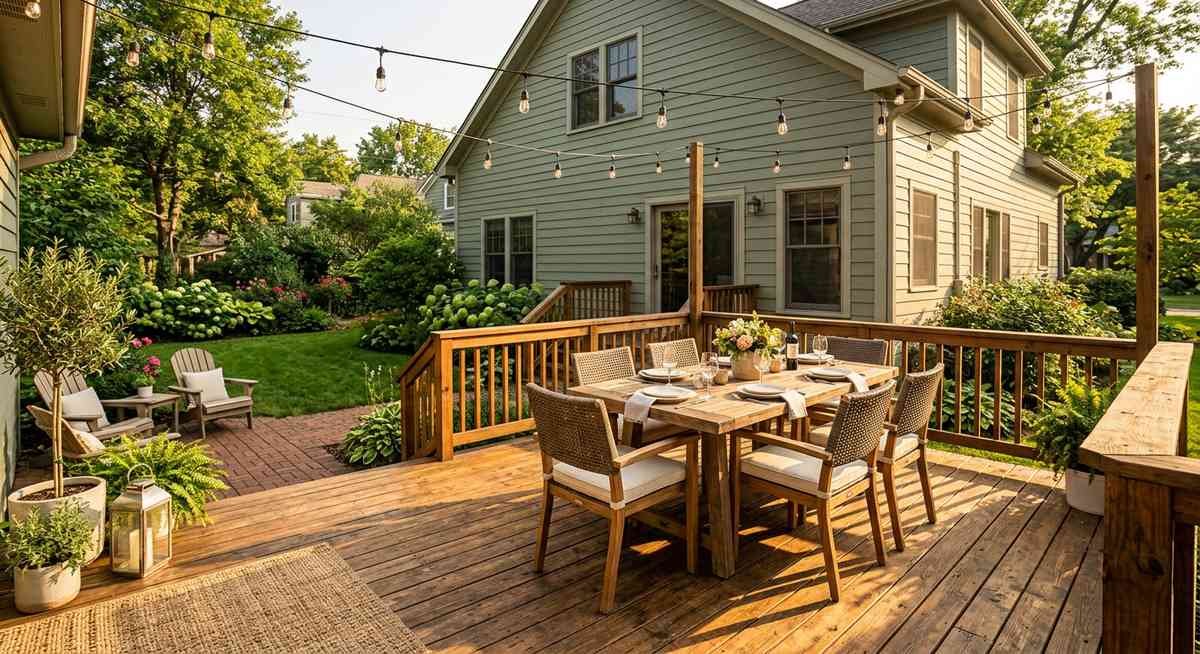

Building a deck breaks down into six stages: plan the size and budget, pull permits, set posts in concrete footings, frame with beams and joists, install decking boards, then add railings and stairs, with Keyrenter North Dallas solutions offering a helpful reference point for owners thinking beyond the build itself.
A typical 12×16-foot attached deck takes two to four weekends for an experienced DIYer working with one helper. What separates a deck that lasts 30 years from one that rots in a decade comes down to decisions made before the first board is cut.
Plan Your Deck Before You Buy a Single Board
Deck planning means settling three things first: the size and layout, the material type, and the realistic budget. For a pressure-treated wood deck, plan on $15 to $35 per square foot in materials; composite decking runs $30 to $60 per square foot depending on the product line.
The table below compares the three most common decking materials side by side.
| Material | Upfront Cost (per sq ft) | Expected Lifespan | Maintenance | Best For |
|---|---|---|---|---|
| Pressure-Treated Pine | $15–$25 | 15–25 years | Annual staining/sealing | Budget-conscious DIYers |
| Composite (Trex, TimberTech) | $30–$60 | 25–30+ years | Occasional cleaning only | Low-maintenance builds |
| Western Red Cedar | $20–$40 | 20–30 years | Staining every 2–3 years | Natural look, mid-budget |
Start with the footprint on graph paper. Note the house attachment point, property-line setbacks (typically 5–10 feet, but this varies by jurisdiction), and any buried utilities in the build area.
A deck that just fits a grilling station and table will feel crowded the first time guests pull up chairs. Build at least 10% larger than the minimum you think you need.
For free downloadable deck plans and sizing guides by deck type, Decks.com maintains a library of detailed construction blueprints for common configurations.
The biggest cost variables beyond material type are the railing system and whether stairs are included. A simple 200-square-foot pressure-treated deck with basic aluminum rail and one staircase typically runs $3,000 to $7,000 in materials alone.
Permits, Codes, and the Mistake That Can Cost the Whole Project
Most jurisdictions require a building permit for any deck attached to a home, and for freestanding decks over 200 square feet. Permit fees typically run $150 to $500, and inspections confirm the structure is built to code before you cover the framing.
Skipping permits does not just risk a fine. Unpermitted structures can void homeowner’s insurance, block a home sale, and in documented cases require partial or full demolition of completed work.
After the permit, the two code items that matter most are footing depth and railing height. Footings must reach below the local frost line to prevent heaving; that depth ranges from 18 inches in the Deep South to 48–60 inches in northern Minnesota and Maine. Railing height is required at a minimum of 36 inches for decks below 30 feet in height, and 42 inches for taller decks.
Call your local building department before finalizing plans. Most offices will tell you the relevant IRC (International Residential Code) section for your municipality at no charge. Building Advisor’s deck section also provides a detailed breakdown of what typical permit applications require by project type.
Materials, Lumber Grades, and the Tools You Actually Need
For a pressure-treated deck, framing lumber comes in three treatment ratings: “for ground contact” (posts below grade), “.40 treatment” (joists and beams), and “above ground” (decking boards and railings). Using the wrong grade for the application cuts years off the structure’s lifespan.
A core tool and materials list for a 200-square-foot deck:
- Post-hole digger or rented power auger (~$80/day)
- Concrete mix (60 lb bags, 3–4 bags per post)
- Post-saver sleeves or post base hardware
- String line and batter boards for layout
- Circular saw and miter saw
- Framing nailer (rented) or impact driver and structural screws
- Joist hangers, hurricane ties, and post caps
- Laser level or 4-foot spirit level
- Speed square and 25-foot tape measure
- Butyl flashing tape for rim joist and ledger protection
Post-saver sleeves are one purchase that gets skipped on too many first builds. The sleeve is a heat-shrink barrier that seals the zone two inches above ground level, where moisture and oxygen combine to start rot on any buried post.
Skipping that sleeve on a $4,000 deck to save $40 is a calculation that doesn’t hold up after ten wet winters.
How to Frame a Deck: The Six Core Steps
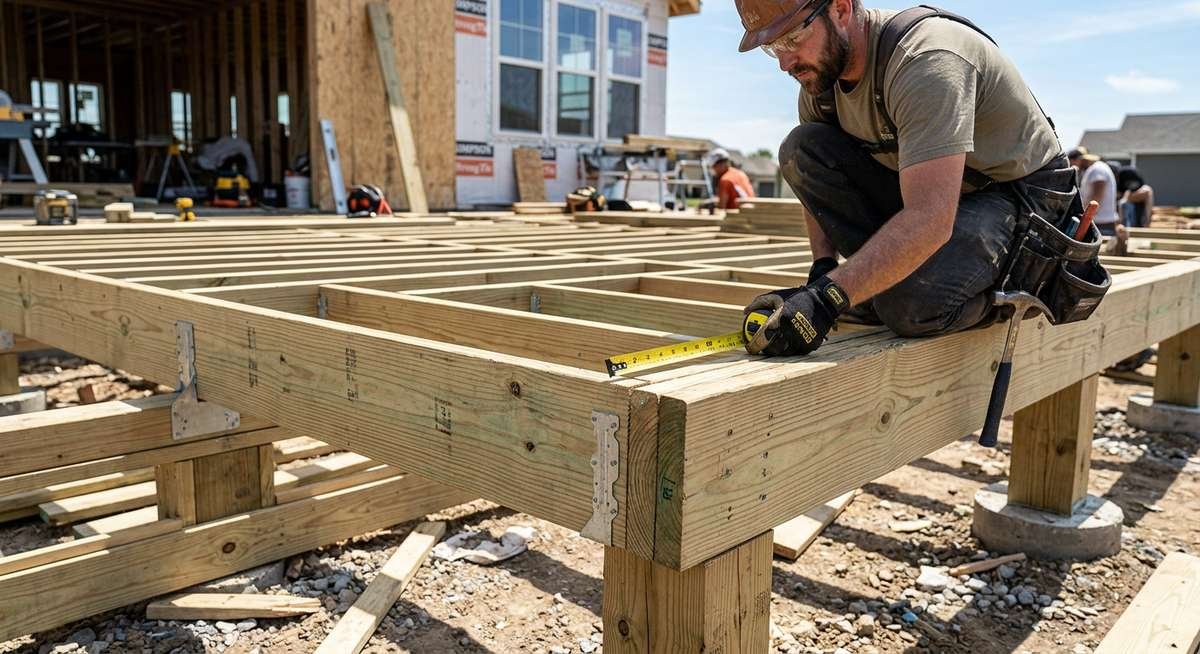
Deck framing follows six sequential steps: lay out with batter boards and string lines, dig footings below the frost line, set posts in concrete, install beams on top of the posts, hang floor joists at 16-inch on-center spacing, then add the rim joist to close the frame.
- Lay out the deck. Set batter boards about 2 feet beyond each corner and run string lines to mark the perimeter. Pull diagonal measurements and confirm the layout is square before digging anything.
- Dig footings. Hand dig or auger holes to at least the local frost depth. Flare the bottom of each hole to 12 inches wide at the base for better bearing capacity under the concrete.
- Set posts in concrete. Slide a post-saver sleeve over each post and position the sleeve 2 inches above grade. Pour concrete into the hole and slope the top surface away from the post so water drains outward rather than pooling at the base.
- Install beams. Doubled 2×12 beams are standard for most residential spans. Crown the boards first (curve faces up), pull them tight with structural screws or power lags, then set them on the posts and secure with post caps.
- Hang joists. Sixteen-inch on-center spacing is worth the extra lumber cost over 24-inch. The difference in how the deck feels underfoot is significant; 24-inch spacing produces a springy surface that most homeowners notice immediately. Use joist hangers at both ends and hurricane ties at beam connections.
- Add the rim joist. The rim joist closes the frame and prevents joist rotation. Tape the top edge with butyl flashing tape before laying decking boards to block water from wicking into the end grain.
“First Solo Deck Build, 31.5’×9.25′. NW Montana. Took me 4 and a half months of evening work.”
That solo build covers 291 square feet and took nearly five months of after-work hours. Most “weekend project” estimates assume a crew, dry weather, and no permit delays.
Solo, evenings only, the real timeline for a deck that size runs deep into autumn.
Laying Decking Boards, Railings, and Stairs
Decking boards go down perpendicular to the joists in most builds. Leave 1/8-inch gaps between boards for drainage; wood boards tighten slightly over time, while composite boards maintain their gap more consistently. Face-screwing is fastest; hidden fastener systems look cleaner but add significant labor time.
Railings are required by code when the deck surface sits more than 30 inches above grade. Post-to-post spacing for railing panels should not exceed 6 to 8 feet depending on the system. Balusters must be spaced so that a 4-inch sphere cannot pass between them.
Stair construction is where most first-time builders slow down. The guideline for stair stringers: the rise (vertical height) plus the run (horizontal tread depth) should total 17 to 18 inches. A 7-inch rise with a 10-inch run equals 17 inches and feels natural to walk.
Once framing is complete and boards are installed, protecting the underside of the deck significantly extends the structure’s lifespan. The guide on how to waterproof under a deck covers the most effective drainage and vapor management methods for the space below.
There is a long distance between buying a pile of lumber and standing on a finished deck. Every stair riser nailed home, every board gapped correctly, is work that will outlast the effort by two or three decades — which is a kind of return on time that most weekend projects simply don’t offer.
The Mistakes That Kill Decks Early
The most damaging deck-building mistakes are undersized footings, skipping post-saver sleeves, using 24-inch joist spacing instead of 16-inch, and treating indoor-grade lumber as interchangeable with outdoor-rated stock. These are not cosmetic issues; they are structural failures waiting on the right wet season.
“Just got quoted $55k to build an 8×14 deck with stairs.”
That thread attracted over 600 responses, mostly from people who had DIYed the same deck size for $2,500 to $4,000 in materials. The gap between contractor quotes and DIY material costs on a basic deck is among the widest in home improvement.
“Guy building my deck says he can’t dig holes for post so the patio stones will be just fine — should I be concerned for the winter?”
Any contractor who dismisses footings on an attached deck is revealing something important about how the rest of the job will be handled. On an attached deck, footings that heave in a freeze-thaw cycle pull against the ledger board and can damage the home’s rim joist.
Hiring without checking licenses, permits, and recent references is the contractor version of skipping the post sleeves: cheap until it isn’t.
For applying a protective coating after construction, the overview of deck coating waterproof systems covers the differences between penetrating sealers, film-forming stains, and elastomeric coatings by board material type.
Frequently Asked Questions
How much does it cost to build a deck yourself?
A DIY pressure-treated deck costs $15 to $35 per square foot in materials. For a 200-square-foot deck, that totals $3,000 to $7,000 depending on hardware, railing system, and whether stairs are included. Composite decking roughly doubles the upfront cost but eliminates most ongoing maintenance expenses over 25-plus years.
Do I need a permit to build a deck?
Most municipalities require a permit for any deck attached to a home, regardless of size, and for freestanding decks over 200 square feet. Permit fees run $150 to $500 in most areas. Skipping permits risks insurance coverage gaps, sale complications, and possible required demolition.
How deep should deck footings be?
Deck footings must extend below the local frost line to prevent heaving in freeze-thaw cycles. Frost depth ranges from 18 inches in warm southern climates to 48 to 60 inches in the northern United States. Contact your local building department for the exact requirement in your area.
What wood is best for building a deck?
For framing — posts, beams, and joists — use MCA or ACQ pressure-treated pine rated for the appropriate contact level (ground contact vs. above ground). For decking boards, pressure-treated pine is the budget choice, Western Red Cedar offers natural aesthetics at mid-range cost, and composite or PVC boards provide the best long-term value for households that prefer minimal upkeep.
How long does it take to build a deck?
A 200-square-foot deck takes two to four weekends for an experienced DIYer working with a helper. First-time solo builders on larger decks (300+ square feet) often take several months of evening and weekend work. Permitting adds two to four weeks to the overall timeline in most jurisdictions.
What is the difference between composite and pressure-treated decking?
Pressure-treated wood costs less upfront but requires annual or biennial sealing and typically shows significant wear after 15 to 20 years without maintenance. Composite decking costs two to three times more at purchase but resists rot, splintering, and fading with minimal care, delivering a lower total cost over 25-plus years for most households.
Can I build a deck alone, or do I need to hire a contractor?
Most adults with moderate DIY experience can complete a straightforward ground-level or low-elevation deck without professional help. Tasks that genuinely benefit from a second person include setting posts, installing heavy beams, and running long decking boards. High-elevation decks or complex ledger connections to the house are better handled by experienced contractors with structural knowledge.
Start With the Footings, Not the Finish
Every impressive deck photo starts with work that is buried in concrete and never seen again. The hours spent on accurate layout, proper frost-depth footings, and correct joist spacing are invisible in the final product but determine whether the deck is still solid when your kids are grown.
Get the permit. Dig the footings to depth. Use the post-saver sleeves. The aesthetic choices, composite versus wood, hidden fasteners versus face screws, cable rail versus wood balusters, all matter far less than the structural work underneath.