
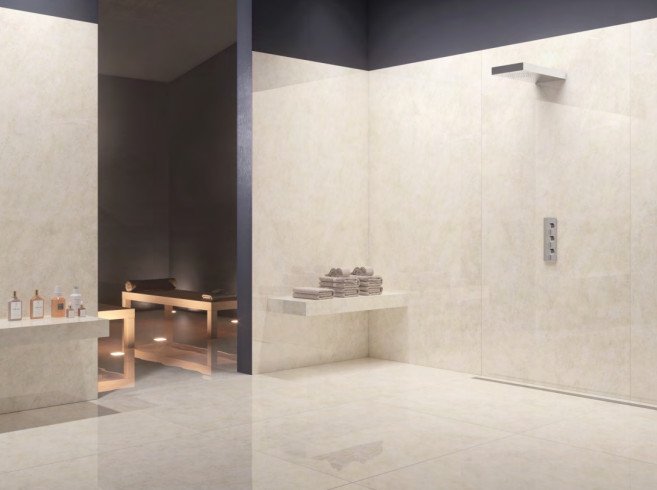

Tiling a shower wall is a three-day project for a standard tub surround. Day one is waterproofing and layout. Day two is setting the tile. Day three is grouting. The tiling itself is repetitive and methodical. The decisions you make before mixing the thinset determine whether the finished wall looks professional or like a first attempt, notes Ohio Security Deposit Law.
The most important decision is where the first tile goes. A shower wall tiled from the bottom up with a level ledger board looks straight. A wall tiled from the tub or shower pan upward without a ledger follows the uneven contour of the pan and looks crooked. Here is how to prep the wall, plan the layout, set the tile, and avoid the mistakes that are visible from across the room.
Before Tile: The Wall Must Be Waterproof
Tile and grout are not waterproof. They are a decorative wear surface. The waterproofing is behind them. If you are tiling over new backer board, the backer board must be covered with a waterproof membrane, either a liquid-applied membrane rolled on in two coats or a sheet membrane applied with thinset. The membrane must extend at least to the height of the showerhead. The seams and corners must be reinforced with waterproofing fabric or tape embedded in the membrane. The fasteners through the backer board must be covered. Every penetration is a potential leak path.
If you are tiling over existing tile, stop. Tile over tile in a shower is a temporary fix that fails because the new tile is only as well-bonded as the old tile, and the old tile may have been poorly bonded or may have water damage behind it. Remove the old tile and the old backer board down to the studs. Install new backer board, waterproof it, and tile. A shower is the worst place in the house to cut corners. A leak that rots the framing and subfloor costs thousands to repair. The extra day of demolition and new backer board is cheap insurance.
Layout: Where the First Tile Goes
Find the center of each wall. Mark a vertical plumb line at the center. Dry-lay a row of tile on the floor with spacers to determine the exact measurement from the center line to the edges. Adjust the layout so that the cut tiles at the corners are at least half a tile wide. A sliver of cut tile at the edge of a wall is the most visible sign of a layout that was not planned. If moving the center line left or right by half a tile eliminates a narrow cut, move the layout.
Do not start the first row of tile on the tub or shower pan. Tubs and pans are never perfectly level. Starting on the pan follows the pan’s uneven slope and produces crooked grout lines. Instead, screw a ledger board to the wall one row above the bottom. The ledger is a straight piece of wood, typically a 1-by-3 or 1-by-4, screwed into the studs through the waterproofing. The top edge of the ledger is level and supports the first row of wall tile. Tile upward from the ledger. After the tile has set for 24 hours, remove the ledger, patch the screw holes with waterproofing, and cut and install the bottom row of tile to fit the uneven gap between the wall tile and the tub or pan.
This method produces a level first row and a clean cut at the bottom where the unevenness is absorbed by the cut tiles. The bottom row is the least visible row in the shower. The uneven cuts are hidden by the tub or pan. The rest of the wall is straight.
Mixing and Applying Thinset
Use a polymer-modified thinset mortar rated for wet areas. The bag says suitable for intermittent wet conditions or suitable for showers. Premixed mastic in a bucket is not acceptable for shower walls. Mastic re-emulsifies when it gets wet. In a shower, it gets wet. Use powdered thinset that you mix with water.
Mix the thinset to the consistency of smooth peanut butter. It should hold its shape on the trowel but spread easily. Too wet and the tiles sag down the wall. Too dry and the thinset does not bond. Mix only as much as you can use in 30 to 45 minutes. The pot life of thinset is printed on the bag. After the pot life expires, the thinset begins to set in the bucket and must be discarded. Do not add water to extend the pot life. Water added after the thinset has begun to set weakens the bond and voids the manufacturer’s warranty.
Spread thinset on the wall with the notched side of the trowel. The notch size depends on the tile size. A 1/4-inch by 1/4-inch square-notch trowel is standard for wall tile up to 8 inches. A 1/4-inch by 3/8-inch trowel is used for larger tiles. Hold the trowel at a consistent 45-degree angle. The ridges of thinset should all be the same height. Inconsistent ridges produce uneven tile.
Spread thinset in sections of approximately 3 square feet, which is the area you can cover with tile before the thinset skins over. Do not spread thinset over the entire wall at once. Back-butter large tiles or tiles with deep lugs on the back. Back-buttering is applying a thin layer of thinset to the back of the tile with the flat side of the trowel before pressing it into the ridged thinset on the wall. The two layers of thinset collapse together and achieve full coverage. A tile without full coverage has hollow spots that sound dull when tapped and are more likely to crack.
Setting the Tile
Press each tile firmly into the thinset with a slight twisting motion. The twisting collapses the thinset ridges and achieves full contact between the tile and the wall. Insert spacers between the tiles as you go. The spacers maintain consistent grout joints. The joint width is a design choice. Standard wall tile uses 1/8-inch or 3/16-inch joints. Larger tiles can use 1/8-inch joints. Mosaic sheets have the spacers built into the mesh backing but still require adjustment to keep the sheets aligned.
Check every few rows with a level. A tile that is slightly out of level compounds over multiple rows. An error of 1/16 inch over 10 rows is over half an inch at the top. The level catches the drift early when it can be corrected by adjusting the next row. A tile leveling system, which uses plastic clips and wedges to hold adjacent tiles flush, eliminates lippage, which is the term for one tile edge sitting higher than its neighbor. Leveling systems are most useful for large-format tiles, 12 inches or larger, where lippage is more visible and harder to control by hand.
Cut tile as needed with a manual snap cutter for straight cuts or a wet saw for L-cuts, U-cuts around pipes, and cuts that are too narrow for a snap cutter. A manual tile cutter costs $20 to $40 and works for straight cuts on most wall tiles. A wet saw can be rented for $50 to $80 per day and is necessary for the complex cuts around the shower valve and showerhead. An angle grinder with a diamond blade handles small notches and curved cuts.
Remove spacers before the thinset sets completely, typically 30 to 60 minutes after setting the tile. Spacers left in place overnight are glued into the joint by the thinset and are difficult to remove without chipping the tile edges. Remove them when the tile is firm but the thinset is still workable. The tile should not slide when you pull the spacer.
Shower Niches and Soap Dishes
A shower niche, which is a recessed shelf in the wall for shampoo and soap, is tiled after the surrounding wall tile is set. The niche must be waterproofed before tiling, with the waterproofing extending onto the surrounding wall. The niche is framed during the backer board stage. Tile the back wall of the niche first, then the sides, then the top and bottom. The bottom shelf of the niche must slope slightly forward so water drains into the shower, not pool in the niche. A slope of approximately 1/8 inch per foot is built into the thinset under the bottom tile. A niche with a flat bottom shelf holds water. A niche that slopes forward stays dry.
After the Tile Is Set
Let the thinset cure for at least 24 hours before grouting. Remove the ledger board if you used one. Patch the screw holes with the same waterproofing membrane used on the walls. Measure, cut, and install the bottom row of tile. The gap between the bottom row and the tub or pan is filled with silicone caulk, not grout. The caulk allows the tub to move independently of the wall. Grout in this joint cracks.
Grout the tile after the thinset has cured. The grouting process for shower walls is the same as for any tile surface. Use sanded grout for joints 1/8 inch and wider, or unsanded grout for joints narrower than 1/8 inch. Seal the grout after it cures. The grouting and sealing steps are covered in detail in a separate guide on grouting shower tile.
Frequently Asked Questions
Can I tile over drywall in a shower?
No. Drywall is not an acceptable substrate for a shower wall, even with a waterproof membrane applied over it. Building codes generally require cement backer board or a foam backer board in wet areas. Drywall with a waterproof membrane is permitted by some membrane manufacturers, but it is not best practice. If the membrane fails at a single pinhole, the drywall absorbs water and disintegrates. Cement board does not disintegrate when wet. For the cost difference of $15 to $20 per sheet between drywall and cement board, use cement board.
Can I install heavy tile on shower walls?
Yes, within limits. Standard ceramic and porcelain wall tile up to 15 pounds per square foot can be installed on cement board with polymer-modified thinset without additional support. Natural stone tile, which is heavier, and large-format tile may require a mortar bed or additional mechanical support per the tile manufacturer’s instructions. The weight limit for thinset on walls is specified by the thinset manufacturer. Check the bag.
What order should I tile the shower walls?
Tile the back wall first, then the side walls. The side wall tiles cover the cut edges of the back wall tiles, which hides the cuts in the corners. The corner joints between walls are filled with silicone caulk, not grout. The caulk allows the walls to move independently. Grout in the corners cracks. This is the same rule that applies to every change of plane in a tile installation. Corners get caulk. Flat surfaces get grout.