
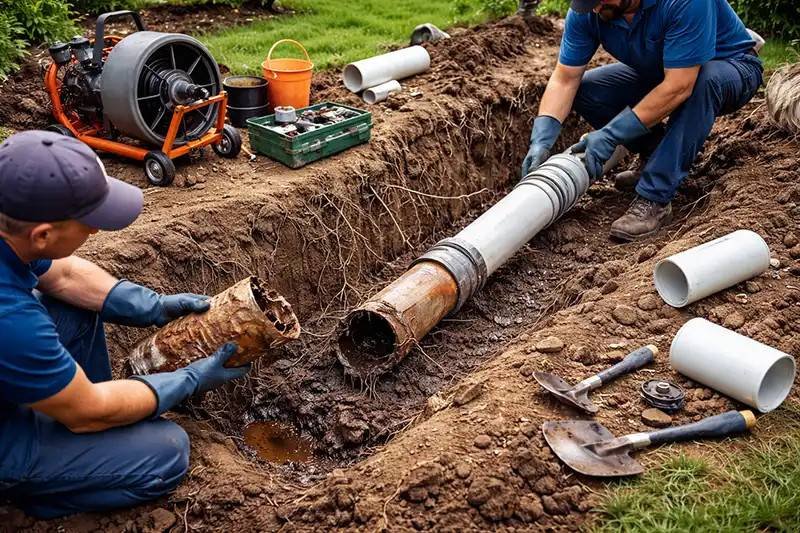

Just as understanding Florida Security Deposit Laws.html protects landlord interests, this guide compares sewer line replacement vs repair across cost, pipe condition, and longevity. The decision between sewer line repair and replacement comes down to what a camera inspection reveals about the pipe material, the extent of the damage, and whether the pipe has collapsed.
The cost difference between repair and replacement is $6,000 to $20,000. The decision is not about which is cheaper. The decision is about which is possible. Some sewer line problems can only be solved by replacement. A collapsed pipe cannot be repaired. An Orangeburg pipe — a bituminous fiber conduit installed between 1940 and 1970, cannot be repaired. A clay pipe with offset joints every few feet cannot be spot-repaired, the repair fixes one joint and the next joint fails six months later. The camera tells you which category your sewer line falls into. Here is how to interpret what the camera shows.
When Repair Is the Right Choice
A spot repair is the right choice when the damage is localized, a single cracked joint, a section crushed by tree roots, a pipe that separated at a coupling, and the rest of the line is in good condition. The camera shows a mostly intact pipe with one problem area. The soil above the problem area is excavated. The damaged section is cut out and replaced with new PVC. The excavation is backfilled. The repair costs $2,500 to $5,000 and takes one to two days. The rest of the line remains in service. The repair fixes the problem. The repair does not fix the rest of the line. The rest of the line must be in good enough condition to justify leaving it in place.
Trenchless spot repair, cured-in-place pipe lining applied to a single damaged section, costs $3,000 to $7,000 and avoids excavation entirely. A felt or fiberglass liner saturated with epoxy resin is inserted into the pipe at the damaged section, inflated, and cured. The liner creates a new pipe inside the old one at the repair location. Trenchless spot repair works when the pipe is still structurally intact enough to support the liner during installation. It does not work on a collapsed pipe, a pipe with offset joints, or a pipe that has been crushed. The liner needs a round, continuous surface to bond to. A collapsed pipe provides no surface. An offset joint creates a step that the liner cannot bridge. The camera shows whether the pipe can support a liner. The liner is the repair. The camera is the qualification test.
The Environmental Protection Agency (EPA) provides guidance on sewer line repair and replacement, including information on trenchless technology options. Trenchless methods reduce landscape disruption but are not available for every type of damage. The camera inspection determines eligibility. The pipe condition determines the method. The method determines the cost.
When Replacement Is the Only Option
Seven common pipe conditions determine whether repair is possible or replacement is required. Here is the decision matrix based on camera inspection findings.
| Condition | Repair Possible? | Recommended Action | Cost |
| Single cracked joint, pipe otherwise sound | Yes, spot repair | Spot repair (trench or trenchless) | $2,500 – $7,000 |
| Single root intrusion, pipe intact | Yes, root removal + spot repair | Root removal + repair damaged section | $2,500 – $5,000 |
| Multiple offset joints, clay pipe | No, distributed failure | Full replacement | $10,000 – $20,000 |
| Collapsed pipe (any material) | No, structural failure | Full replacement (trench or pipe bursting) | $10,000 – $25,000 |
| Orangeburg pipe (any condition) | No, material failure | Full replacement only | $8,000 – $18,000 |
| Cast iron, heavily corroded, multiple leaks | Partial, repairs are temporary | Full replacement recommended | $10,000 – $22,000 |
| Clay pipe, cracking along entire length | No, distributed failure | Full replacement | $10,000 – $20,000 |
Orangeburg Pipe, the Automatic Replacement
Orangeburg pipe, a bituminous fiber conduit manufactured during and after World War II as a low-cost alternative to cast iron and clay, has an expected lifespan of 30 to 50 years. Every Orangeburg line still in the ground is past its expiration date by at least 25 years. The pipe deforms into an oval cross-section under soil pressure. Once deformed, the pipe continues to collapse. It cannot be spot-repaired because the adjacent sections are in the same condition. It cannot be lined because the deformed shape prevents the liner from creating a circular cross-section. The only fix for Orangeburg is a full replacement. If a camera inspection reveals Orangeburg, a black, fibrous pipe that looks like tar paper rolled into a tube, the repair conversation is over. The replacement conversation has begun. The cost is $8,000 to $18,000 for a typical residential sewer line. The cost is not negotiable. The pipe is not salvageable. The replacement is mandatory.
Trench vs. Trenchless Replacement
A full sewer line replacement can be done by traditional trench excavation or by trenchless pipe bursting. Trench excavation involves digging a trench from the house to the street, removing the old pipe, installing new PVC, backfilling, and restoring the surface. The cost is $8,000 to $15,000 for a line under a lawn, $15,000 to $25,000 for a line under a driveway, sidewalk, or patio. The excavation damages the surface. The surface restoration, replacing concrete, replanting grass, repairing landscaping, is included in the cost but does not return the yard to its original condition. The yard will show the scar of the trench for a year or two. The scar is the evidence of the replacement. The replacement is permanent.
Trenchless pipe bursting costs $10,000 to $20,000 and replaces the old pipe without excavating a trench. A bursting head is pulled through the old pipe, breaking it apart as it goes. A new HDPE pipe is pulled in behind the bursting head. The new pipe follows the same path as the old one. Two small access pits, one at the house, one at the street connection, are the only excavations. The yard is undisturbed. The driveway is untouched. The cost is $2,000 to $5,000 more than a trench replacement under a lawn, and $5,000 to $10,000 less than a trench replacement under a driveway or patio. Trenchless is the right choice when the old pipe path is acceptable and the pipe is not so collapsed that the bursting head cannot pass through. The camera shows whether the pipe can be burst. A fully collapsed, flattened pipe may require a receiving pit at the collapse point. The cost increases if additional pits are needed. The camera estimates the number of pits. The pits determine the cost.
Cost Comparison, Repair vs. Replacement
Sewer line repair costs $2,500 to $7,000 for a spot fix versus $8,000 to $25,000 for a full replacement, with the method determined by the pipe condition and the presence of hardscape. Here is how the five methods compare.
| Method | Cost Range | When It Applies | Lifespan |
| Spot repair (trench) | $2,500 – $5,000 | Single damaged section, rest of line sound | 50+ years for the repaired section; original pipe remains |
| Spot repair (trenchless lining) | $3,000 – $7,000 | Localized crack or joint failure, no collapse | 30–50 years for the liner |
| Full replacement (trench, lawn only) | $8,000 – $15,000 | Entire line deteriorated, no hardscape obstacles | 50–100 years (PVC) |
| Full replacement (trench, with hardscape) | $15,000 – $25,000 | Line under driveway, sidewalk, or patio | 50–100 years (PVC) |
| Trenchless full replacement (pipe bursting) | $10,000 – $20,000 | Full replacement without excavation | 50–75 years (HDPE) |
Frequently Asked Questions
How do I know if my sewer line can be repaired or needs replacement?
A camera inspection is the definitive diagnostic. If the camera shows a single problem, one cracked joint, one root intrusion, one separated coupling, and the rest of the line is in good condition, a spot repair is possible. If the camera shows distributed damage, multiple cracks, offset joints every few feet, Orangeburg material, or a collapsed section, full replacement is required. The camera shows the answer. The plumber interprets the camera. The camera does not lie.
How much does sewer line repair cost compared to replacement?
A spot repair costs $2,500 to $7,000. A full trench replacement costs $8,000 to $25,000. A trenchless replacement costs $10,000 to $20,000. The cost difference is $6,000 to $20,000. The decision is not about which is cheaper. The decision is about which the pipe condition allows. A collapsed pipe cannot be repaired regardless of the cost difference.
How long does a sewer line repair last compared to replacement?
A spot repair on a PVC section lasts 50-plus years, but the original pipe on either side of the repair is unchanged. The repair may outlast the original sections. A full PVC replacement lasts 50 to 100 years. A trenchless HDPE replacement lasts 50 to 75 years. A cured-in-place liner lasts 30 to 50 years. The replacement resets the clock on the entire line. The repair resets the clock on the repaired section only.
Can I delay sewer line replacement with repeated repairs?
You can delay replacement with spot repairs as long as the pipe condition allows spot repairs, meaning the damage is still localized. At some point, the damage becomes distributed. The repairs become more frequent and more expensive. The cumulative cost of repairs approaches the cost of replacement. The replacement becomes the better financial decision when the repair frequency reaches one repair every 12 to 18 months. The plumber can advise on the trend. The trend determines the decision.
Does homeowners insurance cover sewer line replacement?
Standard homeowners insurance does not cover sewer line replacement due to gradual deterioration, tree roots, or aging pipes. Some insurers offer sewer line coverage as an add-on rider for $50 to $150 per year. The rider typically covers up to $10,000 per claim. If your home has an older sewer line, clay, cast iron, or Orangeburg, the rider is worth the premium.
Who is responsible for the sewer line, the homeowner or the city?
The homeowner is responsible for the sewer lateral from the house to the property line or the street connection point. The city is responsible for the main sewer line in the street. The exact boundary varies by municipality. Contact your local water and sewer utility to confirm before authorizing any work. Do not pay for a repair on the city’s side of the line.
The Camera Decides
Before you authorize any work on your sewer line, get a camera inspection. The camera costs $200 to $600. The camera shows what is inside the pipe. The pipe tells the truth. The truth determines whether you need a $4,000 repair or a $15,000 replacement. The camera is the cheapest part of the project and the most important. The camera is the decision tool. The decision is expensive either way, $4,000 or $15,000. The wrong decision is more expensive than either. A repair on a pipe that needed replacement costs $4,000 for the repair and $15,000 for the replacement that follows within a year. The total is $19,000. The replacement alone would have cost $15,000. The camera would have shown that the pipe needed replacement. The camera was not used. The $4,000 repair was money spent on a pipe that was already dead. The camera would have saved $4,000. Camera the line before you authorize any work. The camera is the first $400 of a $15,000 project. The camera is the insurance against the wrong decision. The insurance costs $400. The wrong decision costs $4,000. The camera is cheaper. Ever authorized a $4,000 sewer repair, paid the invoice, and then watched the toilet gurgle again three months later? The repair fixed the cracked joint the camera showed. The camera did not show the three other cracked joints further down the line. The camera operator stopped at the first problem. The problem was fixed. The other problems were still there. The second repair cost another $4,000. The replacement would have cost $15,000. The two repairs and the eventual replacement cost $23,000. The replacement alone would have cost $15,000. Pay for the thorough camera inspection. The thorough inspection saves money. The quick inspection saves time. The time saved is not worth the money lost.