
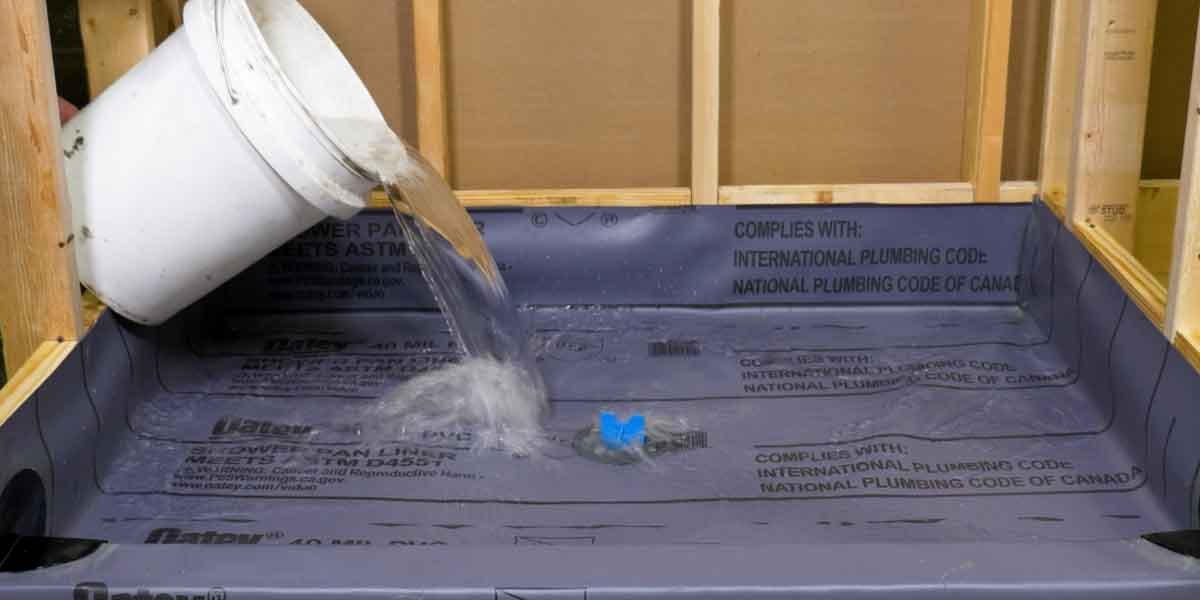

A shower pan liner is the waterproof sheet between the mortar bed and the tile floor, and it exists to catch the water that gets past both.
Everything that decides whether a shower lasts happens around that sheet: the sloped bed it lies on, the fold at the curb, and the ring that clamps it to the drain. Get those three right and the liner outlives the tile above it.
Most of the failed pans I have been asked to look at were installed by someone who assumed the liner itself was the hard part.
What a Shower Pan Liner Actually Does
A shower pan liner is a 30- to 40-mil sheet of PVC or CPE laid over a sloped bed and carried up the framing past the curb, where it channels whatever water reaches it into the drain’s weep holes.
Oatey, which supplies most of the liners sold at home centers, describes a mud-bed shower as five stacked layers: the subfloor, a slope bed, the liner, a second mortar bed, and the tile.
The liner is not there to protect the tile. It protects the floor framing and the ceiling below, which is why the sheet travels up the wall framing and over the curb instead of stopping at the floor line.
Water does not need a crack to get through a tiled floor. Grout and mortar are porous, so a working shower passes a little water into the bed during every use, and the liner is the only thing keeping that water out of the structure. A shower that has been leaking for months usually has an intact liner and a broken slope, which is the part no one sees.
The Pre-Slope Is the Part That Fails
The pre-slope is the mortar bed under the liner, pitched at 1/4 inch per foot toward the drain. Skip it and water that reaches the liner has nowhere to travel, so it pools in the pan until it wicks back up through the tile joints.
Oatey’s installation guide is specific about the geometry: pour mortar on the subfloor at 1/4 inch per foot, sloping inward from the wall framing to the top of the drain base, then let it cure before the liner goes down.
Picture where the water actually goes. It passes the tile and the upper mortar bed, hits the liner, and then has to travel sideways to the drain. The clamping ring screwed down over the sheet carries the weep slots that let it out. Those slots only drain if the membrane beneath them tilts toward the drain, which is the whole job of the pre-slope.
Checking the slope is arithmetic, not art. A 4-foot level laid across the cured bed should show roughly an inch of fall from the wall to the drain, because 1/4 inch per foot adds up to that over four feet.
The trade does not agree on this as cleanly as the drawings suggest. In a Fine Homebuilding forum thread on pan slope, one homeowner reported that two local plumbers told him the slope should be built on top of the liner (Fine Homebuilding).
A reply from the poster Usanigel laid out the sequence tile setters use: slope the bed to the drain at roughly 1/4 inch per 12 inches, set the liner, then install the clamping plate dry over it so the weep slots stay clear. His warning about the shortcut is worth keeping in mind. “Without the pre-slope you invite water being trapped and minerals being pushed up through the tile joints.”
Another poster in the same thread, jnsn, described the mud above the liner as more than 1 1/2 inches thick and pitched a second time toward the upper part of the drain. Both beds slope. Only the lower one carries the water out.
JeffinPA made the code point in the same discussion: under the IRC, the floor has to be pre-sloped before the vinyl, copper, or membrane goes in. Inspectors check the slope on the bed itself, before anyone lays tile, which is the one moment a homeowner can still ask for a correction cheaply.
PVC Versus CPE, and When a Bonded Membrane Wins
A shower pan liner in PVC is the default choice, CPE is the one to pick when radiant heat runs under the floor, and a bonded sheet membrane such as Schluter KERDI replaces the liner and mortar-bed assembly by gluing straight to the substrate.
Oatey sells both materials in 30-mil and 40-mil gauges, in rolls from 5 by 6 feet up to 6 by 100 feet, and recommends CPE over radiant floor systems.
| System | Thickness | How it goes in | Where it fits |
|---|---|---|---|
| PVC pan liner | 30 or 40 mil | Draped over the pre-sloped bed, stapled near the top edge, corners bonded with X-15 adhesive | The traditional mud-bed shower, and repairs that reuse the existing drain |
| CPE pan liner | 30 or 40 mil | Same fold-and-staple sequence, bonded with Oateyweld | Floors with radiant heat, where the sheet would otherwise rest against a warm surface |
| Bonded sheet membrane | 8-mil PEVA core | Thin-set directly to the substrate or a prefabricated sloped tray, with no folded corners | Rebuilds where the mortar bed is coming out anyway |
The gauge gap is not a quality ranking.
Schluter’s membrane is 8 mil and still waterproofs a shower, because the bond to the substrate does the work that a draped sheet needs folds and staples for. Oatey’s own guide states that it covers center-point drains only, and points linear and curbless designs somewhere else, since those remove the curb that normally holds the liner’s folded edges above the flood level.
Choose on the assembly, not the material. If the mud bed and drain stay in place, a PVC liner is cheaper and easier for the next plumber to inspect. If the bed is coming out regardless, a bonded membrane removes the weep-slot dependency that causes nearly every failure described here. A stock acrylic base is the third option, arriving already sloped and waterproof, and it fits any project that can live with a standard pan size instead of a custom one.
Where Installations Go Wrong, and What Replacement Costs
Most liner leaks trace to four details: staples driven through the middle of the sheet, a missing dam corner where the curb meets the framing, the wrong adhesive, and a flood test that never happened.
Oatey puts a number on the first. Only the top half-inch of the liner should take staples, since anything lower is a hole below the waterline.
The same guide warns against felt paper under the sheet. Petroleum in the paper reacts with the membrane, which can crack or turn brittle, and a brittle liner leaks at the folds.
Corners get dam corners bonded with the adhesive matched to the material, and the curb gets its own scrap of liner stapled over the top and down both faces before the main sheet is adhered to it.
Loose mud and grout are what plug a weep slot. Setting a few small pebbles around the drain before the upper bed goes down keeps the slots open, a step Usanigel recommended in the same thread.
The flood test is the step a homeowner can verify without a moisture meter. Oatey calls for water poured to curb height and left for at least two hours after the adhesives cure overnight. If the level holds and nothing shows up on the ceiling below, the membrane is doing its job.
Replacement rarely stays a liner job. The tile and both mortar beds have to come out to reach the sheet, so most of the bill is labor, disposal, and rebuilding a pan that was fine a week before the demolition started.
The material itself is modest. An Oatey 40-mil PVC liner in the 5-by-40-foot size lists at $218.83 at Walmart, and a single 3-by-5 shower uses a fraction of that roll.
Four signs point at the liner rather than the grout: a stain spreading on the ceiling below, hollow-sounding tile near the drain, a musty smell that comes back after cleaning, and grout that cracks along the same line twice.
FAQ
Is a shower pan liner necessary?
A tiled shower built over a mortar bed needs a waterproof layer tied into the drain, and a pan liner is the traditional way to provide one.
How do you install a shower pan liner on a concrete floor?
Set the drain base into the slab opening first, build the 1/4-inch-per-foot pre-slope, drape the liner over it, clamp the ring down, and staple only the top half-inch to the framing before the flood test.
Do you need a membrane under a shower pan?
A molded acrylic or fiberglass shower base is its own waterproof surface and needs nothing under it, while a tiled pan always needs a liner or a bonded membrane beneath the mortar.
How much does it cost to install a shower pan liner?
The sheet is the cheap part, listed at $218.83 for a 40-mil Oatey PVC roll that covers several showers, and the labor of removing tile and mortar to reach it is what makes a replacement expensive.
Pick the assembly your installer can tie into the drain without improvising. The slope and the clamping ring are what the shower is betting on, and both are still visible before the first tile goes down.