
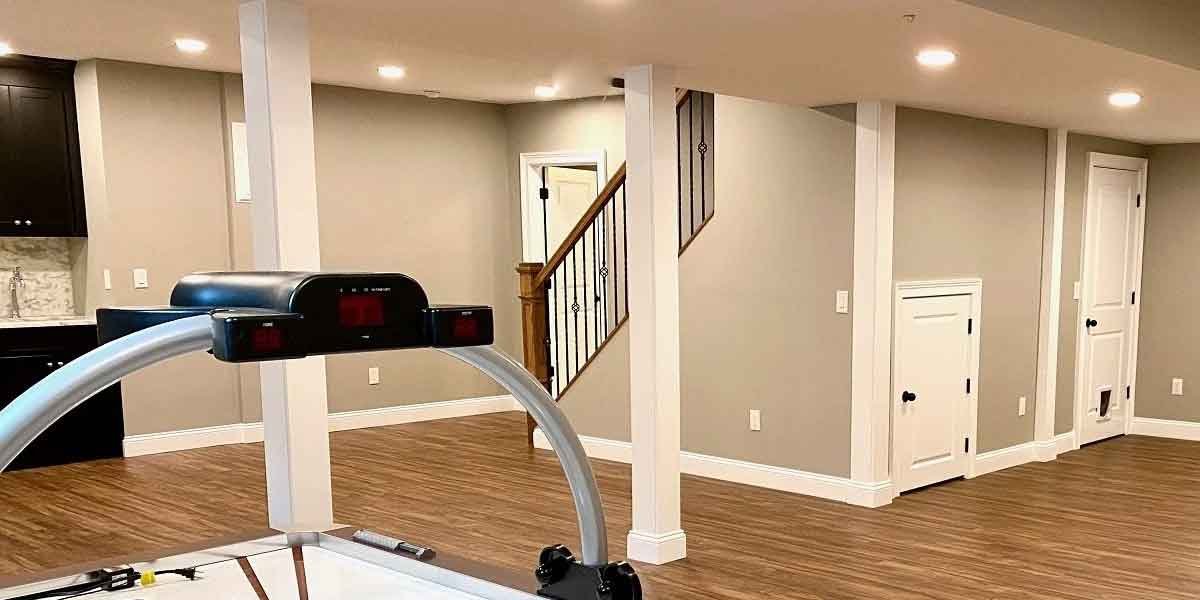

Does remodeling a basement increase home value? Yes, but by less than the floor area suggests. The National Association of Realtors puts a basement conversion to living area at 71% cost recovery in its 2025 Remodeling Impact Report, against a national remodel cost that Fixr places near $50,000.
The gain is real and partial, and the honest version of the number is smaller than most homeowners expect going in.
On an appraisal grid, the line that decides most of it sits well below the total living area. It reads finished rooms below grade, and it is filled in by comparison rather than by measurement.
What a Finished Basement Adds at Resale
A finished basement typically returns about 71 cents on the dollar, according to NAR’s 2025 Remodeling Impact Report. That sits above a complete kitchen renovation at 60%, a bathroom addition at 56%, and an attic conversion at 67%.
Cost matters as much as the percentage. Fixr’s national figures put a basement remodel between $27,000 and $81,000, averaging $50,000, or $30 to $90 per square foot depending on how much plumbing, insulation, and ceiling work the space needs.
Run the two sources together and the shape of the return appears. A $50,000 project recovering 71% returns roughly $35,500 at resale. On a 1,000-square-foot basement that is about $35 per finished square foot, and the figure most owners carry in their heads is far larger.
That mental math multiplies neighbourhood price per square foot by basement area. At $200 and 1,000 square feet, it promises $200,000.
Nobody pays that.
The 71% is a national survey average, and averages travel badly. NARI remodeling professionals supply the project costs, real estate professionals estimate the resale value each project adds, and NAR publishes the ratio. A dry walk-out in a market where finished basements are standard behaves nothing like a low-ceilinged cellar in a town where most houses sell with bare concrete.
Does Remodeling a Basement Increase Home Value as Much as an Addition?
No. Finished basement space is excluded from gross living area, the measure appraisers and lenders compare, so it is valued on a separate adjustment line instead of at the price per square foot of the rooms above it.
The rule is written into Fannie Mae’s Selling Guide, section B4-1.3-05, and it is blunt: “Fannie Mae considers a level to be below-grade if any portion of it is below-grade, regardless of the quality of its finish or the window area of any room.” The next sentence closes the loophole most owners hope for, adding that a walk-out partially below-grade area with finished rooms would not be included in the above-grade square footage or room count.
Walk-outs surprise people.
A lower level that opens onto a patio still counts as below grade, because part of it sits under the floor above. The same section requires appraisers to measure and report both areas using ANSI Z765-2021, the standard that sorts finished areas into standard, nonstandard, and separately reported. Finished space that fails the standard’s ceiling-height test becomes nonstandard finished area, calculated on its own and labelled as such in the report.
Below-grade space is not ignored, it is repositioned. The Selling Guide instructs the appraiser to “report below-grade areas separately and make appropriate adjustments for them on the Basement & Finished Rooms Below-Grade line in the Sales Comparison Approach adjustment grid,” after allowing that rooms outside the above-grade count “may add substantially to the value of a property, particularly when the quality of the finish is high.”
That pair of sentences carries the whole answer, and two nearly identical houses a mile apart can carry very different basement adjustments because of it. Where most comparable sales have bare concrete, a finished media room is supportable as an upgrade. Where half the street already has one, the adjustment shrinks toward the cost of the finishes themselves.
Working Out Your Own Number Before You Spend
Use local sales instead of a national percentage: find three to five recent sales with finished basements, compare each with a similar house without one, and average the gap.
- Pull three to five closed sales from the past six to twelve months where the property has a finished basement, plus a matched sale without one on a comparable lot. The gap between each pair is the local basement adjustment.
- Divide that gap by the finished area below grade to get a local per-foot figure, then apply it to your own space. A 900-square-foot basement carrying a $27,000 adjustment works out to $30 per foot.
- Subtract whatever a buyer would have to repair. Water staining, a dead sump pump, a smell that follows you up the stairs, and ceiling height an inspector will not bless all come off the top before finishes count.
The result will land below what contractor marketing suggests, and it is the only version a buyer’s lender will recognise.
If no sale in the past year had a finished basement, the local market has not priced one yet. The appraiser then has little to support, and the project becomes a comfort purchase instead of a value play.
When a Basement Remodel Does Not Add Value
A basement remodel stops paying when water gets in, when the finishes are too personal for the neighbourhood, or when the owner sells within a couple of years and eats the transaction costs.
Moisture is the expensive one. EPA guidance for mold control tells homeowners to keep indoor relative humidity below 60%, ideally between 30 and 50 percent, and to dry water-damaged areas within 24 to 48 hours.
That window closes before most contractors return a call.
Water claims are not a fringe event either. The Insurance Information Institute reports that about one in 60 insured homes files a property damage claim from water damage or freezing each year, with an average severity of $15,400 for that cause across 2019 to 2023.
Three winters of a slow seep along a cold joint, and the carpet smells faintly of damp at the edges. The drywall looks fine from a foot away. Then the baseboard comes off.
Personalisation is the quieter trap. A wine room, a workshop built around one fixed bench, or a gym sized for a single person’s rack all read as renovation work to the next buyer instead of as space. Timing finishes the list, since the 71% assumes a sale years out and a sale within two or three years rarely leaves the recovered share intact after closing costs.
Dry the Basement Before You Finish It
Water management is cheaper before framing than after a flood. Grading, gutter extensions, a sump pump with a battery backup, and an interior drain are the work that protects everything built on top of it, and most of it disappears behind drywall once the room is done. The order of waterproofing work matters as much as the individual fixes.
One line on a grid carries the decision, and that line follows finished condition and dryness, not floor area.
FAQ
Is it worth finishing a basement to sell a house?
Only when the basement is dry and local buyers pay for finished lower levels. At 71% average cost recovery, a seller gets most of the money back but not all of it, so finishing purely to sell rarely beats leaving that cash in the asking price.
What is the average cost to finish a 2,000 sq ft basement?
Between roughly $60,000 and $180,000. Fixr’s national range of $30 to $90 per square foot scales to about that spread on 2,000 square feet, while a smaller basement with standard finishes lands near Fixr’s $50,000 national average.
Does remodeling a basement increase home value more than a kitchen?
Yes, by NAR’s 2025 ranking. A basement conversion to living area recovers 71% of its cost, ahead of a complete kitchen renovation at 60%, a bathroom addition at 56%, and an attic conversion at 67%.
Does a finished basement count as square footage?
It counts as finished space, not as gross living area. Appraisers and lenders report it on the separate below-grade line, which is why a finished basement adds less than its measured area multiplied by the local price per square foot.