
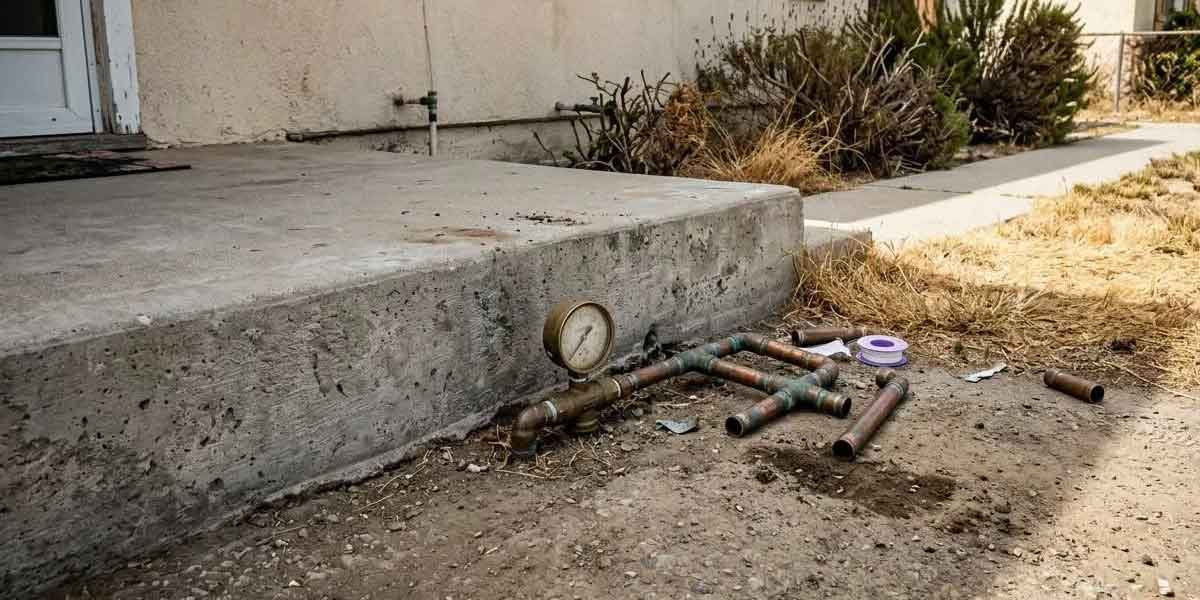

A slab leak repair costs $1,500 to $4,400 in most single-family homes. Detection adds $150 to $400 before anyone picks up a hammer.
Neither number describes the total most owners pay. A slab leak repair cost is assembled from four lines, and the estimate stops at the fourth one: finding the break, opening the slab, repairing the pipe, and returning concrete to floor level. Tile, laminate, the shower base, and the soil that washed out underneath are separate projects with separate trades.
Contractors quote the same house $2,000 apart without either one cheating. The difference sits in where a bid stops and what each plumber assumes someone else will handle.
What the number on the estimate actually covers
A slab leak quote covers four things: locating the leak, cutting into the slab, repairing the failed pipe section, and patching the concrete back to floor level. Finish flooring above the cut, and any structural work beneath the slab, are normally billed by somebody else.
Locating the leak comes first, and it is priced like a service call. Cost surveys put professional detection at $150 to $400. Crews that run their own acoustic and thermal equipment describe a minimum for the first 90 minutes and an hourly charge after that.
One test before paying for any of that costs nothing. With every fixture, appliance, and irrigation valve shut off, watch the low-flow dial on the water meter for fifteen minutes. Movement there confirms a leak is running under pressure; it says nothing about where the pipe failed.
Repair to grade is the phrase worth listening for in the bid. It means the hole gets filled to the top of the concrete and the room is left for someone else to finish, which is ordinary practice across the trade.
Opening the slab is the expensive line. Breaking, diamond cutting, dust control, and carrying rubble out of a finished room are all crew hours, and labor accounts for $500 to $4,000 of a typical repair.
Welding in a replacement pipe section is quick by comparison. A cut and sweat on copper or a crimp coupling on PEX takes minutes; reaching it takes hours.
Patching to grade is where bids separate a second time. One plumber pours concrete and leaves the room ready for new flooring. Another stops at slab level and hands the owner a list of trades to call.
Who pays for each line depends on the contractor and the policy, and that gap is where disputes start. Plumbing crews do not replace flooring as a rule, and finish carpenters do not open concrete. Somebody in the middle has to schedule both.
The table below shows what each line typically costs and who usually pays it.
| Line item | Typical range | Usually inside the bid |
|---|---|---|
| Leak location | $150 to $400 | Often a separate charge |
| Opening the slab and repairing the pipe | $500 to $2,500 | Yes |
| Concrete patched back to floor level | Included in most bids | Usually |
| Finish flooring replaced | Depends on material and room | No |
| Slab repair or replacement | $300 to $6,750 | No |
HomeAdvisor’s cost data puts the average repair at $2,280 across a range of $630 to $4,400, with concrete work running $300 to $6,750 when the slab itself needs rebuilding. Fixr’s figure for the hardest cases, where pipe has to be abandoned and rerouted down at the foundation, reaches roughly $15,000.
Why one slab leak repair cost lands at $1,500 and another at $4,400
Five variables move a slab leak repair cost more than the size of the leak does: how far the failed pipe sits from an accessible edge, what the pipe is made of, how thick the slab is, what floor covers it, and what labor costs in that particular market.
Access is the largest of the five. A leak beneath a shower base means the base, the pan, and the wall tile come out before the pipe is even visible. The same leak in an open corner of a garage is a morning’s work.
Pipe material sets the clock. Soft copper cuts and sweats in place. PEX crimps quickly but needs a dry, clean end to work with. Galvanized steel under some older slabs is often not worth repairing at all, because the next section is on the same failure schedule as the first.
Slab thickness and steel decide how long the saw runs. Thicker pours, mesh, and rebar mats add cutting time, and cutting time is the invoice. Crews price it the same way: two people on site for a day is a fixed cost before any pipe is touched, and a breaker hammer rental shows up as its own line item.
What sits on top of the slab changes the owner’s total, not the plumber’s number. Ceramic tile over a repaired trench is demolition and replacement. Vinyl plank over the same trench can often be lifted and reused.
Market rates finish the picture. A working plumber on the PlumbingZone contractor forum said it without hedging:
Pricing is usually specific to the market you are in. We usually get on average 2400 to 2800 for a domestic repair. I always tell the customer if they ask about price you can find anything cheaper if you look hard enough, but you will get what you pay for in the long run.
Same town, same leak, and two bids can still differ by a factor of two, because one contractor is pricing a repair while the other is pricing a solution. The dollar figures in that thread come from a discussion that is years old, and rates move; the way bids are built has not changed.
Spot repair, reroute, or repipe
The leak count usually makes this decision. One accessible leak gets a spot repair. Two or more on the same line, or a repeat at a spot that was already fixed, push the choice toward rerouting the pipe through the attic or walls, or repiping the house entirely.
Count the leaks before comparing prices.
Spot repair is the cheapest option and the narrowest promise. Contractors quoting $1,500 per leak in that same forum thread were explicit about the limits: the warranty covers the repaired pipe and the spot around it, so a fresh leak two feet down the line is a new job at a new price.
Reroute abandons the buried section and brings the line up into an attic, a wall cavity, or a perimeter trench. It costs more up front and depends on whether the house has a path for new pipe. A single-story slab home with an open attic is straightforward; a two-story with finished ceilings is not.
Drywall is the hidden half of a reroute. Every room the new line crosses gets opened and patched, and carpentry almost never appears in the plumbing bid. In a house with a finished basement ceiling, the framing and drywall can outrun the pipe itself.
Repipe replaces the system and takes it out of the slab for good. Contractors in that thread quoted around $3,500 for an overhead repipe against $1,500 for one spot repair. Two spot repairs approach the price of a single repipe, and only one of those two options ends the problem.
A rule that survives contact with a real bid: if the same line has already been repaired once in the past few years, price the repipe before approving the second spot repair. Original copper that has pitted once tends to pit again somewhere else in the same run.
The bill that keeps running while you decide
The EPA’s current figures put the average household’s leak losses at more than 9,300 gallons a year, and 9 percent of homes leak 50 gallons or more every day. Those numbers cover every household leak, not slabs specifically, which makes a broken supply line under pressure the expensive end of the range rather than a typical case.
Older write-ups still repeat 10,000 gallons a year and 90 gallons a day for the same category. Those came from an EPA leak page that has since been revised downward, and the current agency numbers are the ones worth budgeting against.
A running leak hides inside the baseline. Toilets, faucets, and irrigation dominate a normal household total, so the extra from a slab leak reads as a higher plateau on the bill instead of a spike, which is why the meter test matters more than the bill.
Waiting raises the total in two ways at once. Soil under the slab loses bearing strength as it washes away, so the foundation may need work that had nothing to do with the pipe, and drying out a slow release indoors is a restoration invoice rather than a plumbing one.
Water that escapes under a slab does not leave. It softens the soil the slab rests on and works its way up into baseboards, tack strips, and the bottom plate of walls, which is how a plumbing repair turns into a restoration bill.
Moisture work is its own budget with its own pricing shape, and basement waterproofing cost breakdowns read the same way slab leak bids do: a diagnosis charge, a labor-heavy core, and a stop line the owner has to ask about.
Insurance covers part of this and not the rest. Standard homeowners forms pay for sudden and accidental discharge, meaning the break itself, and exclude wear, corrosion, and gradual seepage. Damage to flooring and belongings usually lands on the covered side; the pipe, the concrete cut, and the detection fee usually land on yours.
Read every bid as a boundary. The number answers a narrower question than it appears to: how far does this contractor’s repair go, and what is left for you to buy separately.
Common questions about slab leak repair cost
What can cause a slab leak?
Slab leaks come from pipe failure rather than from the concrete itself. Copper pinholes from corrosion, soil movement that flexes the line, water pressure above the normal range, and abrasion where pipe rubs against rebar or gravel are the usual causes, and homes over 20 years old on slab foundations produce the most of them.
How much is slab leak detection?
Leak detection costs $150 to $400 in most markets. Crews with their own locating equipment often bill a minimum for the first 90 minutes and an hourly rate after that, and the charge is separate from the repair even when the leak is never found.
Does homeowners insurance pay any of the slab leak repair cost?
Standard policies pay for sudden and accidental discharge, which covers a pipe that breaks, and exclude leaks caused by long-term corrosion or poor installation. Treat it as two claims: the pipe and the slab repair are usually yours, while damaged flooring and personal property are usually covered.
Should I repipe instead of repairing a slab leak?
Repipe when the same line has leaked more than once, when the house still has original copper plumbing past 30 years, or when the leak sits under a finished bathroom. A first leak in an accessible spot is cheaper to repair than to repipe.