
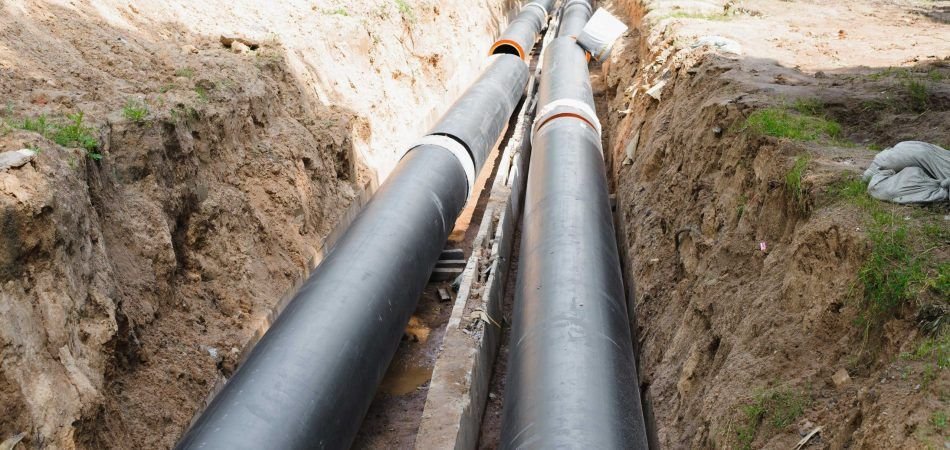

This trenchless sewer line repair guide covers the two methods — lining and bursting. Trenchless sewer line repair is a method of fixing or replacing a damaged underground sewer pipe without digging a trench from the house to the street. The pipe is accessed through two small excavation pits. The cost is $3,000 to $20,000 depending on whether the repair is a spot repair or a full replacement. The trenchless method saves the landscape, explains California Realty Group management company. The landscape savings are the primary reason homeowners choose trenchless over traditional excavation. The preserved landscape is the return on the trenchless premium.
Trenchless repair is not available for every sewer line problem. The pipe must be mostly intact for lining — the new liner needs a round, continuous surface to bond to. A collapsed pipe cannot be lined. The old pipe must have a path that is acceptable for the new pipe to follow for pipe bursting. A pipe with a belly, a section that has sagged and holds standing water, cannot be burst because the new pipe would follow the same sagged path. The camera inspection determines eligibility. The camera is the decision tool. The camera shows the inside of the pipe. The pipe condition determines the method. Here is the complete guide to trenchless sewer line repair.
The Two Trenchless Methods, Lining and Bursting
| Method | What It Does | Cost | Lifespan | When It Works |
| Cured-in-Place Pipe (CIPP) Lining | Creates a new pipe inside the old one by inserting a resin-saturated liner and curing it in place | $3,000 – $15,000 | 30 – 50 years | Pipe is intact but cracked, leaking at joints, or has root intrusion |
| Pipe Bursting | Breaks the old pipe apart as a new HDPE pipe is pulled through behind a bursting head | $10,000 – $20,000 | 50 – 75 years | Pipe is deteriorated, offset, or partially collapsed; full replacement needed |
Cured-in-Place Pipe Lining, the New Pipe Inside the Old One
CIPP lining is the most common trenchless repair method. A felt or fiberglass tube, the liner, is saturated with a two-part epoxy resin. The liner is inserted into the existing pipe through an access point, typically the cleanout at the house or a small excavation pit. The liner is inflated with air or water pressure, pressing it against the inside walls of the old pipe. The liner conforms to every curve, every joint, every crack, and every root intrusion. The resin cures, typically with hot water, steam, or ambient temperature, and hardens into a rigid, seamless pipe within the old pipe. The new pipe is smooth, the flow capacity is actually improved over the old rough pipe, despite the slight reduction in diameter. The cured liner is fully structural, it carries the load of the soil and the groundwater without relying on the old pipe for support. The old pipe is the form. The new pipe is the structure. The form can continue to deteriorate. The structure is independent.
CIPP lining costs $80 to $250 per linear foot, $3,000 to $15,000 for a typical residential sewer line of 30 to 75 feet. The cost depends on the length of the line, the diameter of the pipe, 4 or 6 inches typical for residential, and the accessibility of the access points. A spot repair, lining a single damaged section of 5 to 10 feet, costs $3,000 to $7,000. A full-length lining costs $6,000 to $15,000. The lining is the right choice when the camera inspection shows a pipe that is mostly intact, structural integrity remains, but has cracks, leaking joints, or root intrusion at multiple points. The lining seals every crack and every joint simultaneously. The lining eliminates the leaks. The lining eliminates the root entry points. The lining is the comprehensive repair without the comprehensive excavation.
The Environmental Protection Agency (EPA) provides guidance on trenchless sewer repair methods, noting that CIPP lining and pipe bursting reduce the environmental impact of sewer line replacement by minimizing excavation, reducing construction waste, and preserving landscaping and hardscape. The environmental benefit is the reduced excavation. The reduced excavation is the reason the method exists. The method was developed for urban environments where excavation under a busy street was prohibitively disruptive and expensive. The method migrated to residential applications because the same benefit, reduced excavation, applies to the residential yard. The yard is the street of the residential property. The yard is preserved.
Pipe Bursting, Full Replacement Without the Trench
Pipe bursting is the trenchless equivalent of a full sewer line replacement. A bursting head, a conical steel breaker, is pulled through the old pipe from the access pit at the house to the access pit at the street. The bursting head is larger in diameter than the old pipe. It shatters the old pipe into fragments that are pushed into the surrounding soil. A new HDPE pipe, high-density polyethylene, is pulled in behind the bursting head. The new pipe follows exactly the same path as the old pipe. The new pipe is continuous, no joints, no seams, no entry points for roots. The new pipe is connected to the house plumbing at the house end and to the municipal sewer connection at the street end.
Pipe bursting costs $150 to $300 per linear foot, $10,000 to $20,000 for a typical residential sewer line. It is $2,000 to $5,000 more than CIPP lining and roughly $2,000 to $5,000 more than traditional trench excavation under a lawn. It is $5,000 to $10,000 less than traditional trench excavation under a driveway, sidewalk, or patio, the hardscape restoration costs more than the trenchless premium. The pipe bursting is the right choice when the camera inspection shows a pipe that is too deteriorated for lining, offset joints, partial collapse, multiple sags, or when the pipe material cannot be lined, Orangeburg, heavily corroded cast iron. The bursting replaces the old pipe with a new pipe. The new pipe is larger in diameter than the old pipe, bursting typically upsizes from 4-inch to 6-inch diameter. The upsize improves flow capacity. The new pipe is fully structural with a 50- to 75-year lifespan. The new pipe is the permanent solution. The permanent solution without the trench.
When Trenchless Repair Is, and Is Not, Possible
Trenchless repair is possible when the pipe is accessible from at least two points, typically the cleanout at the house and a small excavation pit at the property line or the street connection. The pipe must have a continuous path, no complete collapses that block the passage of the liner or the bursting head. A partial collapse is acceptable for pipe bursting, the bursting head breaks through it. A complete collapse is not acceptable for either method, the passage is blocked, and traditional excavation at the collapse point is required. The pipe material determines the method. Clay, cast iron, and concrete pipes are candidates for both lining and bursting. Orangeburg, a bituminous fiber pipe, cannot be lined because the deformed, oval shape prevents the liner from creating a circular cross-section. Orangeburg can be burst, the bursting head breaks the Orangeburg into fragments. PVC and ABS pipes are candidates for lining if they are still round and intact. The camera inspection is the eligibility test. The camera shows the pipe material, the condition, and the presence or absence of a complete collapse. The camera answers the question. The question is: can this pipe be repaired or replaced without a trench? The camera answers yes or no. The yes leads to a trenchless repair. The no leads to a traditional excavation at the point of the collapse. The traditional excavation is the fallback. The trenchless is the preference.
Frequently Asked Questions
How much does trenchless sewer line repair cost?
Trenchless sewer line repair costs $3,000 to $20,000 depending on the method and the length of the line. A spot CIPP liner costs $3,000 to $7,000. A full-length CIPP liner costs $6,000 to $15,000. Pipe bursting costs $10,000 to $20,000. The cost is $2,000 to $5,000 more than traditional excavation for a full replacement under a lawn, and $5,000 to $10,000 less than traditional excavation under a driveway or patio.
How long does trenchless sewer line repair take?
A spot CIPP lining takes one day, the liner is inserted and cured in 4 to 8 hours. A full-length CIPP lining takes one to two days. Pipe bursting takes one to three days. In all cases, the sewer line is out of service for the duration of the repair, typically 8 to 12 hours. The plumbing in the house cannot be used while the repair is in progress. A traditional excavation takes three to five days, and weeks more for landscape restoration. The trenchless method is faster because there is no landscape to restore.
Is trenchless repair a permanent fix, or will it need to be redone?
A CIPP liner is a permanent repair with a 30- to 50-year lifespan. A pipe-burst HDPE replacement is a permanent replacement with a 50- to 75-year lifespan. Both are permanent. The liner will eventually age and may require replacement, but not for 30 to 50 years. The HDPE pipe is a new pipe with a lifespan comparable to or exceeding PVC. The trenchless repair is permanent. The traditional excavation replacement is also permanent. Both are permanent. The difference is the method, not the permanence.
Does trenchless sewer line repair come with a warranty?
Most contractors provide a 10- to 25-year warranty on CIPP lining and a 25- to 50-year warranty on pipe bursting. The warranty covers defects in the materials and the workmanship. The warranty does not cover root intrusion from new growth, roots can enter the pipe at the connections, not through the liner or the new pipe itself. The warranty is the guarantee. The guarantee is the contractor’s confidence in the method. The method is proven. The warranty is the proof.
Can tree roots grow back through a CIPP sewer liner?
No, a CIPP liner is a continuous, seamless pipe within the old pipe. There are no joints, no cracks, and no entry points for roots. The liner eliminates the root intrusion points. The roots that are sealed inside the old pipe by the liner will eventually die, they have no source of moisture. The roots outside the pipe remain. They will not penetrate the liner. The liner is impermeable to roots. The root problem is solved. The solution is permanent.
Do I need a permit for trenchless sewer line repair?
Yes, a plumbing permit is required for sewer line repair or replacement, regardless of the method. The contractor pulls the permit. The permit costs $50 to $200. The permit triggers an inspection. The inspector verifies the connection at the house and at the street. The inspection confirms the repair is code-compliant. The permit is required. The inspection is the verification. The verification is the protection.
The Sewer Line That Stays Underground
Get a camera inspection. If the pipe is mostly intact, cracked but not collapsed, CIPP lining is the right choice. The liner creates a new pipe inside the old one. The liner costs $6,000 to $15,000. The liner lasts 30 to 50 years. The yard is untouched. The day after the repair, the grass is still growing where the sewer line runs. There is no trench to fill, no sod to replace, no paver pattern to recreate. The repair is invisible. The repair is under the ground. The ground is unchanged.
If the pipe is too deteriorated for lining, offset joints, partial collapse, sagging, pipe bursting is the right choice. The old pipe is shattered and a new HDPE pipe is pulled through. The new pipe costs $10,000 to $20,000. The new pipe lasts 50 to 75 years. The yard is untouched. The repair is a full replacement without the trench. The full replacement without the destroyed landscape. The landscape is the yard. The yard is where the children play, where the dog runs, where the garden grows. The yard is preserved. The sewer line is new. The yard and the sewer line coexist. The trenchless method made the coexistence possible. The method costs more than the trench. The method costs less than the trench plus the landscape restoration. The method is the value. The value is the yard. The yard is worth the premium. The premium is the trenchless. The trenchless is the guide. The guide is the camera inspection, the method selection, and the invisible repair. The invisible repair is the goal. The goal is a sewer line that works and a yard that was never destroyed. The trenchless method achieves both. The method is the answer. The answer is under the grass. The grass is green. Ever walked across your yard, looked down at the strip of grass that runs from the house to the street — the strip that covers the sewer line — and thought “if this pipe ever needs to be replaced, every inch of this grass, this garden, and this patio will have to be dug up”? The thought was the reason you called the trenchless contractor. The trenchless contractor said the pipe could be burst. The pipe was burst. The new HDPE pipe was pulled through. The grass was never disturbed. The garden was still in bloom. The patio pavers were still in place. The trenchless method turned the thought into relief. The relief was the grass. The grass was green. The green was the proof. The proof was the patch of grass that covered the sewer line, unchanged by the replacement underneath.