
All About Wood Warping: Types, Reasons, and Solutions

Wood warping, also known as lumber distortion, timber deformation, or board twisting, is the unnatural bending, twisting, or curving of timber due to uneven moisture content and environmental imbalances in or around the wood fibers. Wood warping occurs when the wood fibers absorb and release moisture unevenly, causing internal stress that bends or twists the board. Wood warping is mainly of 5 types, such as bowing wood, cupping wood, twisting wood, crooking wood, and kink wood.
Wood can be warped due to uneven moisture exposure, poor drying methods, water intrusion, improper storage, fluctuating humidity, and inadequate sealing or finishing. Pine, Maple, Douglas fir, poplar, and flat-sawn lumber types are the most warped wood types.
To straighten warped wood, you can use these methods, including balancing the moisture, heat, and pressure of the wood, mechanical clamping, kerf cutting, and sanding. To fix the warped wood at home, you should follow the step-by-step guide mentioned below.
To prevent the wood from warping, we highly recommend you store wood properly, acclimate wood before installation, use kiln-dried lumber, apply a sealant or finish, control the indoor humidity, and install a waterproofing membrane in problematic areas in the home.
Wood warping is prolonged water damage in the home. You can use Teak wood, which has excellent warp resistance, for the home. When you see prolonged wood warping in your home, call us. We will find the problem and give you a solution.
What Is the Definition of Wood Warping?
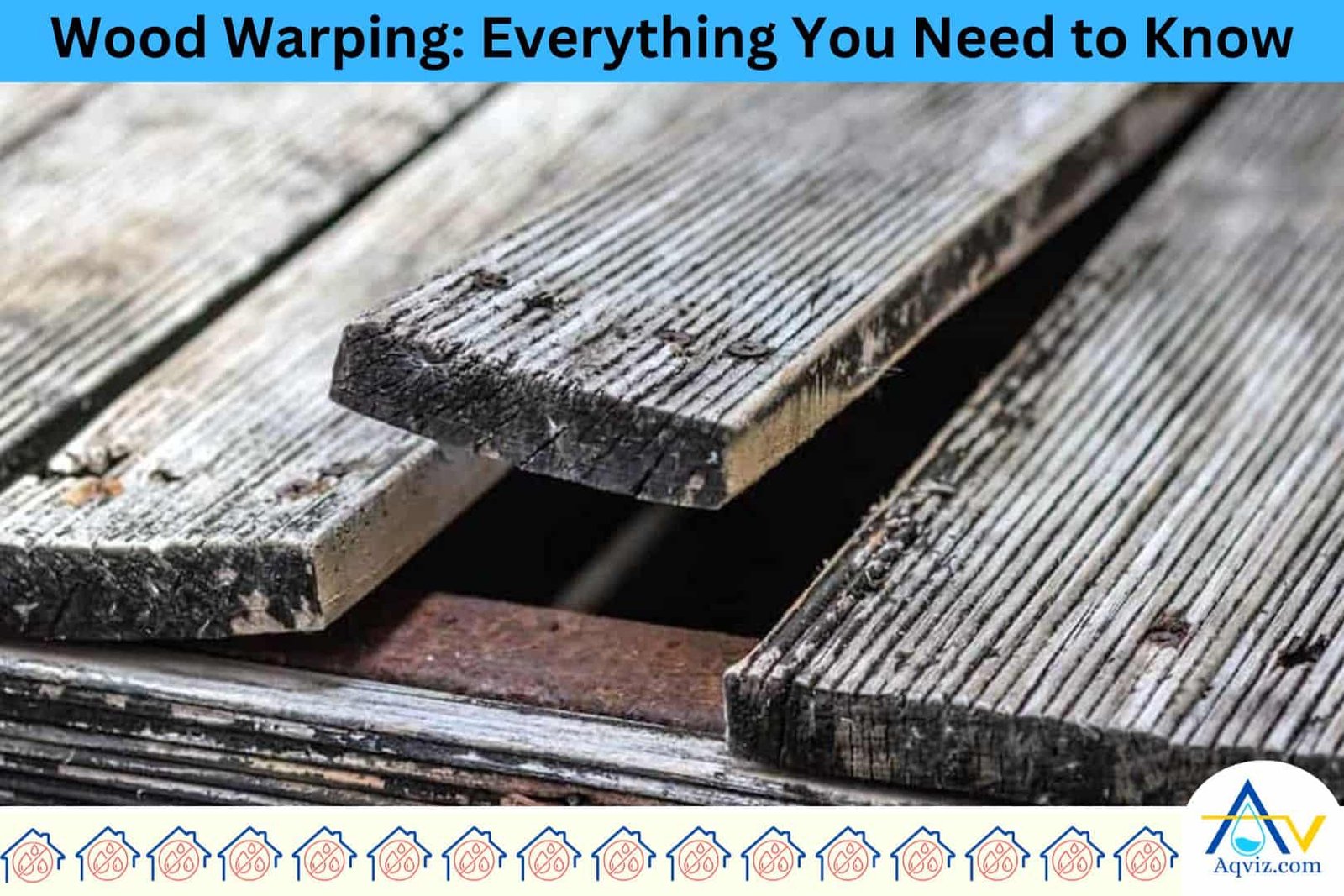
The definition of wood warping is the unnatural bending, twisting, or curving of timber due to uneven moisture content and environmental imbalances in or around the wood fibers. Wood warping occurs in water-prone areas like basements, crawl spaces, and wet foundations. Wood warping causes loss of structural integrity, misalignment of framing elements, flooring gaps, cracked drywall, and increased mold risk.
Normally, wood warping is named by other names like lumber distortion, timber deformation, or board twisting. It depends on the region or industry.
5 Types of Wood Warping and Their Signs
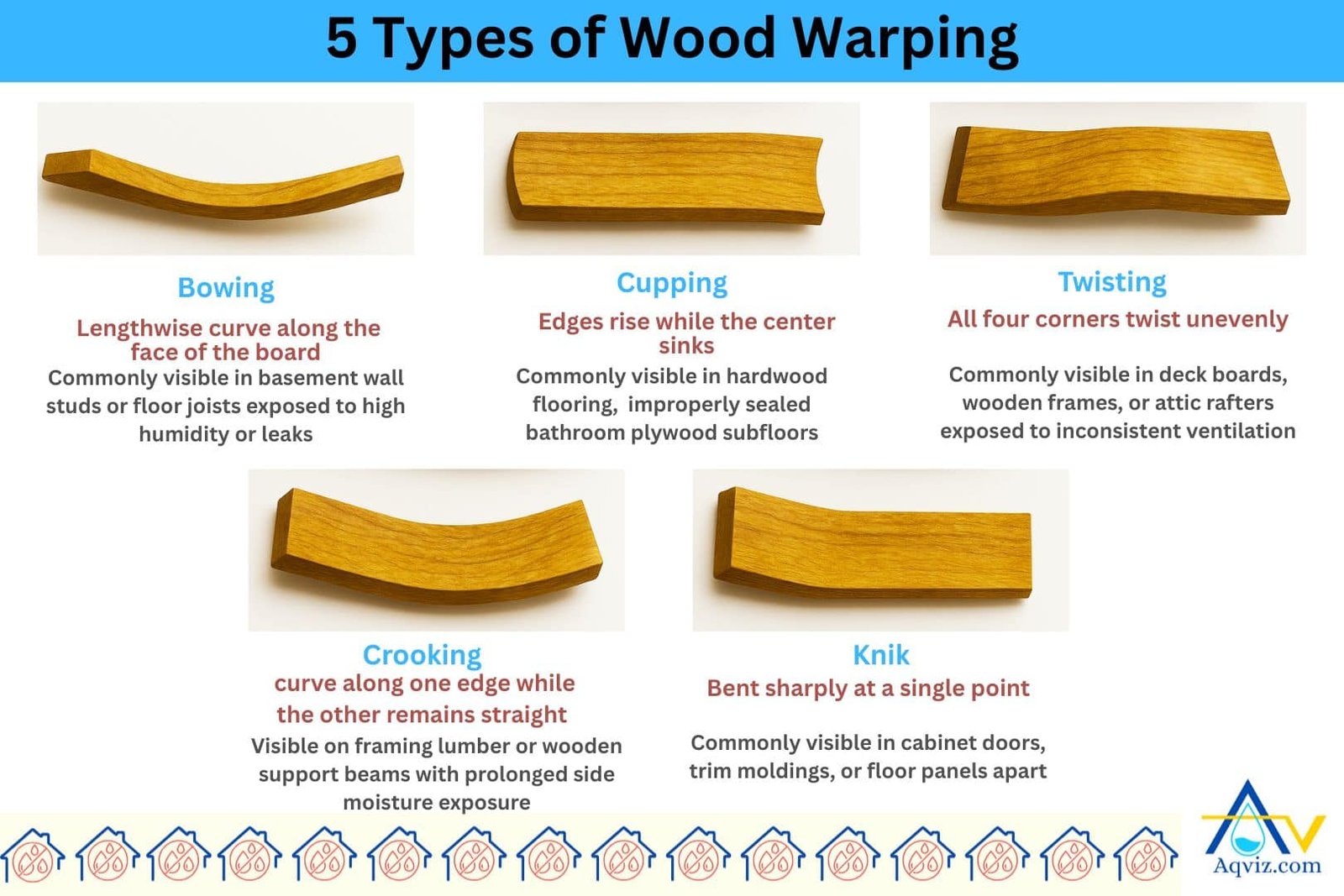
Wood warping is mainly of 5 types, such as bowing wood, cupping wood, twisting wood, crooking wood, and kink wood. Each of these warping types has a specific sign. We have included all of them below.
Bowing wood
Bowing wood is a lengthwise curve along the face of the board where the center arches outward or dips inward. Bowing wood is visible when a straight board no longer sits flat against a wall or floor line. The most common bowing woods are pine, spruce, fir, and construction-grade plywood. We commonly see bowing wood in basement wall studs, floor joists, roof rafters, and garage framing exposed to high humidity, foundation seepage, or plumbing leaks.
Cupping wood
Cupping wood is when the edges of a board rise while the center sinks, creating a concave surface across the width. Cupping wood feels uneven underfoot and often traps dirt and moisture along the edges. The most common cupping woods are hardwood floor planks, engineered wood flooring, and plywood sheets. We usually find cupping wood in hardwood floors installed over damp concrete slabs, bathroom subfloors, kitchens, and laundry rooms with poor vapor control.
Twisting wood
Twisting wood, also called wind, occurs when all four corners of a board rotate in different directions, creating a spiral distortion. Twisting wood causes boards to sit unevenly and resist fastening. The most common twisting woods are deck boards, fencing lumber, framing studs, and untreated timber. We often see twisting wood in outdoor decks, attic rafters, wall frames, and crawl spaces with uneven ventilation or moisture imbalance.
Crooking wood
Crooking wood is a lengthwise bend along one edge of the board while the opposite edge remains relatively straight. Crooking wood creates alignment issues during installation and weakens structural connections. The most common crooking woods are framing lumber, wall studs, beams, and door frames. We typically see crooking wood in load-bearing walls, basement framing, and structural members exposed to moisture from one side only.
Knik wood
Knik wood is a sharp, localized bend at a single point rather than a gradual curve. Knik wood forces joints apart and prevents doors, panels, or trims from closing properly. The most common knik woods are cabinet panels, MDF boards, plywood trims, and laminated flooring planks. We frequently observe knik wood in kitchens, bathrooms, and basements where humidity fluctuates or leaks repeatedly wet specific contact points.
What Are the 6 Reasons for Wood Warping?
There are 6 main causes of wood warping due to moisture imbalance and environmental stress. These issues often appear in poorly ventilated or waterproofed areas of the home.
- Uneven moisture exposure: When one side of the wood absorbs more moisture than the other, it expands unevenly and causes distortion in the wood.
- Poor drying methods: Lumber that isn’t kiln-dried to 6%-8% moisture content warps more quickly, especially during seasonal changes.
- Water intrusion: Leaks from foundation cracks, basement seepage, or plumbing failures raise the surrounding humidity, triggering wood warping.
- Improper storage: Stacking lumber directly on concrete or outdoors without airflow can trap moisture and lead to deformation of the wood before installation.
- Fluctuating humidity: Indoor relative humidity over 60%, especially in crawl spaces or bathrooms, causes wood to absorb and release water erratically.
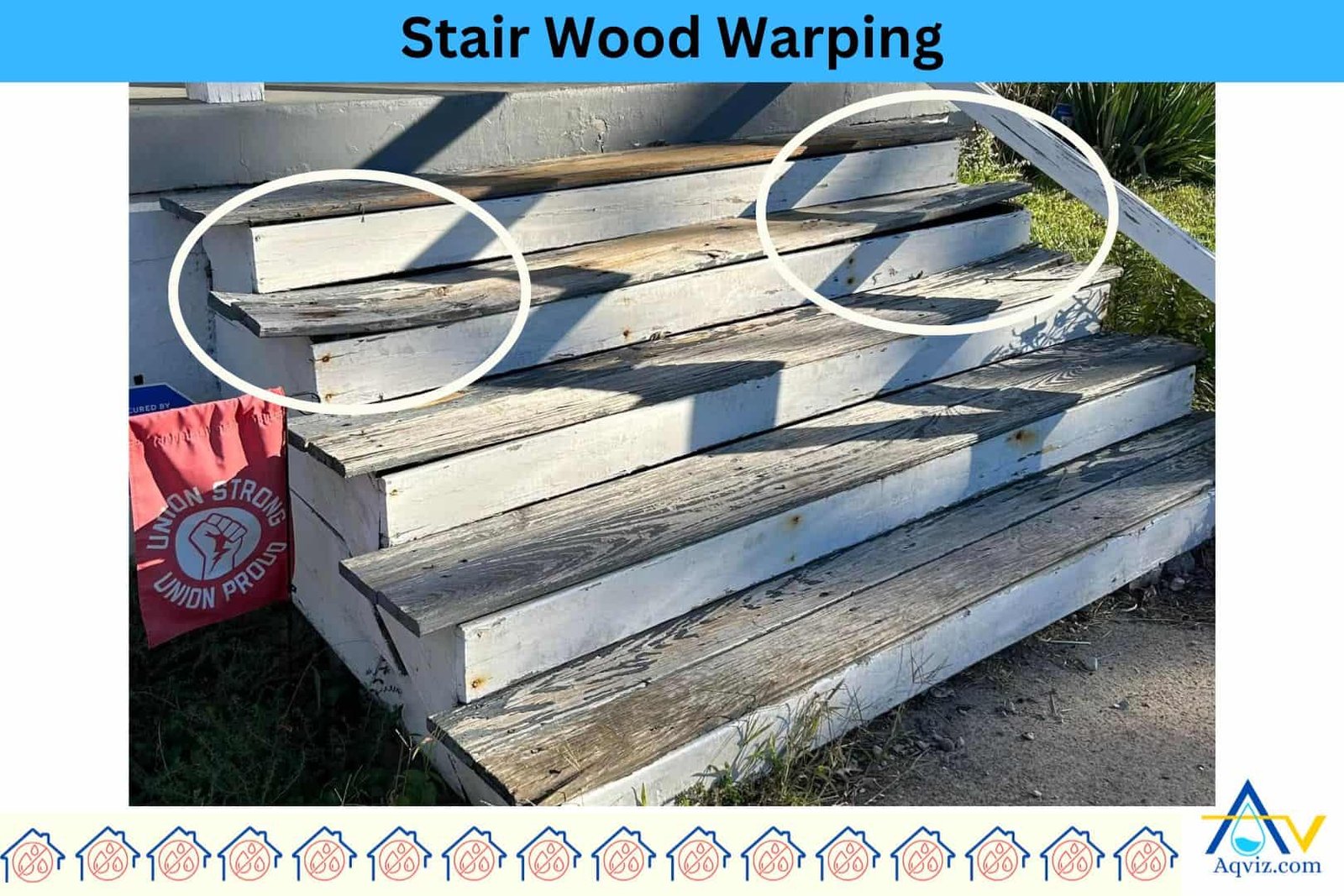
- Inadequate sealing or finishing: Unsealed or poorly sealed wood, particularly on decking, trim, or basement stairs, is more prone to rapid moisture shifts and surface stress on the wood.
You should know these 6 Critical Water Problems and Solutions in a House to identify and fix the wood warping in your home.
What Wood Types Warp Easily?
These 5 wood types warp easily due to their cellular structure, grain orientation, and moisture sensitivity.
- Pine: Pine is a softwood with wide grain patterns and low density. Pine absorbs moisture quickly and warps easily, especially in basements and attics with poor ventilation.
- Maple: Although maple is hard, non-porous maple tends to warp due to internal stress when exposed to uneven drying or relative humidity fluctuations above 55%.
- Douglas fir: Douglas fir is prone to crooking and bowing when stored improperly or installed in moisture-prone areas like crawl spaces.
- Poplar: Poplar is a lightweight and affordable wood type. Poplar lacks dimensional stability and can twist or cup in bathroom trims or unsealed subfloor applications.
- Flat-sawn lumber (any species): Boards cut with the grain flat to the surface, such as flat-sawn oak or spruce, tend to cup due to uneven grain stress under humid conditions.
Does Teak Wood Warp?
Teak wood rarely warps, thanks to its high natural oil content, tight grain, and excellent dimensional stability. Therefore, teak wood is highly recommended for outdoor decks, bathroom vanities, and high-humidity zones, because it resists both water absorption and thermal expansion better than most hardwoods.
Even under high humidity or direct sun exposure, teak maintains its shape if it’s properly sealed and ventilated. However, improper installation or prolonged saturation without airflow can still cause minor cupping or surface movement. For best performance, we advise using marine-grade sealers and ensuring adequate air circulation around all teak surfaces.
Does Cedar Wood Warp?
Yes, cedar wood can warp, but it’s less prone than many softwoods due to its natural oils, low density, and resistance to moisture decay. Hence, you can use western red cedar for siding, trim, and outdoor fencing, but you will see board twisting and cupping when cedar isn’t properly dried or sealed over time with exposure to moisture.
Does Faux Wood Warp?
Yes, faux wood can warp, especially low-grade medium-density fiberboard (MDF) or plastic-composite trims used in high-humidity spaces. Faux wood baseboards, crown moldings, or interior doors are distorted due to steam exposure, plumbing leaks, or poor ventilation in bathrooms and laundry rooms.
Unlike solid wood, faux wood may delaminate or bubble when exposed to moisture levels above 60% RH. The adhesive resins inside the product break down, causing structural failure. To reduce risk, we recommend using moisture-resistant MDF, applying primer-grade sealers, and installing faux wood only in dry, well-ventilated areas.
Which Wood Areas in the Home Warp Mostly?
Wood warping commonly occurs in moisture-exposed and poorly ventilated areas of the home, including basements, bathrooms, kitchens, crawl spaces, attics, and laundry rooms.
- Basements: High humidity, condensation, and foundation leaks cause floor joists, studs, and subfloor wood panels to cup or twist over time.
- Bathrooms: Constant exposure to steam and water splashes in the bathroom warps vanity cabinets, door trims, and wooden flooring without proper sealing.
- Kitchens: Leaks under sinks and near dishwashers lead to buckled toe kicks, cabinet bases, and wood trims.
- Crawl spaces: Unventilated crawl spaces with ground moisture warp support beams, subfloor systems, and framing lumber, which tend to warp over time.
- Attics: Fluctuating temperatures and roof leaks cause rafters, sheathing, and storage shelves to bow or crook over time.
- Laundry rooms: Washer overflows and high humidity trigger warping in flooring and wood-based shelving.
How Long Does It Take for Wood to Warp?
Wood warping can begin in as little as 24 to 72 hours if exposed to excessive moisture or intense heat, depending on the wood type and environmental conditions.
In wet conditions, such as water leaks or flooding, wood can start to cup or swell within 1 to 3 days, especially if the moisture content rises above 20%.
In hot conditions, especially under direct sunlight or attic heat above 90°F (32°C), warping can develop in 2 to 5 days, particularly if the humidity is unbalanced on either side of the wood surface.
How Do You Straighten Warped Wood?
Straightening warped wood depends on the type of warp and the extent of damage. You can use these 5 proven methods to prevent wood from warping.
- Moisture balancing: For cupped boards, you should apply moisture to the concave side and let the convex side dry in the sun. This evens out the fibers and reduces the warp.
- Heat and pressure: You should use a heat gun or steam, then clamp the board flat for 24-48 hours. This method works well for twisting and bowing in decking or framing.
- Mechanical clamping: You should place warped wood between flat surfaces with clamps and leave it in a dry, controlled environment to slowly realign over several days.
- Kerf cutting: For severe crook or bow, you should cut relief grooves along the back to release tension. This method is common with trim boards and subfloor panels.
- Planing or sanding: If warping is minimal, you should remove the high spots with a hand planer or belt sander. This is useful in floors or countertops.
How to Fix a Warped Wood?
Fixing warped wood involves reversing the distortion and restoring structural shape. You should follow this step-by-step guide from our experts based on years of experience.
- Identify the type of warp: Check if the wood shows cupping, bowing, twisting, or crooking. Each type requires a different technique.
- Measure the moisture content: Use a moisture meter to check if it’s above 15%. If yes, place the wood in a dry, ventilated space to stabilize before starting repairs.
- Apply moisture or heat: For cupped or bowed boards, dampen the concave side with a wet cloth. Then, expose the convex side to sunlight or use a heat gun carefully to balance fiber stress.
- Clamp the wood flat: Place the board between two flat, straight surfaces. Apply uniform clamping pressure and leave it for 24-72 hours. For twisted boards, use crosswise clamping.
- Add kerf cuts (if necessary): For stubborn crooks or bows, cut shallow relief grooves along the back side using a circular saw. This relieves tension and helps straighten the board.
- Plane or sand to level: After reshaping, use a hand planer or sander to smooth any uneven surfaces and restore proper thickness.
- Seal the wood: Apply a waterproof wood sealer, especially if the board is in a humid area like a basement, kitchen, or bathroom, to prevent future warping.
How to Prevent Wood Warping?
Preventing wood warping requires controlling moisture exposure and ensuring proper handling from storage to installation. You should follow this 6-step guide to avoid future wood warping in high-risk damp zones like basements, bathrooms, and crawl spaces.
- Store wood properly: You should keep wood stacked flat on a raised surface with spacers between boards for airflow. Avoid direct contact with concrete floors or damp areas.
- Acclimate wood before installation: You should let the wood sit in the room where it will be installed for at least 72 hours. This allows it to adjust to the temperature and humidity.
- Use kiln-dried lumber: You should choose kiln-dried wood with a moisture content between 6%-8%, especially for indoor use. Avoid green or wet lumber for structural framing.
- Apply sealant or finish: You should coat all sides, including ends and hidden surfaces, with a quality wood sealant or waterproof finish like polyurethane or epoxy resin.
- Control indoor humidity: You should use dehumidifiers and maintain indoor relative humidity between 40%-60%, particularly in basements, bathrooms, and laundry rooms.
- Install waterproofing systems: You should apply vapor barriers and waterproof membranes and ensure proper drainage in areas exposed to moisture. At Aqviz, we often install sump pumps, moisture barriers, and foundation sealants to protect the wood structures
Wood rotting is another wood damage in the home due to excessive water. Wood Rotting: Everything You Need to Know guide includes all the important causes, signs, prevention methods and many more related to wood rotting.
Can Waterproofing Stop Wood Warping?
Yes, waterproofing can effectively stop wood warping by eliminating the root cause: water and moisture. A waterproofing system helps to seal all the cracks and damages on the surface, which are prone to leaking and allowing water through the substrate. This helps to control the moisture and water content in the area that affects the wood from warping.
Can Wood Warp From Heat?
Yes, wood can warp from heat, especially when high temperatures cause uneven drying across the wood’s surface. Timber deformation and board twisting occur in areas like attics, sunrooms, and unshaded decks, where the temperature regularly exceeds 90°F (32°C).
When heat dries one side of the wood faster than the other, it creates internal stress, pulling the fibers out of alignment. If the wood moisture content drops below 6%, the board may cup, bow, or twist, especially in species like pine, fir, or flat-sawn oak.
Is Wood Warping a Sign of Water Damage?
Yes, wood warping is often a clear sign of water damage , especially in high-risk areas like basements, crawl spaces, and bathrooms. When wood absorbs excess moisture, it expands unevenly. Over time, this triggers visible warping on the wood. That is why you can see board twisting, cupping, and lumber distortion back to underlying issues such as leaking pipes, foundation seepage, or poor drainage systems.