
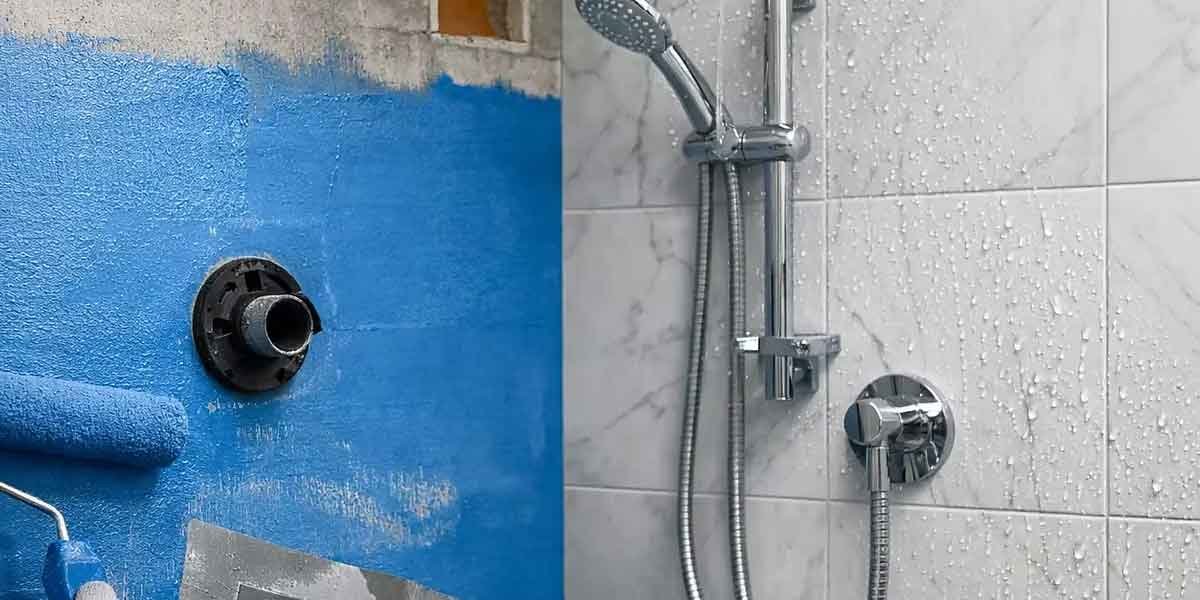

No product sold as waterproofing paint for shower walls is waterproof enough to be the finish. The coatings qualified to stop water there are liquid and sheet membranes rated to ANSI A118.10, and every one of them belongs behind tile, stone, or a panel.
Sales copy folds three different products into one phrase. There is the membrane that waterproofs a shower, the mildew-resistant paint that keeps a humid wall from turning black, and the epoxy refinishing coating sold to cover old tile. The can in your hand may not say which of the three you bought, and the difference decides whether the wall behind it survives.
Can You Use Waterproofing Paint for Shower Walls?
No. Nothing sold as paint is qualified to be the exposed finish on a surface that takes direct spray, weekly scrubbing, and standing splash. A coating can go on a shower wall only when it is a membrane rated to ANSI A118.10, and it gets covered afterward.
The rating matters more than the wording on the front of the container. TileLetter, the Tile Council of North America’s own publication, describes the A118.10 membrane, sheet or liquid-applied, as a layer that must be continuous through every change of plane and run from the drain to the full height of the tile assembly (TileLetter). The waterproofing sits under the tile. The tile is the wear surface.
What the A118.10 Rating Actually Covers
Custom Building Products publishes RedGard’s coverage in four listings, and the numbers do not match. A gallon covers 100 sq ft as a crack-prevention membrane, 25 sq ft where the listing carries ANSI A118.12, 55 sq ft as a waterproof membrane, and 40 sq ft as a pan liner meeting ANSI A118.10 (Custom Building Products). Four numbers, four tests.
Reading which figure belongs to which listing tells you what a coating was tested to do. A can with a bold waterproof claim and no ANSI line has told you nothing about a shower.
Where the Wet Zone Ends
The same TCNA detail puts a hard edge on the work. The membrane must continue one foot beyond the immediate shower area, stopping at the tiled boundary, so splash landing outside the enclosure is still covered.
Past that line, the surface changes character. A wall that receives humid air and an occasional spray dries between uses. A wall inside the spray path does not, which is why one finish works outside the enclosure and the other one belongs inside it.
Why Mildew-Resistant Bath Paint Fails Inside the Enclosure
Bath paints are decorative, vapor-permeable films built for humid air. Zinsser’s data sheet for Perma-White, a mold and mildew-proof interior paint, states that the product is not intended for any surface subject to immersion or prolonged contact with water, including shower enclosures, saunas, or steam rooms.
The limitation sits in the same document as the drying times. Perma-White dries to the touch in 30 minutes and can be recoated after two hours, and scrub resistance builds over five to seven days; the sheet then warns against scrubbing the new coating for seven days (Zinsser technical data sheet). A film engineered around occasional washing is being asked to survive a shower.
I found this out on a rental unit of mine. I rolled a mold-proof bathroom paint over the surround to dodge the cost of tile. It looked fine for a season. By the second winter the lower foot of each wall had blistered off the substrate and the board behind it had gone soft. Nothing about that failure was a defect. It was a latex film being wet most days.
The EPA’s mold guidance rests on one rule, that mold does not grow without water, and it tells homeowners to dry water-damaged areas within 24 to 48 hours to keep growth from starting (EPA). A shower wall is soaked for twenty minutes a day and never gets that drying window. The wall cavity behind it gets even less.
Fans and squeegees help, and they do not change the specification.
The Ceiling, the Curb, and the Wall Above the Tile
A shower ceiling usually sits outside the spray path, so a mildew-resistant bath paint is the ordinary finish up there. The surface collects humid air and condensation instead of a directed stream, and it dries between uses.
Change the fixture and the specification changes with it. A rain head or a ceiling-mounted unit puts the ceiling in the wet zone, where it needs the same membrane and nonabsorbent face as the walls.
What to Buy Instead
Choose by what the surface does, not by what the can says. Direct-spray walls and the shower floor need an ANSI A118.10 membrane under tile, stone, or a factory panel. Walls beyond the spray path take a mildew-resistant bath paint. Refinishing coatings that cover old tile are cosmetic repairs with no waterproofing role.
Direct-Spray Walls and Floors
Oatey describes the liquid option plainly, as painting a waterproof membrane directly onto the surface to be tiled (Oatey). The coating goes on the wall, and the tile goes on the coating.
A sheet membrane does the same job with a different application method: it is bonded with thin-set and its seams are lapped to the width the maker prints on the roll. Either system ends at the same place, an assembly that is watertight before any finish material arrives. Mike O’Neil, a tile installer on the This Old House accessibility project, put it this way about a completed membrane over a foam tray and walls: “you can actually take a shower in this when it’s all waterproofed and done without any tile” (This Old House).
Humid Walls Outside the Spray Path
Bath paint earns its place on the walls a shower humidifies but does not soak. The failure mode there is surface mold fed by condensation, and a mildew-resistant coating plus an exhaust fan that actually moves air solves it.
How Much Membrane One Shower Takes
At the RedGard waterproof-membrane rate of 55 sq ft per gallon, a 60-by-32-inch shower with walls carried to 80 inches comes to 69 sq ft of wall around 13 sq ft of floor, or about 82 sq ft of membrane surface. That is one and a half gallons of material for a standard enclosure, so two pails, and the second pail is not spare capacity.
Six Ways a Shower Membrane Fails
Verify the membrane, not the finish. Oatey’s list of shower failures names the pre-slope left out, non-waterproof backer board used behind the assembly, membrane coverage that stops short, punctures from fasteners, missing dam corners where a liner turns a curb, and a flood test that never happened.
The order of the work carries as much weight as the materials in it, and the full sequence for a walk-in unit is set out in the walk-in shower waterproofing checklist.
The flood test is the one a homeowner can insist on. Oatey’s instruction is to fill and hold the pan before tile goes down, so leaks show up while the waterproofing is still accessible. Fastener penetrations are the other item worth watching, because a screw through a membrane is a hole that no coating on top of it will close. All six failures are invisible from inside the shower once the tile is set. The evidence turns up on a baseboard in the next room, in a soft spot outside the enclosure, or on the ceiling below.
FAQ
Is there a waterproofing paint for shower walls that works?
There is no brand, because waterproofing paint for shower walls is not a product category that manufacturers stand behind. Coatings for that wet surface are qualified as membranes under ANSI A118.10, and those films are covered by tile or a panel.
What is the best waterproof bathroom paint for tiles?
A coating applied over existing tile is a refinishing product, and it works on the scrubbing and staining that old grout shows. Waterproofing for tiles is a separate layer underneath them, and that layer is a membrane, applied before the tile.
How do I waterproof a shower ceiling?
Most shower ceilings need a mildew-resistant bath paint and ventilation rather than a membrane, because humid air and condensation are the exposure. A ceiling-mounted showerhead puts the same surface in the spray path and moves it into the membrane specification.
How do I waterproof my bathroom?
The wet zone takes a continuous ANSI A118.10 membrane from the drain to the full height of the tile assembly and one foot past the shower area. Walls outside that zone take a mildew-resistant paint, and the room needs air movement to dry out between showers.
Before money changes hands, open the technical data sheet for whatever is in the cart and look for the ANSI A118.10 line. A coating whose sheet carries that listing for a wet-area use has been tested for the surface; a coating whose limitations section names shower enclosures has already answered the question.