EPDM Membrane: What it is, Types, Properties, and Installation

EPDM membrane is a synthetic rubber waterproofing membrane made from ethylene propylene diene monomer. It forms a continuous, flexible, and water-tight barrier that resists moisture ingress, weathering, and ozone exposure. EPDM membranes are mainly of 3 types. They are fully adhered, mechanically fastened, and ballasted membranes. EPDM membranes have higher thickness, durability, UV resistance, and lower breathability, which are the most important properties as a waterproofing membrane.
You should install EPDM with 75-100 mm (3-4 in) seam overlaps and 150 mm (6 in) at terminations, prime both surfaces at 6-8 m²/L (150-200 ft²/gal) with 5-15 minutes flash-off, and apply only when temperatures stay above 5 °C (41 °F), ideally 10-30 °C (50-86 °F). Maintain minimum edge heights of 150 mm (6 in) and use seam tapes, pre-molded corners, termination bars, and substrate-appropriate adhesives.
Using EPDM waterproofing membranes, you can waterproof roofs and decks, mainly. When you install an EPDM membrane, you can check the guide here. An installed EPDM waterproofing membrane can be damaged due to human activities and environmental incidents. You can protect the EPDM waterproofing membrane by doing regular inspections, minimizing foot traffic, avoiding chemical exposure, implementing proper drainage systems, applying UV sealants, avoiding sharp objects, and following proper installation methodology. You can use PVC waterproofing membranes instead of EPDM waterproofing membranes.

What is EPDM Membrane?
EPDM membrane is a synthetic rubber waterproofing membrane made from ethylene propylene diene monomer. It forms a continuous, flexible, and water-tight barrier that resists moisture ingress, weathering, and ozone exposure. EPDM maintains elasticity over long periods and performs consistently under temperature fluctuations without cracking or shrinking.
EPDM membranes are mainly of 3 types. They are fully adhered, mechanically fastened, and ballasted membranes. EPDM sheets are commonly available in thicknesses of 1.14 mm, 1.2 mm, and 1.5 mm (45 mil, 60 mil), depending on exposure and load conditions.
EPDM membranes are widely used in flat and low-slope roofs, terraces, commercial buildings, industrial sheds, and pond linings. We recommend EPDM if a structure experiences UV exposure, thermal movement, or long-term water ponding. In Aqviz installations, EPDM performs best on concrete, metal, and timber decks where minimal maintenance and a service life of 30-50 years are required.
What is EPDM Rubber Membrane?
EPDM rubber membrane is a synthetic rubber waterproofing membrane manufactured from ethylene, propylene, and diene compounds. It creates a seamless, elastic, and water-tight layer that blocks moisture penetration while tolerating thermal expansion and contraction. In our Aqviz waterproofing work, we rely on EPDM because it stays flexible in temperature ranges from -40 °C to +120 °C (-40 °F to +248 °F) without cracking or becoming brittle.
What are the 3 Types of EPDM Membranes?
EPDM membranes are mainly of 3 types according to their installation method. They are fully adhered, mechanically fastened, and ballasted membranes.
The fully adhered EPDM membrane bonds to the substrate using contact adhesive applied over 100% of the surface. This system delivers maximum stability, uniform load transfer, and strong resistance against membrane flutter. We use fully adhered EPDM on concrete slabs, plywood decks, and occupied roof areas if long-term durability and clean finishes become priorities.
The mechanically fastened EPDM membrane uses fasteners and plates fixed along seams or perimeter zones while leaving the field loosely laid. This system reduces adhesive usage and speeds up installation on large roof areas. We recommend mechanically fastened EPDM for commercial roofs and metal decks if wind uplift resistance and cost efficiency are key factors.
The ballasted EPDM membrane relies on weight instead of adhesion, using gravel, concrete pavers, or tiles to hold the membrane in place. This method protects EPDM from UV exposure and thermal shock while allowing easy access for future repairs. In Aqviz projects, we apply ballasted EPDM on flat roofs, podium decks, and green roofs if structural load capacity permits.
What Are the Properties of EPDM Membrane?
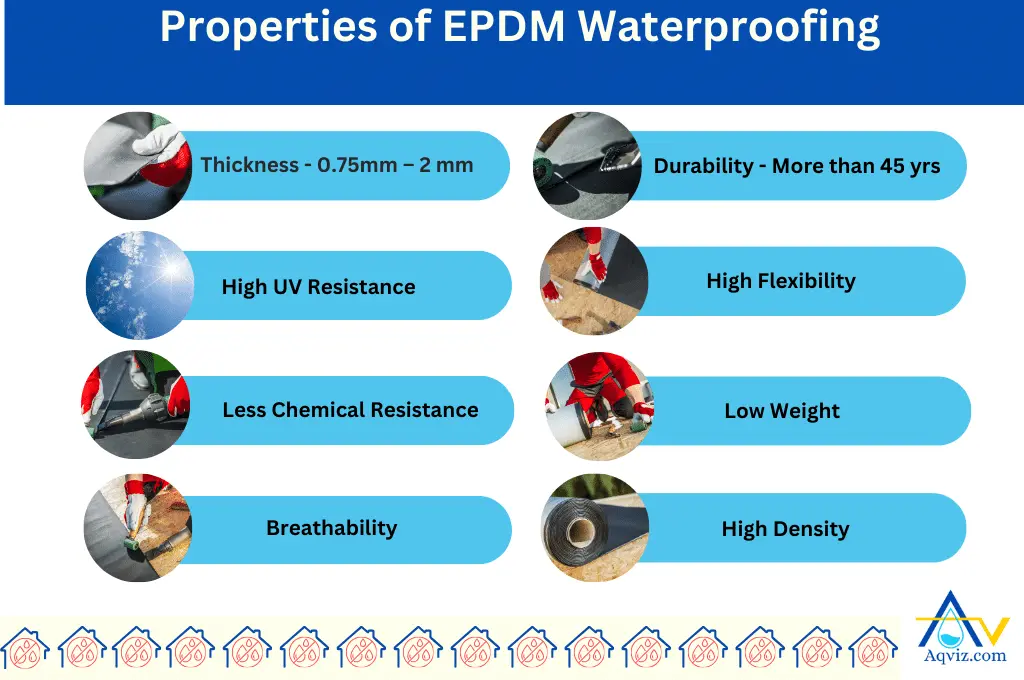
The most important properties of EPDM membranes are thickness, UV resistance, chemical resistance, breathability, durability, flexibility, weight, and density. These properties are highly important as a waterproofing membrane.
What is the Thickness of EPDM Rubber Membrane?
The recommended thickness of the EPDM membrane, according to the ASTM D-142, is 1.37 millimetres. But it is available in thickness between 0.75 mm and 2 mm according to different tasks and purposes. Thinner EPDM membranes are weak at waterproofing, and thicker membranes are more resistant to higher water pressure.
What is the Durability of EPDM Membrane?
The durability of the EPDM membrane is more than 45 years. The durability of the EPDM depends on the weather conditions, sunlight conditions, temperature fluctuation, repair and maintenance, and outer coating that you apply. Hence, EPDM membranes are used for roof and basement waterproofing.
Is EPDM Rubber Membrane UV-Resistant?
Most of EPDM rubber membranes are UV resistant. Therefore, EPDM membranes can be used for outdoor waterproof projects such as roofs, decks, and balconies. The UV resistance of the EPDM helps to prevent decay, and degradable due to UV radiation in the sunlight during the day.
Is EPDM Rubber Membrane Breathable?
Yes, EPDM rubber membranes are breathable. Hence, it can pass vapour water through the EPDM membrane. Due to the breathability of the EPDM waterproofing membrane, it prevents blistering and mold and mildew growth under the waterproofing layer. Therefore EPDM waterproofing membrane on the substrate will be protected over time from moisture.
EPDM Membrane Installation Recommendation
There are 7 key EPDM membrane installation recommendations you should follow for an efficient membrane.
- Lap length: Overlap EPDM sheets by 75-100 mm (3-4 in) for seam tape joints and 150 mm (6 in) at terminations and penetrations.
- Priming: Apply EPDM primer on both mating surfaces at 6-8 m²/L (150-200 ft²/gal) and allow 5-15 minutes flash-off until tacky.
- Installation temperature: Install EPDM if ambient and substrate temperatures remain above 5 °C (41 °F); optimal range is 10-30 °C (50-86 °F).
- Edge height: Maintain minimum vertical upstand height of 150 mm (6 in) above finished deck or roof level.
- Connection methods: Use seam tape for field joints, pre-molded corners for internal and external angles, and termination bars at vertical transitions.
- Adhesive selection: Apply water-based adhesive on porous substrates like concrete and plywood; use solvent-based adhesive on metal and non-porous surfaces.
How to Install EPDM Roofing Membrane?
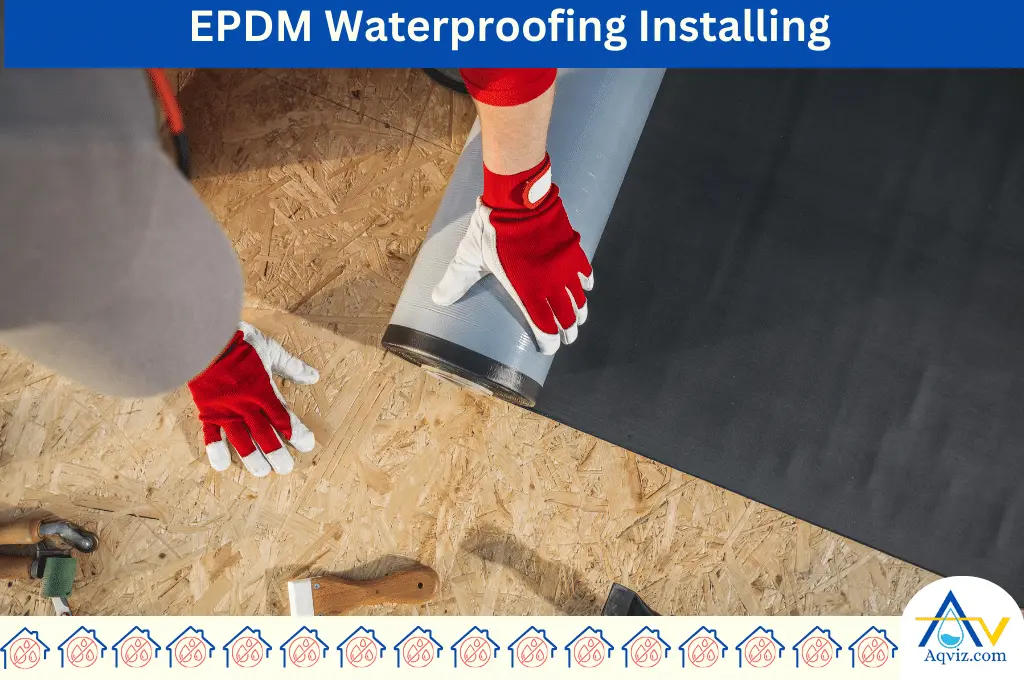
EPDM membrane can be installed on the roof by following these 7 steps.
- Prepare the surface for EPDM membrane: Remove any debris, like screws, nails, wood, dust and oil marks on the roof. If the roof is not clean, the EPDM membrane may not adhere properly.
- Install underlayment before installing EPDM: Install suitable underlayment for the EPDM membranes.
- Unroll and position the EPDM waterproofing: Once you have your EPDM material ready, roll it out onto the surface. Position it correctly and let it relax for at least half an hour.
- Adhere the EPDM membrane: Choose a suitable adhering method for the last long and efficient EPDM waterproofing membrane.
- Seal the seams, corners, edges, and openings.
- Do EPDM quality inspection: After installing the EPDM, check for defects and mistakes.
- Protect the installation: Protect the EPDM layer by following the recommended protection method to last long.
Before you install EPDM membrane on the roof, you should know How to Install EPDM Waterproofing Membrane properly. This guide will help you to do it as an expert.
What Building Components Can I Waterproof Using EPDM?
You can waterproof roofs and decks mainly using EPDM roofing. More than that, EPDM can be used in basements and foundations. EPDM waterproof membranes are water-resistant, UV-resistant, flexible, and durable waterproofing membranes. Hence, it can withstand in high sunlight. Groundwater pressure, wearing and tearing, minor structural movements, and temperature fluctuation in the building components.
EPDM Roofing
EPDM can be used as roofing. EPDM act as a roof waterproofing membrane when it is applied on the flat roof. EPDM roofing is a water-resistant, UV-resistant, flexible, and durable waterproofing membrane with a wide range of temperature fluctuations. Hence, it can withstand the roof under heavy rain, wide temperature fluctuation in the winter season, as well as under heavy sunlight in summer. Due to its lightweight and flexibility, EPDM waterproofing membranes can be installed on the roof with minimal effort.
EPDM Decking
EPDM decking is a rubber-based waterproof decking system that uses EPDM rubber membranes to create a seamless, water-tight surface over decks and flat outdoor structures. It protects the deck substrate from water ingress, UV exposure, and thermal movement while maintaining long-term elasticity. In our Aqviz projects, we use EPDM decking mainly where traditional coatings fail due to standing water or repeated expansion and contraction. EPDM decking is widely used on balconies, roof decks, terraces, podiums, and walkable flat roofs. We recommend EPDM decking if water ponding, UV exposure, or substrate movement becomes a concern.
ASTM Test Methods and Requirements for EPDM Membranes
ASTM test methods are standards developed by the American Society for Testing and Materials in order to establish procedures and guidelines for testing and evaluating the properties of materials and products.
EPDM membrane material properties are tested by ASTM-412, ASTM D-624, ASTM-746, ASTM D-573, ASTM D-1204, ASTM D-471, ASTM D-816, ASTM E-96, and ASTM E-154 test methods. These are the recommended values according to these test methods.
| Physical Property Of EPDM | ASTM test method | Requirement Values |
| Thickness (mm) | ASTM D-412 | 1.37 |
| Hardness | ASTM D -2240 | 60±10 |
| Tensile Strength (MPa) | ASTM D-412 | 9 (min) |
| Elongation Ultimate (%) | ASTM D-412 | 300 (min) |
| Tensile set (%) | ASTM D-412 | 10 (Max) |
| Tear Resistance (kN/m) | ASTM D-624 | 26.27 (min) |
| Brittleness Temperature ( °C) | ASTM D-746 | -45 |
| Heat Aging (166h @ 116 °C) | ASTM D-573 | |
| Tensile Strength (MPa) | ASTM D-412 | 8.30 (min) |
| Elongation Ultimate (%) | ASTM D-412 | 210 (min) |
| Linear Dimensional Change (%) | ASTM D-1204 | ±1 |
| Water Absorption at 70°C 166 hours (%) | ASTM D-471 | 4 (max) |
| Factory Seam Strength (MPa) | ASTM D-816 | 8.8 |
| Water Vapour Permeance (mgpasm2) | ASTM E-96 | 3.50 (max) |
| Puncture Resistance (Kg) | ASTM E-154 | 32 |

How to Damage EPDM Waterproofing?
An EPDM waterproofing membrane can be damaged due to human activities and environmental incidents. As human activities, EPDM membrane can damaged due to wear and tear due to cutting and drilling, exposure to chemicals, incorrect installations, and poor maintenance. The most popular environmental incidents that can damage EPDM membranes are UV radiation, higher thermal fluctuation, wind, higher rainfall, and water pressure.
- Wear and tear due to cutting and drilling on the EPDM membrane: The EPDM membrane can be damaged due to punctures or tears in the membrane. That can wear and tear the membrane as it is prone to leaking water through.
- EPDM membrane exposure to chemicals: The EPDM waterproofing membrane can be damaged or degraded when it is exposed to harsh chemicals.
- Incorrect EPDM installation: Incorrect EPDM installation can cause the waterproofing membranes at the seams and joints. Hence, this can damage the EPDM membrane over time.
- Poor EPDM waterproofing maintenance: Poor waterproof membrane maintenance allows for severe leakages and damage to the membrane.
- UV radiation: EPDM membranes can be degraded due to UV rays when it is open a long time to the sunlight.
- Higher thermal fluctuation: Higher thermal fluctuation of the environment can fatigue the material. When it happens over time, the EPDM membrane can be damaged.
- Higher wind and rainfall: Higher wind can tear the EPDM membrane as it ages. Rainfall can increase the underground water pressure. This causes wear and tear in the EPDM layer.
You can install one of these 10 Waterproofing Membranes if the EPDM membrane is damaged.
How to Protect EPDM Waterproofing?
EPDM waterproofing membranes can be protected by doing regular inspections, minimizing foot traffic, avoiding chemical exposure, implementing proper drainage systems, applying UV sealants, avoiding sharp objects, and following proper installation methodology.
- Do regular EPDM layer inspection: Do regular EPDM layer inspection to identify any signs of damage, such as punctures, tears, or visible wear.
- Minimize foot traffic on the EPDM membrane: Avoid dragging heavy equipment or tools across the membrane during the construction period.
- Avoid chemical exposure on the EPDM layer: Protect the EPDM membrane from exposure to chemicals, solvents, or petroleum-based products that can degrade the material.
- Implement the Proper drainage system around the EPDM layer: Build a properly sloped drainage system around the EPDM membrane to drain away the accumulated water on the surface
- Use UV protection on the EPDM: You can use UV-protection sealant, spray, or coating on the waterproofing membrane to protect it from UV rays.
- Avoid drilling and cutting on the surface: Waterproofed EPDM membranes should be protected by cutting and drilling on the surface. These activities can damage the waterproofing membranes by making holes.
- Follow proper EPDM installation method: You can protect the EPDM waterproofing membrane by following proper manufacturing instructions. This causes more durability of the EPDM membrane.

EPDM vs PVC Waterproofing: What are the Differences?
These are the main 6 differences between EPDM and PVC waterproofing
- EPDM waterproofing membranes are made from a synthetic rubber membrane, while PVC (Polyvinyl Chloride) waterproofing is made from a thermoplastic membrane.
- EPDM and PVC waterproofing both have excellent water resistance
- EPDM waterproofing is more flexible than PVC waterproofing
- EPDM waterproofing has a lower chemical resistance than PVC waterproofing
- EPDM waterproofing has a higher thermal stability than PVC waterproofing
- EPDM has a higher UV resistance than PVC waterproofing