
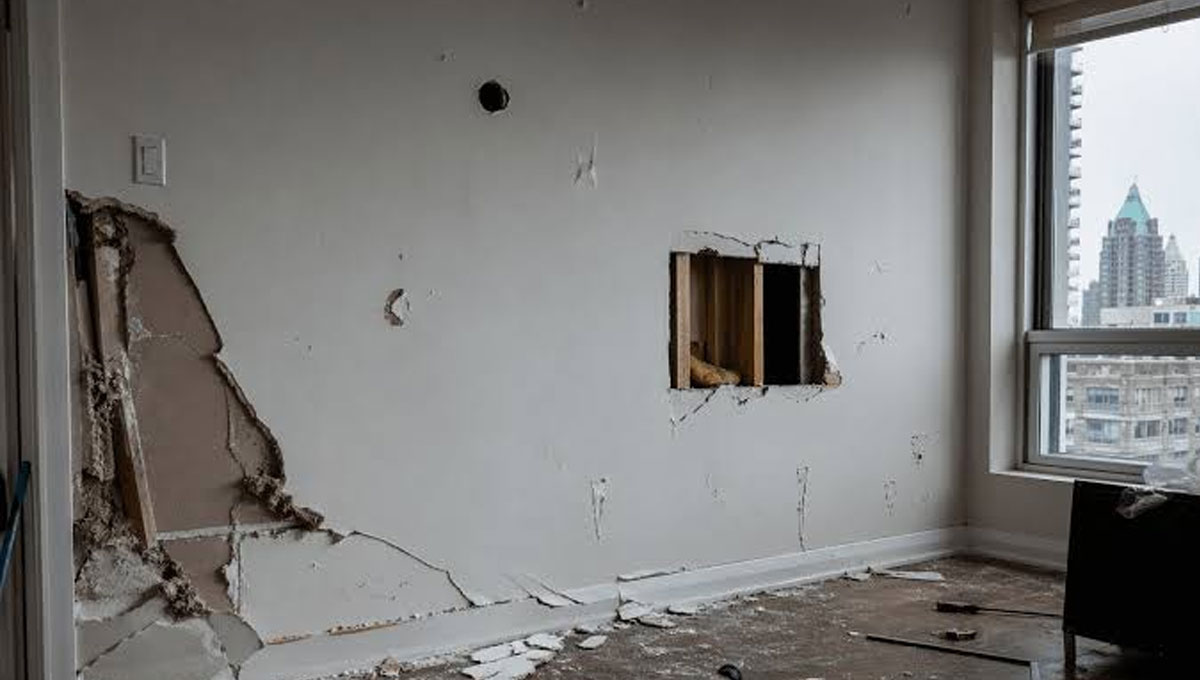

Most people don’t think about their walls until something goes wrong with them. A crack appears above a bedroom door. A faint brown ring spreads across the bathroom ceiling. A small round bump surfaces in the middle of a freshly painted hallway. It’s tempting to file these under “cosmetic” and move on, but drywall is surprisingly good at telling you what’s happening inside your house. Learning to read it can save you money and, occasionally, a far bigger headache.
This matters more in Toronto than in most cities. According to the City of Toronto’s analysis of 2021 census data, about 58% of the city’s households live in dwellings built before 1981, and nearly three in ten live in homes built in 1960 or earlier. Add a housing stock in which 30% of homes are condominiums, plus a climate that swings from bone-dry winters to muggy summers, and you have walls that are constantly being asked to flex, settle and absorb whatever life throws at them.
Here is what the most common problems usually mean, and how to decide what to do about them.
Hairline cracks: usually movement, occasionally a warning
Thin cracks running diagonally from the corners of doors and windows are among the most frequent complaints drywall contractors hear. In most cases they are the result of normal movement. Wood framing expands and shrinks as indoor humidity rises and falls through the seasons, and the corners of openings are where that stress concentrates.
A single hairline crack that stays the same width is rarely cause for concern. The ones worth watching are cracks that keep widening, reappear soon after being patched, or arrive together with doors that suddenly stick or floors that have started to slope. That combination can point to foundation or structural movement, and it should be assessed before anyone reaches for a putty knife.
Nail pops: the drywall’s version of growing pains
Those small circular bumps, often in a neat vertical line, are nail or screw heads pushing through the finish. They are especially common in newer builds and recent additions, where framing lumber is still drying out and shrinking during its first couple of years. They are almost always harmless. The proper fix is to drive a new screw beside the old fastener, set the popped one back below the surface and refinish the spot. Simply smearing more compound over the bump tends to buy you a few months at most.
Water stains: never just cosmetic
If there is one type of drywall damage that should never simply be painted over, it’s a water stain. A yellow or brown ring on a ceiling means water has travelled through the assembly above it, and the stain is usually the smallest part of the problem.
Water is also far more common than most homeowners assume. Allstate Canada’s claims data showed that 42% of the property claims its customers filed between 2019 and 2022 involved water damage, with burst indoor pipes, faulty toilets, sinks, showers and washing machines among the usual culprits. In a Toronto semi or a downtown condo, the source can just as easily be a neighbour’s bathroom as your own.
The real concern is what happens behind the surface. Health Canada points out that mould can grow on drywall and insulation and hide inside walls or above ceiling tiles, and it recommends keeping indoor relative humidity between 30% and 50%. The correct order is always the same: find and fix the leak, let the area dry completely, cut out any drywall that stayed wet or soft, and only then patch, prime and paint. A stain-blocking primer is essential; without it, the ring tends to bleed straight back through fresh paint.
Holes left behind by other trades
A large share of drywall damage in Toronto homes isn’t caused by accidents at all. It’s the aftermath of other work: an electrician running a new circuit, a plumber chasing a leak, pot lights that were relocated, a thermostat or wall-mounted air conditioner that came down. These openings are necessary, but closing them properly is a separate skill. Anything bigger than a few centimetres needs backing or a new piece of drywall screwed in place, followed by tape, several thin coats of compound and careful sanding.
Knowing when to do it yourself
Small nail holes and minor dents are a perfectly reasonable weekend job. Spackle, a putty knife, fine sandpaper and a little patience will get you there. Where most DIY repairs struggle is the finish rather than the patch itself. Feathering compound wide enough that the repair disappears, matching an existing texture, and avoiding “flashing” (the dull or shiny patch that appears when paint sits on unprimed compound) all take practice. On a ceiling, or on a wall that catches low light from a window, every flaw shows.
That is usually the tipping point. If the damage is larger than your palm, involves water, sits on a ceiling, or simply has to be invisible before you list your home, it makes sense to bring in drywall repair experts in Toronto who can handle the patching, sanding and painting in a single visit, rather than coordinating separate trades yourself. In condos especially, one crew working within the building’s renovation hours and elevator bookings makes the whole process far less disruptive.
A few habits that prevent repeat damage
Keep an inexpensive hygrometer in the house and use a humidifier or dehumidifier to stay within Health Canada’s recommended range. Run bathroom fans during showers and for a few minutes afterwards. Fit door stoppers wherever a handle can meet a wall. And when you notice a new crack or stain, take a dated photo. If it changes, you’ll know, and so will whoever comes to fix it.
Walls rarely fail all at once. They send small signals first, and the homeowners who pay attention to them tend to end up with smaller repair bills.