
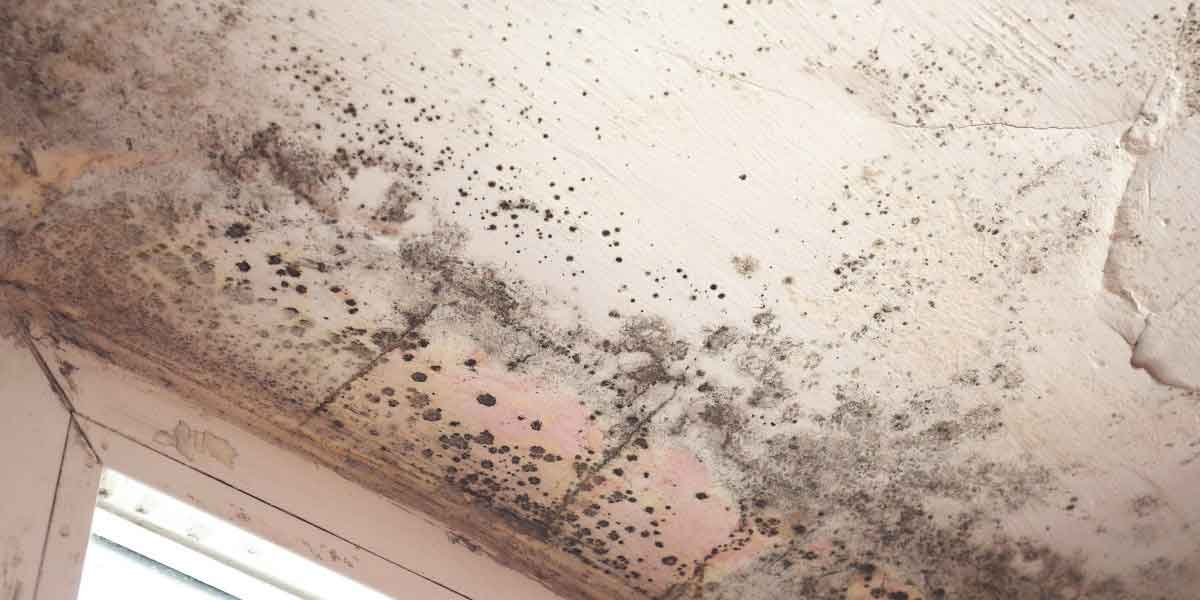

An air quality test for mold counts spores in a measured slug of air and reports them per cubic meter. It describes one room during one hour.
That scope is narrower than the question most people bring to it. A laboratory can put a number on what a cassette caught. Nothing in that number locates the colony, clears a building, or says anything about what someone breathed in over the past month.
Three conditions make the fee defensible: a decision that changes on the result, a sampler who records how much air was pulled, and an outdoor sample from the same day. Without all three, the printout describes a dish, not a home.
What an air sample measures, and what it does not
A spore-trap sample counts fungal spores in a known volume of air and reports the result per cubic meter. It answers one thing well: what was airborne in that room while the pump ran. It does not find the growth, prove a home is clean, or measure what anyone inhaled.
The CDC’s National Institute for Occupational Safety and Health says so on its mold testing page. There are no health-based standards for mold or other biological agents in indoor air, and the agency does not recommend routine air sampling for building air quality evaluations. What occupants react to is not settled either. NIOSH lists mold, compounds mold produces, bacteria-related material, and emissions from building products as candidates, then notes that thorough visual inspection or a musty odor finds trouble more reliably than sampling does.
Time is the second problem. A Minnesota Department of Health guide to testing for mold calls a result a snap-shot of one place at one moment, and warns that airborne counts change widely over the course of hours or less. Can two samples from the same hallway, taken a morning apart, both be right? Yes, and neither of them is wrong.
A negative finding is the one that gets misread. That guidance calls it a serious error to conclude a mold problem does not exist because a test failed to find evidence of it. A cassette that comes back clean has shown that a small volume of air, in one room, at one hour, held few spores. Nothing more follows.
How do you test for mold in the air?
Air sampling draws a known volume of air through a spore-trap cassette at head height, and a laboratory counts what landed on the slide under a microscope. The lab reports spores per cubic meter, read against an outdoor sample collected the same day.
The method is the easy part.
Pump-and-cassette work done without discipline produces a figure that looks like evidence and behaves like noise.
- Pick the room from evidence. Ceiling tile that gives slightly under a thumb, a stain below a window, a musty smell that returns an hour after the exhaust fan has run. Sampling a hallway because it is convenient answers a question nobody asked.
- Sample at the height you breathe. A cassette on the floor or on top of a cabinet measures a different air mass, and the report will not mention it.
- Run the building normally. Doors, HVAC, and ordinary activity keep particles in circulation; a sealed, silent room understates what a Tuesday morning actually looks like.
- Write down the volume and the run time. Those two numbers turn a spore count into a concentration, and they are the fields a report is checked against afterward.
- Take outdoor air the same day, by the same method. The baseline is what gives an indoor figure a scale.
One cassette is one snapshot, which is why investigators who do this for a living take several: suspect room, a control room, and outdoors. A single sample is a data point wearing the costume of a diagnosis.
Three fields that separate evidence from a printout
A lab report is either reviewable or it is a verdict with a letterhead. Three fields separate the two, and a homeowner can check all three without a microscope.
Sampling volume and duration
Concentration equals the spore count divided by the volume of air the cassette pulled. That arithmetic makes volume a first-class number instead of a footnote.
Put a single spore on the slide of a 75-liter sample and it reads as about 13 spores per cubic meter. The same lone spore in a 750-liter sample reads as 1.3. One slide, one technician, an order of magnitude apart, because the denominator moved.
A report that omits volume and run time cannot be checked, cannot be compared with a sample taken next year, and will not survive a landlord or an insurer asking how the figure was produced.
An outdoor baseline from the same day
No indoor space is free of mold spores, per NIOSH, and outdoor air is where most of the indoor load arrives from. That is why a raw indoor figure needs a companion from outside the same building, ideally within a few hours of the indoor draw.
Indoor air at 800 spores per cubic meter is unremarkable beside outdoor air in the thousands. The same 800 is odd beside outdoor air at 40. Identical numbers, opposite conclusions, and the difference is entirely in the second sample. A baseline pulled on a windy afternoon, or the weekend before, is not a comparison; it is a second number.
The method and the lab behind the number
A spore trap counts everything the pump caught, living or dead. Culture plates grow only what suits the agar and the incubation temperature, so viable sampling can miss or undercount a mixed population; the Minnesota guidance points out that non-living mold stays invisible to culture while still contributing to complaints.
For someone deciding whether a cavity is wet, direct microscopic counting is the useful method. A culture report naming three genera has told you less than the spore trap nobody sold you.
Settle plates and the kits on a shelf
A settle plate is an open dish of agar left on a counter. Spores fall in, colonies appear, and within a week the dish is a fuzzy circle.
Nothing in that process measures how much air passed over the agar. No volume means no concentration, and no concentration means no comparison with outdoors, with another room, or with last year. The dish also feeds only the species that like its food.
What a positive plate establishes is that spores were present. Since no indoor space is free of them, a shelf kit sold as an air quality test for mold has confirmed a certainty and charged for it.
The interpretation is where these kits go wrong. A state health department distinction is worth keeping: ordinary spore presence and active indoor growth are different findings, and a colony on agar does not separate them. Neither does a color change on a swab.
When an air quality test for mold earns its fee
An air test of this kind pays when the result changes the next move, and two cases carry that weight: a musty smell with nothing visible to open up, and a clearance record after a cleanup. Everything else usually buys an answer a flashlight already gave.
The first is a smell with nothing to look at. A finished basement that smells musty, no visible growth, no stain anyone can point to: growth hides in wall cavities, on the back of drywall, above ceiling tile, under carpet and pad. A paired cassette, suspect room plus outdoors, can flag a cavity before you open it, and that flag is a reason to open it.
The second is a record. After a cleanup, a clearance sample documents that the work met a bar somebody else accepts: a buyer, a landlord, an insurer handling a claim. The audience is somebody else’s file.
Everything else tends to waste money. Visible growth has already given you the answer, and the health department position is that any indoor growth gets removed whatever the genus turns out to be. A leak you have located needs a repair crew. A symptom you cannot explain needs a physician, because no cassette measures exposure.
One ordering mistake is worth naming. Sampling before the repair is finished measures a building that is still wet, so fix the source and dry the assembly first. NIOSH puts the drying window at 48 hours from the moment materials get wet, and a clearance figure taken against a leaking sill will fail for reasons no pump can fix.
Budget is a separate arithmetic with its own variables, covered in what mold testing in a home actually costs and the four sampling types a report can be built from.
Mold air testing questions
Can you get an air quality test for mold without hiring someone?
Yes. A pump-and-cassette sample sent to a lab returns a spore concentration per cubic meter that can be read against an outdoor sample from the same day. Settle plates sold for home use produce a growth result, not a concentration.
Does a dust score like ERMI count as an air quality test for mold?
No. An ERMI or HERTSMI-2 figure is computed from one settled-dust sample analysed by DNA methods, and no air passes through a cassette to produce it. A dust score describes what has accumulated in a room over months; an air sample describes what was floating during the run.
What are the signs of mold sickness?
No home air test answers that. Complaints blamed on mold overlap with other damp-building exposures, and NIOSH lists mold, its byproducts, bacteria-related material, and building-product emissions as possible triggers of the same symptoms. A clinician evaluates the person; a cassette describes the room.
How can I test myself for mold toxicity?
Household air sampling is the wrong instrument for the body. State health guidance notes that mold tests cannot measure how much of anything occupants were exposed to, so a spore count has nothing to match against a person. Exposure questions belong to a doctor. A cassette run in October describes October.
