
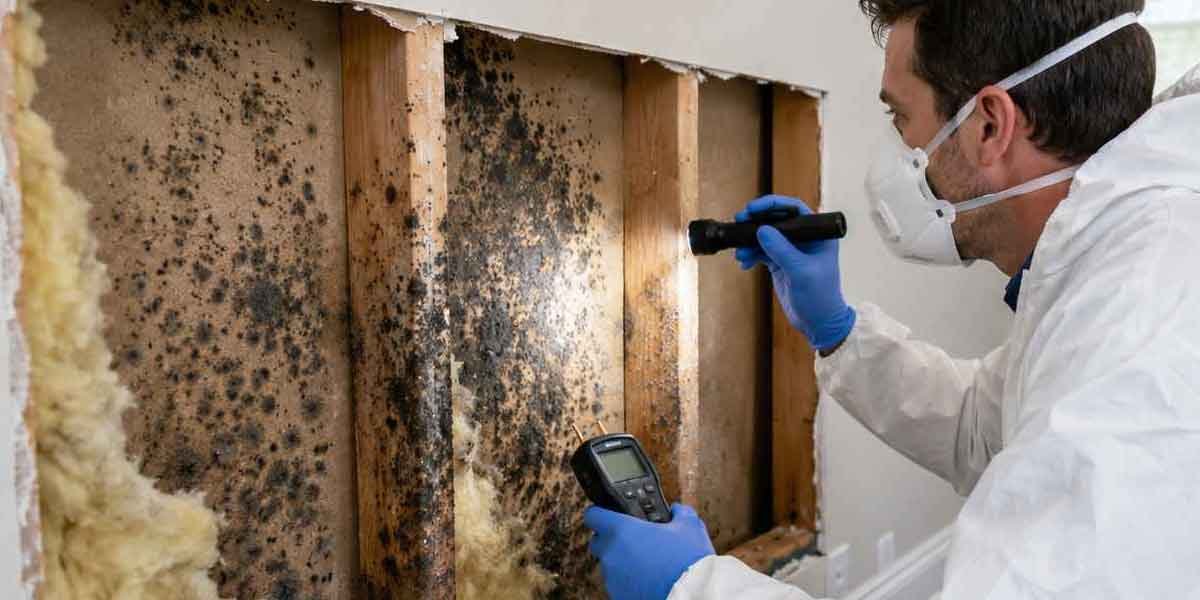

Mold behind drywall usually costs the board. Gypsum soaks up a leak, the paper facing feeds what grows, and no spray reaches the far side of the panel.
That sounds worse than it is. A utility knife and two hours settle the board. A leak that drips into the same cavity for a week settles the framing behind it.
The EPA home guide puts the drying window at 24 to 48 hours for water-damaged materials. Inside that window mold mostly does not start. Past it, the growth is already in the paper.
Read the panel with a meter before you call anybody. Then decide with numbers.
The paper facing is the food
Drywall is a mineral core wrapped in paper. The core offers mold nothing. The facing, the joint compound, and the household dust stuck to both are organic, and the EPA notes that molds grow on virtually any organic substance as long as moisture and oxygen are present.
Growth on a porous material does not stay on its surface. The EPA remediation guide says mold can fill the empty spaces and crevices of porous materials, which makes it difficult or impossible to remove completely.
That is why a scrubbed panel comes back. Cleaning moves what sits on the paper. It does not reach what has grown into it.
A pin-type moisture meter tells you how far the wet zone runs. Press the pins into the panel at the stain, a foot past it, and past that again. The reading holds high beyond the discoloration more often than not, and that is why a cut line lands wider than the stain.
Two construction details make this worse in ways that are easy to miss. Vinyl wallpaper over drywall and wood paneling both act as vapor barriers, and the EPA points out that they trap moisture underneath, feeding growth on the back of the board in rooms that never looked damp.
Mold behind drywall without a stain on the paint
Two conditions justify opening a wall: a moldy smell with no visible source, or known water damage plus people reporting symptoms. Stains, bubbling paint, and allergy complaints are prompts to go looking, not proof of what is back there.
EPA states the suspicion rule plainly. You may suspect hidden mold if a building smells moldy and you cannot see the source, or if you know there has been water damage and occupants are reporting health problems.
Everything else on the usual checklist is weaker evidence. A brown ring can be a water stain with nothing growing on it. Paint that bubbles along a joint usually means moisture moved through, not that growth is present.
Run a palm along the baseboard cap on a cold morning. A cool, damp strip above the trim with the paint still intact is where winter condensation shows up first, and it is a different repair from a supply-line leak.
Faceplates are the cheapest inspection point in the house. Pull a switch plate on an exterior wall and look at the paper behind it. The cavity is right there, and the cover hides a color change that the painted surface will not show for months.
One warning belongs here. Poking a hole through a suspected area to check releases spores into the room, and peeling wallpaper off a moldy substrate can release a large amount of them. The EPA guide says investigating hidden mold needs respiratory protection, and that when you expect hidden growth, an experienced remediator is the safer route than a knife.
When mold behind drywall passes ten square feet
Size decides the equipment, and the EPA publishes the tiers. Under about 10 square feet, roughly a 3 ft by 3 ft patch, most homeowners can handle the cleanup. Above that, or with heavy water damage behind it, the remediation guide applies even in a house.
That guide splits the work three ways.
- Up to 10 square feet. Gloves, goggles, an N-95 respirator, and sealed bags for the debris. No containment for a small isolated patch.
- 10 to 100 square feet. Limited containment: one layer of 6-mil fire-retardant polyethylene, a slit entry with a covering flap, supply vents and doors sealed, and the enclosure held under negative pressure by a HEPA-filtered fan vented outdoors.
- Over 100 square feet. Full containment: double layers of polyethylene plus a decontamination chamber or airlock big enough for a waste container and for putting PPE on and taking it off.
The negative pressure test costs nothing. Poly sheeting should billow inward on every surface. If it flutters or bulges outward, containment has failed and the work stops until you find the gap.
Here is the part almost nobody quotes. The EPA says those area tiers exist so a remediator can pick techniques, and states outright that they are not based on health effects or on research showing a particular method is right at a certain number of square feet. Ten square feet is an equipment line.
The full chapter is worth an hour before a 60 square foot job: Mold Remediation in Schools and Commercial Buildings, Chapter 3.
Debris handling is where amateur jobs leak. Cut sections go straight into sealed bags while you are still in the work area, and heavy pieces get wrapped in polyethylene and taped before they leave the room. Carrying an unwrapped panel down a hallway spreads exactly what the containment was built to hold.
Check the end point before you start, because it is not “looks clean.” The EPA’s list runs: moisture problem fully fixed, no visible mold and no moldy odor, a return visit showing no new signs, and occupants able to use the room again without complaints.
Bleach, spray-on treatments, and paint over the stain
EPA does not endorse bleach for this work. Its guidance says a chemical or biocide that kills mold, chlorine bleach named as the example, is not recommended as a routine practice during cleanup, with a narrow exception where professional judgment calls for it.
The reason is mechanical rather than chemical. Dead mold may still cause allergic reactions, so killing it is not enough; it has to come out.
Killing also leaves the moisture untouched, and without that fix the growth returns. Spraying a panel and closing the wall buys a season at most.
Painting over it is worse. The guide is direct that paint applied over moldy surfaces is likely to peel, which turns a hidden problem into a visible one after the room has been repainted.
The methods that do work are unglamorous. A wet vacuum only while material is still wet, never on gypsum board. Damp wiping with water or water and detergent on hard surfaces, then fast drying. HEPA vacuuming last, once debris is gone and surfaces are dry, with the filter bagged and thrown out.
One safety line gets skipped in most how-to videos. Never mix a chlorine bleach solution with cleaners or detergents that contain ammonia, because the fumes are toxic.
One number decides whether the repair holds through next winter. The EPA home guide puts indoor relative humidity below 60 percent, ideally between 30 and 50, and mold will not grow on dry material even when spores are present.
A basement that needs repainting every spring is reporting that humidity number, not asking for paint.
Sampling tells you less than a moisture reading
Sampling is usually unnecessary when visible growth is present, and that is the EPA’s own position rather than a shortcut. It becomes worth considering in a few cases: litigation, a source nobody can locate, health concerns under a doctor’s care, or a post-remediation check on whether cleaning worked.
What sampling cannot do is certify a room. No EPA or other federal threshold limits have been set for mold or mold spores, so a sample cannot be used to check a building’s compliance with federal mold standards.
That gap explains the odd reports homeowners end up holding. Species names, a spore count, no legal limit to compare them against, and a conclusion written by the company that was paid for the test. The EPA’s yardstick is comparison instead: after remediation, indoor air should resemble local outdoor air in the types and concentrations present.
A meter costs less and answers the question that matters. The EPA home guide lists humidity meters at roughly $10 to $50 and N-95 respirators at about $12 to $25, which is a fraction of one lab analysis.
When the source of mold behind drywall stays unclear after the wall is open, the next decision is which test can answer something real. The line between a useful sample and a decorative one is drawn in mold testing in home.
Questions after the cut
Is mold behind drywall harmful?
It can be. EPA lists allergic reactions such as sneezing, runny nose, red eyes and skin rash, asthma attacks in people allergic to mold, and irritation of eyes, skin, nose, throat and lungs. Symptoms outside those categories are not commonly reported from inhaling mold, according to the same guide.
Can you kill mold without removing the drywall?
Killing it does not finish the job. Dead mold stays allergenic, and on a porous panel the growth has already moved past the surface, so contaminated board is usually removed rather than treated.
How do you get rid of mold behind drywall?
Fix the moisture source, cut out the affected board inside a contained work area, bag the debris before it leaves, then dry and HEPA vacuum the cavity. Above 10 square feet, containment and respiratory protection get more involved.
What are the 10 warning signs of mold toxicity?
No federal agency publishes that list. EPA describes allergic and irritant symptoms, notes that other symptoms are not commonly reported from inhaling mold, and sends anything beyond that to a doctor. A ten-item symptom checklist is a marketing format, not a diagnostic standard.
The meter reading is the cheapest purchase in this sequence and the one that sets the scope of everything after it. Photograph the panel with the meter in frame before the cut, and again once the cavity has run dry.
If the numbers will not come down after the leak is fixed, stop drying and start looking for the second source.