
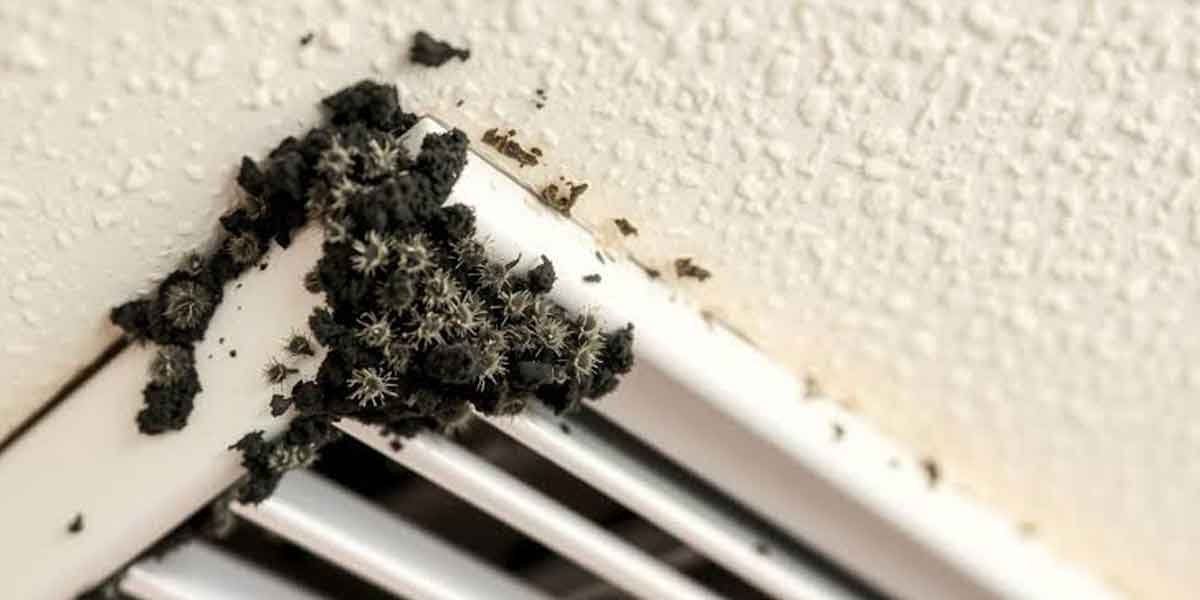

Most mold in air ducts grows from condensation, not from dust, and that single fact decides where your money should go.
EPA treats duct cleaning as an as-needed job. Its guidance states that duct cleaning has never been shown to actually prevent health problems and that the agency does not recommend cleaning air ducts routinely, only when the system meets specific conditions.
So before anyone starts scrubbing, the water has to be located.
When Mold in Air Ducts Actually Calls for Cleaning
EPA names three conditions that justify cleaning a system: substantial visible mold growth inside hard-surface ducts or on other heating and cooling components, ducts infested with vermin such as rodents or insects, and ducts clogged with enough dust and debris that particles are released from the supply registers, as set out in EPA’s air duct cleaning guidance.
The qualifying list, in the agency’s own words:
- Substantial visible mold growth inside hard-surface ducts, or on components such as the cooling coil or the drain pan.
- Ducts infested with vermin.
- Ducts clogged with excessive dust and debris, with particles coming out of the supply registers.
Everything outside those three is a judgment call, and EPA lands on the side of leaving the ducts alone.
When Cleaning Is Probably Money Gone
If nobody in the house reports allergies or unexplained symptoms, and a look inside the ducts turns up no heavy deposits of dust or mold, no musty odor, and no visible growth, EPA’s own conclusion is that cleaning is probably unnecessary. Dusty return grilles are normal, because the grate is the first thing returning air passes through, and a vacuum attachment deals with that in minutes.
Grime on a grille says nothing about the condition of the run behind it. The parts worth inspecting sit further in: the air handler, the coil, the pan under it.
Confirm What You Are Looking At
Ask for proof before you agree to remediation, because the burden should not sit with you. EPA advises homeowners to have the contractor show the mold or biological growth they claim to have found, and then either get laboratory confirmation or rely on their own judgment about what they can see. That call is the same one covered in when mold testing is worth paying for.
A photograph of a dark patch near a vent confirms very little. A duct that hides behind a finished ceiling is worth a sample; a stain on a grille is worth a screwdriver.
Where the Water Comes From in an HVAC System
A cooling coil sits below the temperature of the air moving across it, and EPA points at condensation on or near that coil as a major source of moisture contamination in a forced-air system.
Condensation forms whenever a surface is colder than the dew point of the air around it, which on a humid day describes the coil and the first stretch of supply duct running out of it.
An oversized air conditioner makes the problem worse, and the reason is mechanical. A unit that is too big satisfies the thermostat quickly and shuts down before it has pulled much water out of the air, so the humidity it was supposed to remove stays in the house.
Ducts running through an attic or a crawl space open a second path. Where the outer insulation is torn or has been damp, the metal underneath sweats in summer and the wrap stays wet. EPA’s instruction is that ducts in non-conditioned spaces be sealed and insulated to prevent exactly that.
Two weeks away in July, the thermostat set high and the doors closed, and the return grille smells like a wet basement when you walk back in. The first cool air pushes the same note through every room. Nothing visible is wet.
Water reaching a porous surface starts a clock. EPA gives the mold window as 24 to 48 hours after a leak or spill, so drying is same-day work, not weekend work.
The Duct Material Decides Whether Cleaning Can Work
Sheet metal tolerates brushing and vacuuming. Fiberglass duct board and metal ducts lined with fiberglass do not tolerate biocides, because EPA has registered none for those materials. For flex duct in an accessible spot, EPA’s own note is that replacing it can be more economical than cleaning it.
| Duct material | What cleaning can do | What is off the table |
|---|---|---|
| Bare sheet metal | Soft-bristled brushing with HEPA vacuuming; sanitizers registered for bare metal interiors | Any method that leaves the metal wet |
| Fiberglass duct board | Soft-bristled brushing, following NAIMA practice for fiberglass materials | Biocides; no EPA-registered product exists for this material |
| Sheet metal lined with fiberglass | Soft brushing; replacement gets considered when the liner is damaged | Biocides, and wet cleaning that soaks the liner |
| Flex duct | Soft brushing on runs you can reach | Any real internal cleaning; replacement is often the cheaper route |
When a contractor takes the job, the method has to match the material. EPA expects a provider to follow NADCA standards for duct cleaning generally, and NAIMA recommendations for ducts built from fiberglass or lined with it.
A partial cleaning leaves the system worse off than it found it. EPA warns that failing to clean one contaminated component can re-contaminate the entire system, which erases whatever the rest of the job accomplished.
Biocides, Fogging, and What EPA Has Registered
EPA has registered no biocide for use inside fiberglass duct board or fiberglass-lined ducts, and the products that do carry registration apply to the smooth interior of bare sheet metal. Research has neither demonstrated that biocides work in duct cleaning nor established their health effects.
So what does a homeowner get for the fogging fee? A product distributed through the ducts and out into the rooms, since much of what is sprayed into a running system travels with the air. EPA’s position is that biocides belong in a duct only after visible dust and debris have been removed, if they belong there at all.
Label directions can undercut the whole point. Some sanitizer labels tell the user to rinse with water, and additional water in a duct feeds the growth the treatment was sold to stop.
In a duct, a rinse step adds the moisture mold needs.
EPA’s mold guide goes further and treats disinfectants as something other than routine practice. It does not recommend a chemical or biocide that kills mold for regular cleanup, allows professional judgment in specific cases, and warns against mixing bleach with cleaners that contain ammonia.
The Order of Operations After You Find Mold
Shut the system down, find the water, dry the material, and only then decide whether cleaning is warranted under EPA’s three conditions. EPA’s mold guide is explicit that a system known or suspected to hold mold should not be run, because running it spreads spores through the building.
- Turn the system off if contamination is suspected, and leave it off until the affected parts have been dealt with.
- Inspect what is reachable: supply and return grilles, the coil, the condensate pan, and any insulation near the coil. EPA’s coil test needs a flashlight, and light should pass through the coil to the other side when it is clean.
- Dry wet material within 24 to 48 hours of the leak or spill, which is the window EPA gives for preventing growth.
- Hold indoor relative humidity below 60 percent, ideally between 30 and 50 percent. EPA describes the meter that measures it as a $10 to $50 hardware store item.
- Repair the water source before booking any cleaning: the plumbing leak, the pan that no longer slopes to its drain, the torn insulation on a duct crossing an attic.
Standing water or debris in a condensate pan is same-day work, not a note for the next service visit.
My rule of thumb is blunt: if you cannot name the water source, you do not have a cleaning job yet, you have a diagnosis job.
Why Annual Duct Cleaning Is Not Maintenance
EPA does not recommend cleaning ducts on a schedule, only when the three conditions it lists are met. The maintenance routine described in its guidance is narrower and cheaper: drain pans and coils cleaned, filters changed, and fuel-burning equipment inspected before each heating season.
Component cleaning is the one place the research EPA cites shows an efficiency gain, and it points at cooling coils, fans, and heat exchangers instead of the duct runs. Cleaning only the ducts has little evidence behind it.
An annual duct cleaning, then, sells a benefit the agency calls uncertain, while the coil-and-pan work that would justify the visit sits in the same air handler, a few screws away from where the crew is working.
FAQ
What will kill mold in ductwork?
Physical removal plus moisture control. EPA has registered no biocide for fiberglass duct board or fiberglass-lined ducts, does not recommend disinfectants as routine practice, and points out that spraying a running system can carry the product into living space.
Is mold in air vents harmful?
It can be. EPA lists allergens and irritants among the health effects of mold, with hay fever-type symptoms, skin rash, and asthma attacks in people who are sensitized, and notes that identifying the species is not necessary before cleanup. Persistent respiratory symptoms belong with a clinician, not a duct contractor, and EPA treats ductwork as only one of several possible sources of indoor particles.
How do you get rid of mold in air ducts without taking them apart?
Clean the reachable parts and remove the water feeding the growth. Grilles and registers come off, the coil and pan sit behind a service panel, and a moldy duct that is internally lined or made of flex material usually cannot be cleaned in place at all.
What naturally kills mold in the air?
Nothing dependable. EPA’s mold guide treats moisture as the thing to eliminate, adds that a background level of spores will always remain indoors, and states that those spores cannot grow once the damp source is gone.
Replace the filter, clean the pan, and dry wet material inside the two-day window. That covers nearly everything preventative duct work is supposed to accomplish, and it costs an afternoon at most.