
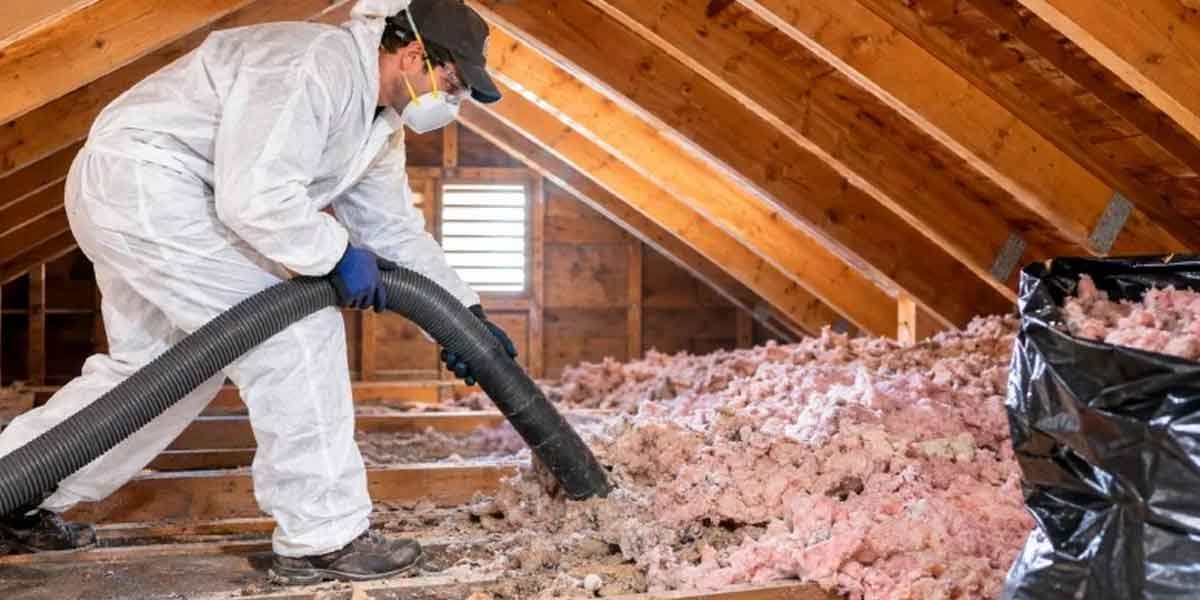

Attic insulation removal and replacement cost lands at $2 to $6 per square foot for most homes.
That figure covers two different jobs: vacuuming the old material out, then blowing a new layer in to the depth your climate calls for. The two are billed on different units, which is where most of the argument starts.
Read enough bid sheets and a pattern shows up. The removal line is the vaguest number on the page, and it is the line homeowners almost never question.
Two neighbors with identical 1,000-square-foot attics can be quoted $1,800 and $4,200 for the same scope. The insulation is rarely the reason.
What attic insulation removal and replacement cost per square foot
Removal is priced at $1 to $3 per square foot of attic floor, and replacement at $1 to $4 depending on material and target R-value. A combined job usually lands between $2 and $6 per square foot, which puts a 1,000-square-foot attic at roughly $2,000 to $4,500.
Those numbers explain why published ranges disagree so violently. A guide quoting $1 to $1.50 per square foot is pricing removal alone, on a clean, easy attic. A contractor quoting $6 is pricing extraction plus treated blown-in plus containment, and neither figure is wrong.
| Scope | Low per sq ft | High per sq ft | 1,000 sq ft attic |
|---|---|---|---|
| Removal only, clean attic | $1 | $2 | $1,000 to $2,000 |
| Removal with contamination | $2 | $3 or more | $2,000 to $3,000+ |
| Replacement only, blown-in | $1 | $4 | $1,000 to $4,000 |
| Replacement only, spray foam | $2 | $5 | $2,000 to $5,000 |
| Removal plus replacement | $2 | $6 | $2,000 to $4,500 |
Angi’s 2026 cost data puts a straight re-insulation at $2,100 on average, with most homeowners paying $1,700 to $2,500, and it carries old-insulation removal as its own line at $1 to $1.50 per square foot.
Buying the two jobs together usually beats buying them apart. A crew already on site preps the attic once, runs the hose once and carries the disposal load out on the same trip, so the removal portion of a full project is often quoted below a standalone extraction.
Labor is the larger half of what you are buying. Homewyse breaks a mid-range attic into 7.5 crew hours at $667 to $851 for labor, before materials, supplies and disposal, and its project totals reach $2,833 to $5,813. A general contractor supervising the work adds 13% to 22% on top of that.
One caution about the unit itself. Per-square-foot pricing is shorthand for an attic the crew can walk, and it holds up on a straight job. It falls apart the moment the access is bad or the old layer is deep, which is why the same published rate produces bids that never match.
Region moves the total through labor rates rather than materials. A crew in coastal California charges more per hour for the same extraction than one in the Midwest, and inspections that run $100 to $300 nationally sit near the top of that range in dense coastal markets.
Blown-in cellulose and fiberglass are the inexpensive route at $1 to $4 per square foot. Spray foam occupies $2 to $5 and folds air sealing into the same pass, which is why some crews push it and others never mention it.
Bad numbers exist.
A licensed contractor answering a homeowner’s question on JustAnswer described an $18,000 quote for 850 square feet of removal and replacement as roughly double the going rate, near $20 to $22 per square foot. That exchange is a few years old and prices have moved, but the shape of the mistake has not.
Why two bids for the same attic differ by 2x
Three variables move the invoice: how much material has to be hauled out, how hard the attic is to reach, and whether air sealing is part of the quoted number. Contamination adds a fourth.
Disposal is charged by volume, not by floor area. A thin layer of settled cellulose leaves in a few dozen bags. Six inches of loose fill in the same attic can triple the trailer load and the tipping fee with it.
Access changes the hours. A pull-down stair into a full-height attic is a straight hose run. A 24-inch hatch into a crawl-height space puts the crew on their knees and adds hose for every foot they move.
Air sealing is the item that hides. Angi prices it at $250 to $750, and the work is real: with the attic floor bare, every gap around wiring, plumbing stacks and wall top plates is reachable. Two bids that look $600 apart are often $600 apart because one crew skipped it.
Contamination is the fourth variable, and it changes what kind of work the crew is doing. Mold, rodent droppings or fire residue turn vacuuming into a containment job with protective equipment, sanitizing and a regulated waste stream.
Crews also disagree about what the word covers. Some vacuum the loose fill and leave old batts sitting between the joists; others pull everything down to the drywall. Ask which one is in the number, because the gap shows up as an extra trailer load and half a day of labor.
Timing moves the price less than homeowners expect, but it changes how much room you have to negotiate. Angi’s booking data shows October and November as the busiest months for insulation installers and April through June as the quietest, which is the window where a removal line is easiest to question.
Run the arithmetic on a 1,000-square-foot attic holding R-11 loose fill about 3.5 inches deep, aiming at R-49. Removal at $1.50 per square foot is $1,500. Blown-in cellulose to reach the target depth adds $1 to $2 per square foot, or $1,000 to $2,000. Air sealing adds $250 to $750. The project lands at $2,750 to $4,250.
Why would the same attic price twice? Five questions answer it before you sign anything.
- Does the bid state a target R-value, or only a depth?
- Is disposal included, and is it charged by volume or as a flat fee?
- Is air sealing inside the total?
- Are roof-edge baffles included so the ventilation path stays open?
- Does the attic hatch get insulated and weatherstripped?
A bid that answers all five has priced the whole job. A bid that answers two is a bid for a different, smaller project.
When you do not need removal at all
Dry, uncontaminated insulation can stay where it is and new material goes on top, because R-values add when layers stack. Removal belongs to material that is wet, moldy, rodent-contaminated, fire-damaged, or vermiculite.
Settling gets misread. Blown-in compacts over decades, and compacted material insulates worse per inch than the same product did when it was fluffy. Add depth and the lost performance comes back. Tearing the attic open first buys nothing extra.
The old layer is usually darker than the day it went in. It lies lower between the joists, some of it drifted into the corners, some of it thin along the hatch path. Nothing about it looks broken.
One physical conflict does force a harder look. Kraft-faced batts installed paper-up, or an attic-side vapor barrier, trap moisture between the old layer and anything stacked on top. Dirt has nothing to do with that problem, and more insulation does not solve it.
Water is the other disqualifier. Insulation that has been wet never recovers its loft. It stays compressed, holds moisture against the roof deck, and keeps feeding whatever the leak started.
Topping off is the cheaper half of the trade. Blowing a few more inches over a clean, dry existing layer is usually priced at $1 to $2 per square foot, so a 1,000-square-foot attic gains depth for $1,000 to $2,000 with no disposal cost attached.
Reading depth and R-value off the old layer
Depth takes a tape measure and nothing else. Push a stiff tape down beside a joist until it touches the ceiling drywall, note where the insulation surface lands, and compare that to the joist height you can see. A photo of the layer next to the tape gives any contractor enough to quote from.
Depth converts to R-value by material. Loose cellulose runs about R-3.2 to R-3.8 per inch when properly fluffed, loose fiberglass closer to R-2.2 to R-2.7, and batts carry the rating printed on the face. Three inches in an attic that once held six is a compressed layer, not a thin new one, and those two behave differently.
Then compare the total with the target for the zone. Cold-climate attics are commonly aimed at R-49 to R-60, the warmest parts of the country can stop between R-30 and R-49. If the existing layer already meets the target and is dry, no project is needed.
Vermiculite and the job a homeowner cannot do
Vermiculite is a loose fill that may contain asbestos, and federal guidance tells homeowners to assume that it does. It is not work for an insulation crew; it needs a licensed asbestos abatement contractor.
The material looks like small gray-brown or silvery pebbles with an accordion shape. Most vermiculite sold in the United States came from one Montana mine that also carried asbestos, and the EPA’s guidance for homeowners is blunt: leave it alone, keep children out of the attic, store nothing up there, and do not attempt removal yourself.
Do not rake through it to check the depth. Disturbing the material is what lifts fibers into the air, and a depth reading is not worth that exposure.
Mixed layers complicate the call. When a newer blown-in layer sits over old vermiculite, identifying what is underneath means working through material that should not be disturbed, and abatement contractors price that with containment in place. Sampling first is the only way to quote it honestly.
The trade distinction matters for the budget. Asbestos abatement runs under a different license and different insurance from insulation installation, so vermiculite cannot be folded into the same line item as the new layer. Expect testing first, then a separate abatement scope, then the insulation work.
Rules on handling asbestos-containing material vary by state, and the licensed contractor who takes that scope carries the compliance work with it.
The federal credit that stopped covering this work
The 25C Energy Efficient Home Improvement Credit no longer applies to insulation placed in service after December 31, 2025. The IRS confirmed the accelerated termination in guidance published on August 21, 2025.
The credit used to cover 30% of qualifying insulation cost, capped at $1,200 a year. Under the One Big Beautiful Bill Act, the IRS states that the credit will not be allowed for property placed in service after that date, so a 2026 attic project should not be budgeted against it. The full table sits in IRS FS-2025-05.
Two boundaries are worth keeping straight. Work placed in service by the end of 2025 can still be claimed on a 2025 return, and state and utility rebate programs were untouched by the federal change.
What replaced the federal credit is a patchwork. State and utility programs vary by region and by year, so the useful check is a call to your own utility rather than any national number.
Frequently asked questions
How much does attic insulation removal and replacement cost for a 2,000 sq ft attic?
A 2,000-square-foot attic typically lands between $2,000 and $8,000 for insulation alone, and removal adds $2,000 to $6,000 when the old material has to come out. Square footage drives that spread more than material choice does.
Can I remove attic insulation myself?
No, and the equipment is the least of the reasons. Vermiculite may carry asbestos, rodent-contaminated material carries pathogens that go airborne once it is agitated, and a commercial HEPA vacuum parked outside is what keeps the debris out of your living space. The honest DIY territory stops well before extraction; clearing access and moving stored items is about where it ends, the same way the DIY line for removing spray foam insulation tends to sit at prep rather than demolition.
Is it worth replacing old attic insulation?
Replacing pays off when the existing layer is thin, wet or contaminated, and rarely when it is dry and already deep. An attic sitting below R-49 in a cold climate usually rewards a top-off; one already at R-49 and dry offers a thin return for a full tear-out.
How much does it cost to remove and replace loft insulation?
In the United States the attic insulation removal and replacement cost ranges from $2 to $6 per square foot. British contractors quote the same job by the square metre, where one square metre covers about 10.8 square feet, so a 50 m² loft works out to roughly 540 square feet of coverage to price.
The order of operations is where the money is. Measure the depth and the current R-value, set the target from your climate zone, and let the removal decision fall out of that number.
