
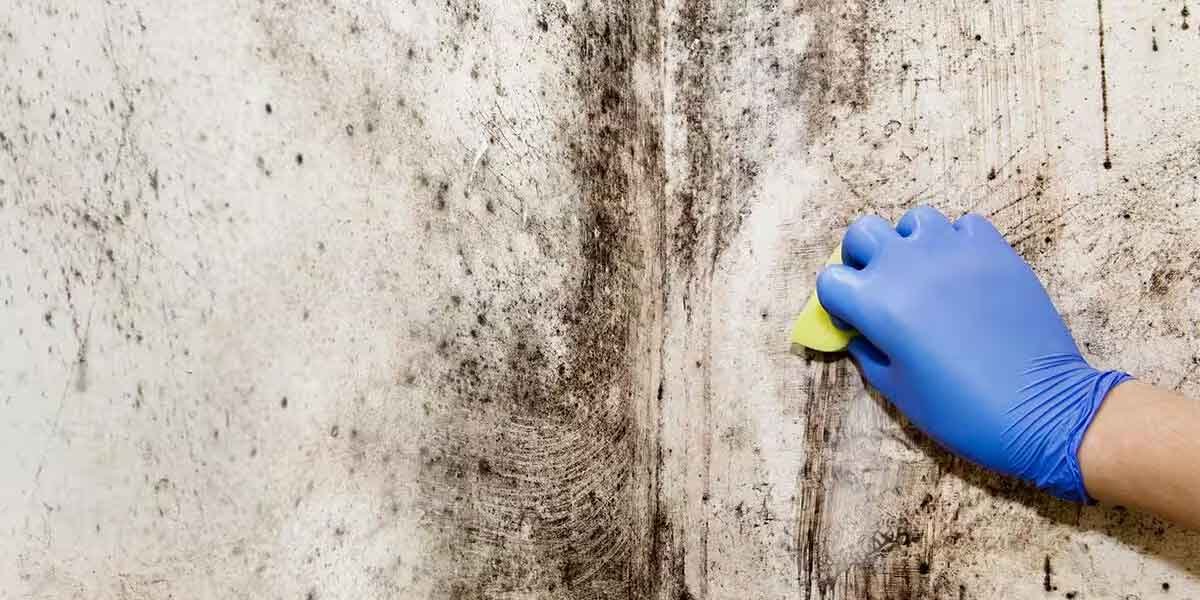

Fix the water source first, then start the black mold removal.
That sequence is the method. Skip it and the same corner goes dark again by summer, because scrubbing removes the growth and does nothing about the moisture that fed it.
The first sign is usually a smell.
A faint damp-cardboard odor at the base of a closet partition shows up weeks before anything turns green-black, and by the time the color arrives the growth has already worked into the paper facing of the drywall.
What decides the size of a black mold removal job
Three variables set the answer, and the visible area is only one of them: how much water damage there is, whether that water was contaminated, and whether the wet assembly can be dried where it stands.
EPA cleanup guidance puts the do-it-yourself line at about 10 square feet of growth, roughly a 3 ft by 3 ft patch. Past that point, or where the water came from sewage or flooding, the same guidance moves the work to a professional. Those conditions override the measurement.
The other two variables are the material and the clock. A four-foot square of staining on glazed shower tile is a two-hour chore. The same square on a gypsum panel that stays damp behind the paint is a demolition job, because the mold is feeding on the panel itself.
Color is not one of the variables, and that catches people every spring.
Fix the source before you touch the growth
Growth cannot be cleaned out of a building that stays wet. EPA treats moisture control as the only durable control there is, which is why the repair comes before the scrubbing: regrowth is governed by water, and cleaning has no effect on it.
Look for the entry point rather than the stain. Water usually lands somewhere other than where it started.
Which of those is it?
- Supply and drain leaks hidden in a wall cavity, which surface a floor below or several feet sideways.
- Roof and flashing failures, where water rides a joist before it drips.
- Condensation on cold supply pipes, window frames, and exterior-wall corners through heating season.
- Groundwater pushing through a basement or crawl space wall, which keeps the bottom foot of drywall damp all year.
A meter reading taken on the material answers faster than air humidity, since a soaked stud cavity does not always change the room reading.
Where a moisture problem never goes away, EPA’s advice is blunt.
Do not install carpet there in the first place.
What to wear, and what to seal off
CDC sets the minimum for anyone doing the work: a NIOSH-approved N95 respirator for light cleanup, a half-face or full-face respirator when drywall is coming out, non-latex gloves, and goggles that seal against the face. Safety glasses with open vents do not qualify, because the particles you are trying to avoid pass straight through them.
Containment does as much work as the mask. Plastic sheeting over doorways and a HEPA vacuum for loose spores keep the rest of the building out of the project, and a box fan in a window should push air outward.
Who should not be in the room
CDC names three groups who should not take part in cleanup at all: people with allergies, people with immune suppression or underlying lung disease, and people with asthma or COPD. In those households the instruction is to stay out of the area, including while a contractor works.
Persistent symptoms after exposure are a medical matter. CDC directs people to a physician, and treats the visible growth as a separate problem with a separate fix.
Match the cleaner to the surface
Cleaning products are marketed as though the type of growth were the variable. The surface decides what works, and on absorbent materials most of the popular options are the wrong tool.
| Surface | What the federal guidance points to | Why it works that way |
|---|---|---|
| Glazed tile, glass, metal, sealed concrete | Detergent and water, scrub, dry completely | The growth sits on the surface and lifts off with it; little has soaked in |
| Gypsum board, fiberboard, paper facing | Clean only if the panel is still sound and the source is fixed; replace it if the material is soft, crumbling, or stained through | The panel is the food source, and the colony runs deeper than any spray reaches |
| Carpet, ceiling tile, upholstery | Plan on removal and replacement | EPA notes absorbent materials such as ceiling tiles may have to be thrown away |
| Previously painted or caulked surfaces | Clean and dry fully before repainting or re-caulking | Paint applied over a moldy surface is likely to peel, taking the repair with it |
Bleach is the default answer on most cleaning shelves, and it is narrower than the label suggests. CDC’s limit is 1 cup of bleach per gallon of water, never mixed with ammonia or another cleaner, and the target is a hard surface where the stain itself is the problem.
Vinegar and hydrogen peroxide are the other two names in circulation.
Both work on a tiled surface film. Neither appears in the cleanup instructions from CDC or EPA for building materials, and neither reaches growth that has moved into gypsum.
Why bleach disappoints on drywall
The wood-pulp core of a gypsum panel is porous, so liquid penetrates a fraction of an inch while the colony keeps going behind it. What changes is the surface color.
That mechanism explains the most common disappointment in the process: a wall that looks clean in April and is mottled again by June.
When the material has to come out
Damaged material gets pulled, not rinsed. EPA treats moldy carpet and ceiling tile as items that may have to be discarded, and gypsum joins that list once it has gone soft, because a paper facing that has been wet this long does not dry back to anything worth painting.
Order matters more than force here. Debris goes into bags inside the containment and comes out through the doorway already sealed, working from the far corner back toward the opening so nothing clean gets dragged past a colonized stretch.
Whatever a bag cannot hold ends up in the air. That is what the respirator and the outward-facing fan are for.
Drying decides whether it comes back
The cleaning is the visible half of the work. EPA sets the other half by the clock: wet or damp building materials need to be cleaned and dried within 24 to 48 hours to prevent growth, and indoor humidity should be held in the 30-60% band afterwards.
Two days is not much time for a wall cavity.
Air movers and a dehumidifier sized for the room do work that open windows cannot. That matters most in a climate where outdoor air is already saturated.
By the second day the panel feels dry to the hand and still reads wet two inches in. That gap is why a meter matters more than a palm. It is also why the paint goes on after the reading rather than after the feel.
The room smells neutral again around the same time the baseboard stops feeling cold. Not proof of anything, just the point where the fan can come down.
EPA’s warning about coatings belongs at this stage.
Product applied over a surface that is still damp or still colonized will peel, and peeling paint turns a cleaning task into a repair.
Does black mold mean toxic mold?
No. Species identification is not part of a cleanup decision, and CDC says so directly: it is not necessary to determine what type of mold is growing in a home, because all molds should be treated the same with respect to potential health risks and removal.
Stachybotrys chartarum is the species behind the reputation. It is greenish-black, it grows on high-cellulose material such as fiberboard, gypsum board, and paper, and it needs constant moisture to establish itself. A suspected link to infant pulmonary hemorrhage has not been proven.
“Mold toxicity” and the “10 warning signs” list that travels with it have no clinical definition behind them. CDC describes mold-related symptoms as nonspecific, which is the practical reason to skip the lab work.
A species report will not change what you do with the wall.
When to hire, and what to ask
Area alone does not make the call. EPA names the cases that go to a professional: growth beyond the 10 sq ft mark or heavy water damage, water from sewage or another contaminated source, a suspected problem in the heating and cooling system, and any household where someone has a health concern.
If the air handler is the suspect, leave it switched off until it has been checked, because running it pushes spores through every room the ducts serve.
Screening a contractor comes down to two answers. Second-guessing a crew on price is less useful than asking which standard they follow, where EPA points to its own remediation guide along with the ACGIH guidelines and IICRC certification, and what number they record to show the assembly is dry when they leave.
Repairing the water source is usually the cheapest line in the budget and the one that decides whether the work holds. Remediation pricing is shaped by containment, air scrubbing, and material replacement, and a basement mold remediation cost breakdown shows how those lines stack up.
FAQ
How toxic is black mold to humans?
No mold species carries a defined toxicity rating. CDC states that no test proves an association between Stachybotrys chartarum and specific health symptoms, and that all molds should be treated the same for health risk and removal.
What are the 10 warning signs of mold toxicity?
CDC publishes no such list, and “mold toxicity” has no clinical definition. The agency describes mold-related symptoms as nonspecific and advises people with persistent symptoms to see a physician.
How long does black mold removal take?
Black mold removal is hours of surface work. EPA’s window for drying wet materials is 24 to 48 hours, and absorbent assemblies that stay damp past that point get replaced instead of cleaned.
Will black mold come back after cleaning?
Only where moisture returns. EPA’s position is that indoor mold growth is controlled by controlling moisture, so an area that stays dry and holds indoor humidity in the 30-60% range has nothing to support regrowth.
The cleaning product is the smallest purchase in the project.
Spend the money on the repair and the dry-out, and take the meter reading before the paint.