
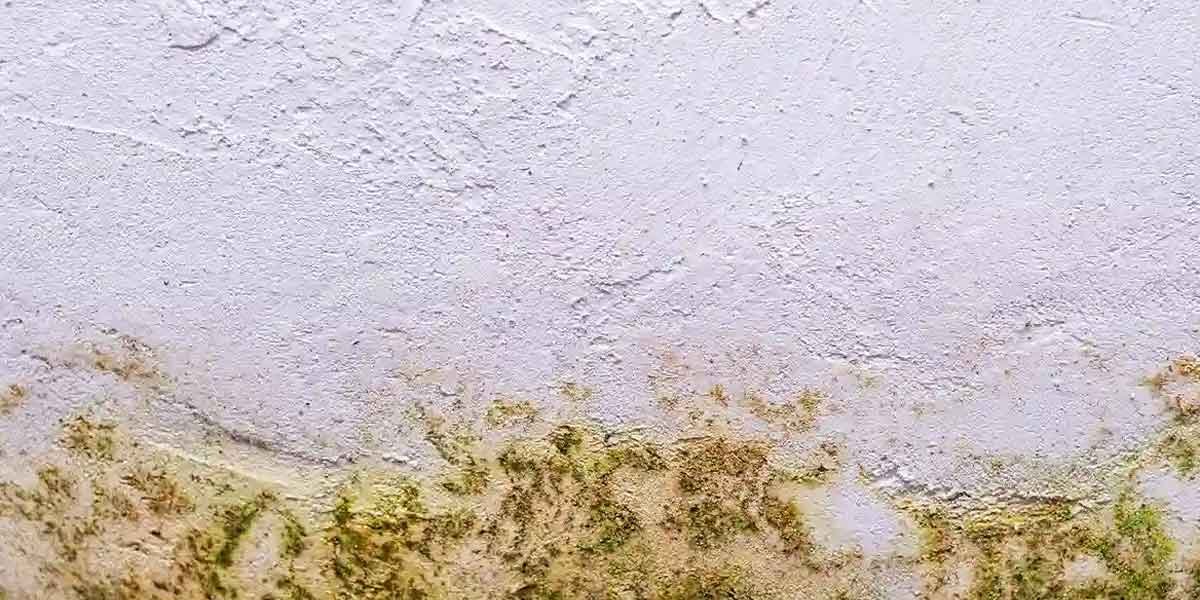

Basement mold paint works as the final coat on a wall that is already clean, dry and closed against water. The U.S. EPA’s mold guide states the order without hedging: do not paint or caulk a moldy surface, because paint applied over moldy surfaces is likely to peel.
Three different products get sold under that one phrase, and they do not swap for each other. One is a fungicidal coating with an EPA registration number printed on the can. One is a primer whose mildewcide protects the dried film and nothing behind it. One is a masonry waterproofer rated in pounds per square inch of water pressure. Buying the wrong one explains most of the repainting that happens down there.
The wall decides which one you need.
The coating is not the fix
Mold needs standing water or sustained damp, and it will not colonize a surface that stays dry. The EPA says the spores “will not grow if moisture is not present,” and that a careful cleanup followed by no water repair ends with the growth coming back.
A mildewcide in a paint film interrupts growth on that film. It does not dry the block behind the film, stop vapor moving through the wall, or close the gap at the cove where the floor meets the wall.
DRYLOK’s own installation notes name one of those gaps. As a concrete floor cures it shrinks and pulls away from the wall, opening a path water can use. No coating on the upper wall touches that joint; a hydraulic cement patch does.
Even the manufacturers split on the order, which is where most confusion starts. KILZ writes on its Mold & Mildew primer page that any existing mold “should be removed before priming and painting.” ZINSSER’s Mold Killing Primer page promises you can “paint directly over existing mold and mildew without extensive pre-cleaning,” then adds a footnote instructing the buyer to fix all moisture issues. The EPA allows no such exception, and the wall does not either.
Three products sold as basement mold paint
Read three things on the can before buying: the active claim, the coverage figure, and the water rating. The active claim tells you what the product is legally allowed to do.
| Product | What the label claims | Label numbers |
|---|---|---|
| ZINSSER Mold Killing Primer | Water-base fungicidal coating that kills existing mold and prevents growth on the film. EPA Reg. No. 87469-1-69587 | 30 minutes to touch, 1 hour to topcoat. Non-porous interior and exterior surfaces |
| KILZ Mold & Mildew Primer | Water-base primer-sealer with an EPA-registered mildewcide that protects the primer film. Existing mold must come off first | 300 to 400 sq ft per gallon. Apply 50 to 90F. New masonry cures 30 days |
| DRYLOK Original Masonry Waterproofer | Masonry coating guaranteed to stop water up to 10 psi. Two coats minimum for the waterproofing warranty | 75 to 100 sq ft per gallon. 1.5 hours to touch, 2 to 3 hours to recoat |
| Watertite Mold & Mildew Proof (oil base) | Film protection against mold and mildew, listed up to 5 years on the retail page. Sold at True Value and independent yards | 75 sq ft per gallon on rough block, 100 on smooth. Dries in 4 hours. $69.99 a gallon |
The first two are interior coatings for surfaces that cannot get wet from behind. The third and fourth are for block that takes water from the soil side. Putting a fungicidal primer on a wall with active seepage burns a weekend: the film blisters, the growth returns, and the EPA’s peeling warning plays out on schedule.
Price does not sort them. The Watertite gallon at $69.99 covers the same 75 sq ft of rough block that DRYLOK covers, and neither one touches drainage. What separates them is the pressure they are rated to hold and how many coats the warranty requires.
The order of work that keeps paint on the wall
Clean it, dry it, then measure
Scrub the growth off hard surfaces with detergent and water, then let the block dry. The EPA gives the drying window as 24 to 48 hours after a leak or spill; past that, mold has what it needs.
The EPA prices a usable humidity meter at $10 to $50, and its reading settles whether the wall is dry and whether the room can keep it that way. The EPA’s target for indoor air is under 60 percent relative humidity, ideally 30 to 50 percent, and it treats condensation on walls, pipes or windowpanes as the visible sign that the reading is too high.
Check what the paint has to grip
KILZ requires a surface that is clean, dry, and free of dust, chalk, oil, grease, wax and loose paint, with the room between 50 and 90F during application. Chalky block is the common failure here, because a dusting of efflorescence looks like a sound surface until the first coat lifts it.
New masonry has to cure at least 30 days before primer goes on. Coating a green wall seals in the water the concrete is still releasing, and that water comes out through the film later.
Two coats, then hunt for pinholes
DRYLOK ties its waterproofing warranty to a minimum of two coats and tells the installer to inspect the whole surface for pinholes after the second one, adding a third coat wherever the film opened. Recoat time is 2 to 3 hours, so a 240 sq ft wall fits in one long day.
A pinhole is not cosmetic. It is a path, and water finds the smallest one first.
When paint is the wrong purchase
Stop coating and fix water in three cases: the wall is wet to the touch, the band of growth returns within a season, or the mold covers more than roughly 10 square feet. The EPA draws the do-it-yourself line at about a 3 ft by 3 ft patch.
Anything larger, or any job that follows heavy water damage, goes to professional remediation in the EPA’s guidance.
Basement mold paint rated to 10 psi is a ceiling. Saturated soil can push harder than any brush-applied film holds, and nothing painted on the inside face relieves that pressure. That is the point where the money moves outside the wall, into footing drainage, grading, downspout discharge or a sump. Interior coatings still have a role after that work, and the masonry waterproofing paint breakdown covers which surfaces they suit.
Condensation is the other pattern, and it is cheaper to solve. Growth near the rim joist, on the upper wall, or around cold water pipes comes from humid air meeting a cold surface, not from water wicking through concrete. Insulation and a dehumidifier address that; paint only hides it for a season.
How much paint the wall actually takes
Work from the coverage figure on the can, because basement mold paint on rough block spreads far thinner than the same gallon on drywall. A 30 ft wall at 8 ft high is 240 sq ft of surface, and two coats turn that into 480 sq ft of coverage.
At DRYLOK’s 75 to 100 sq ft per gallon, that wall takes 5 to 7 gallons. The same wall in KILZ primer at 300 to 400 sq ft per gallon needs about 1.5 gallons for one pass.
Rough block, patched spots and a pitted floor edge all land at the low end of every coverage range. Buy the extra gallon before starting, because a mid-day trip for more paint breaks the recoat window the label specifies.
FAQ
What is the best waterproof mold-proof paint?
No single can is both waterproof and a mold killer, because the two jobs need different films. A masonry waterproofer such as DRYLOK Original handles water pressure up to 10 psi, and a fungicidal primer such as ZINSSER Mold Killing Primer handles growth on the film. On a damp block wall the waterproofer goes on first, and a fungicidal coating earns its place only where the surface cannot take water from behind.
What kind of paint is best for moldy walls?
Clean the mold off first, then prime with an EPA-registered mildew-resistant primer and topcoat with a paint made for the room’s moisture level. KILZ’s instructions require removing existing growth before priming, and the EPA warns that skipping the cleanup ends in peeling. The primer brand matters less than whether the wall can stay dry afterward.
What does mold-deterrent mean on a basement mold paint label?
The claim describes the dried paint film, not the basement. An EPA-registered mildewcide suppresses growth on that film while it stays dry, which is why a bathroom ceiling with an exhaust fan holds up and an unvented corner does not. Mold-proof on a can never means the room is protected.
The gallon is the cheap part of this job. If the same dark band climbs the same block course next spring, the coating did what it was rated to do and the water never left. Spend the next money outside the wall.