
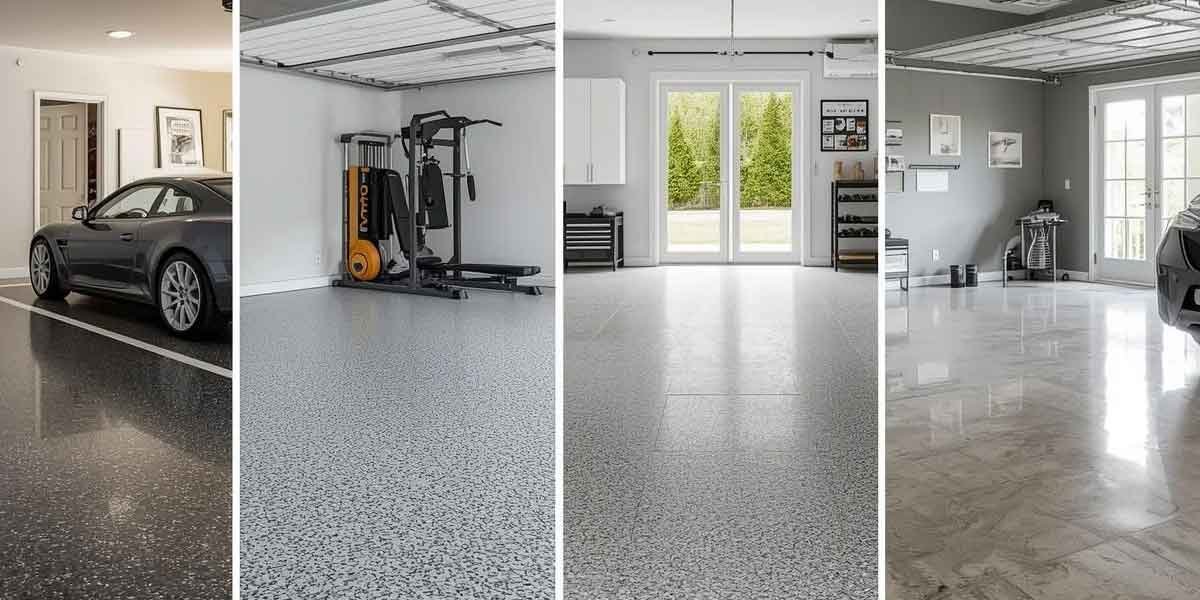

A two-car garage floor typically costs $1,200 to $3,000 installed in the thin-film systems most homeowners buy. Garage floor epoxy cost on a real bid follows what happens to the slab before the resin is ever opened.
The same 400-square-foot slab draws bids two thousand dollars apart, and both contractors are quoting real figures. One is pricing a floor that has been ground open and tested. The other is pricing a floor that has been swept and assumed dry.
What Does Garage Floor Epoxy Cost Per Square Foot?
Installed epoxy runs about $3 to $7 per square foot for water-based systems, $4 to $9 for solvent-based, and $5 to $12 for 100% solids, according to the published price guide from the coating contractor Intermountain Coatings.
| System | Installed price per sq ft | Where it fits |
|---|---|---|
| Water-based epoxy | $3 to $7 | Rental units, light tire and foot traffic, tight budgets |
| Solvent-based epoxy | $4 to $9 | Better flow and penetration, still a thin film |
| 100% solids epoxy | $5 to $12 | Heavier build, better hot-tire and chemical resistance |
| Decorative finishes | Top of the band | Metallic pours, flake and quartz broadcasts under a clear coat |
On a 400-square-foot two-car slab that works out to roughly $1,200 to $2,800 in water-based epoxy and $2,000 to $4,800 in 100% solids, before a single crack is filled.
Decorative work sits at the top of those bands. Metallic pours, flake broadcasts, and quartz finishes add material and hand time on top of the base system.
Contractors quote per square foot because it is easy to compare. The work does not scale that evenly.
What Drives the Price Up?
Preparation carries more of the bill than the resin does. Grinding or shot blasting the slab, testing it for moisture, and repairing cracks and spalls take more crew hours than rolling out the coating, and two bids on the same garage separate right there.
The most expensive quote I have seen land on a residential slab was not the one with the best resin. It was the one where two coats of old paint had to come off first.
Surface profile decides how much grinding
Epoxy bonds by mechanical grip, so a sealed or painted slab has to be opened before any coating goes down. The usual tools are a diamond grinder or a shot blaster, and the target is the roughness the coating maker specifies in its technical data sheet.
The concrete industry grades that roughness on the ICRI concrete surface profile scale, which runs from a nearly smooth CSP 1 up to a deeply scarified CSP 9.
A jug of acid etch opens the surface far less than a grinder does. It gets a thin water-based product to stick on clean, unsealed concrete, and it does very little for a heavy build or a floor that still carries old sealer.
Moisture testing is the line item nobody quotes
Water vapor rising through a slab is the most common reason a garage floor coating blisters and peels within a season, and it is invisible from above. Two standard tests cover it, and both involve attaching or drilling something into the concrete.
ASTM F2170 places in-situ probes in holes drilled into the slab and reads relative humidity from inside the concrete. ASTM F1869 measures the vapor emission rate at the surface using anhydrous calcium chloride.
Manufacturers set their own ceilings, and those limits vary by product, so the figure that matters is the one printed in the data sheet for the coating being installed. A bid that never mentions moisture has assumed the slab is dry, and that assumption belongs to whoever signs the contract.
Cracks, spalls, and the cure clock
Cracks and spalled edges get filled with epoxy mortar before the coating goes down, a separate material on a separate labor line. It shows up on a serious bid and disappears from a lazy one.
New concrete carries its own wait. Coating makers generally call for a slab to cure around a month before it is coated, and most epoxy products want the slab and the air sitting in the low 60s to low 80s Fahrenheit through application and cure. Below that window the reaction slows and the film can stay soft for days.
On a Tuesday morning a bare garage slab looks dry.
After two days of rain, the same slab has a dark patch near the door that sweeping does not touch.
Is DIY Cheaper Than Hiring It Out?
The material is cheap next to the labor. On the AZBilliards garage thread about a 650-square-foot floor, one owner reported about $500 for three epoxy kits and $2,500 for two workers, roughly $3,000 for the finished job.
Another poster in the same thread described two coats plus a clear topcoat for somewhere between $700 and $900 doing it himself.
Hiring buys a grinder, a moisture test, and a crew that has already made the mistakes a first-timer is about to make.
“had 3 boxes of the epoxy kit $500 and paid 2 guys $2500 to do it. they spent day one prepping, day 2 applying. worth every penny.”
AZBilliards Main Forum: typical cost of epoxy coating for a 650 sq ft garage
Quotes on that thread started around $3 to $5 per square foot. A Florida owner reported a 20-by-20 garage in Naples coming in at $3,000 to $4,000 from licensed and insured companies, which is $7.50 to $10 per square foot on a 400-square-foot slab.
Doing it yourself still makes sense on bare, dry, uncracked concrete with a helper, a rented grinder, and a free weekend. It stops making sense the moment the slab fails a moisture reading or the old coating fights back. A floor that lifts has to be ground off and started over, and that bill arrives after the first one has been paid.
What Makes Two Quotes for the Same Garage Differ?
Fixed hours spread thinner as the slab grows. Machinery, diamond tooling, and a crew day cost the same on 400 square feet as on 1,000, so the larger floor carries a lower rate even when the coating system is identical.
Edge length matters as much as area. The stem wall, posts, thresholds, and the apron at the door all get cut in by hand, so a narrow bay with a pillar carries more handwork than an open rectangle of the same size.
Film thickness is the quiet variable. Material is bought by the gallon at a stated coverage rate, and a heavier build consumes more product per square foot, which is why 100% solids quotes sit above water-based ones on the same floor.
Then there is the topcoat.
A clear aliphatic urethane or polyaspartic layer resists the UV yellowing that plain epoxy shows near a sunlit garage door, and it adds both material and another application window to the schedule.
Common Questions About Garage Floor Epoxy Cost
How much does garage floor epoxy cost for a 1,000 sq ft floor?
At $3 to $7 per square foot for water-based systems, a 1,000-square-foot floor comes to about $3,000 to $7,000 installed, and 100% solids at $5 to $12 reaches $5,000 to $12,000. Buying kits instead means working from the coverage rate printed on the label and multiplying by the number of coats, and 100% solids covers less area per gallon than a water-based product does.
What are the disadvantages of epoxy flooring?
A glossy epoxy floor is slippery when wet, it yellows under UV unless a topcoat blocks it, and a thin film can lift under hot tires. It also needs a dry slab and a temperature window to cure, which rules out a cold-weather install without heat.
Does epoxy flooring increase home value?
No appraisal formula has a line for a coated garage slab. Buyers read the space as cleaner and more usable, and a floor that is intact supports that read, but a coating is a usability improvement rather than a measured return.
Is epoxy coating in a garage worth it?
Epoxy coating pays off when the slab passes a moisture test and the prep budget is real. Keeping a coated floor clean takes less work than scrubbing bare concrete that has taken in oil, road salt, and snow melt, and that is the return most owners actually collect.
Before signing anything, ask what the prep line covers. A garage floor epoxy cost estimate that names the grinder, the moisture reading, and the number of coats is priced against a known slab. One that says only surface preparation leaves the moisture risk with the garage’s owner.
