
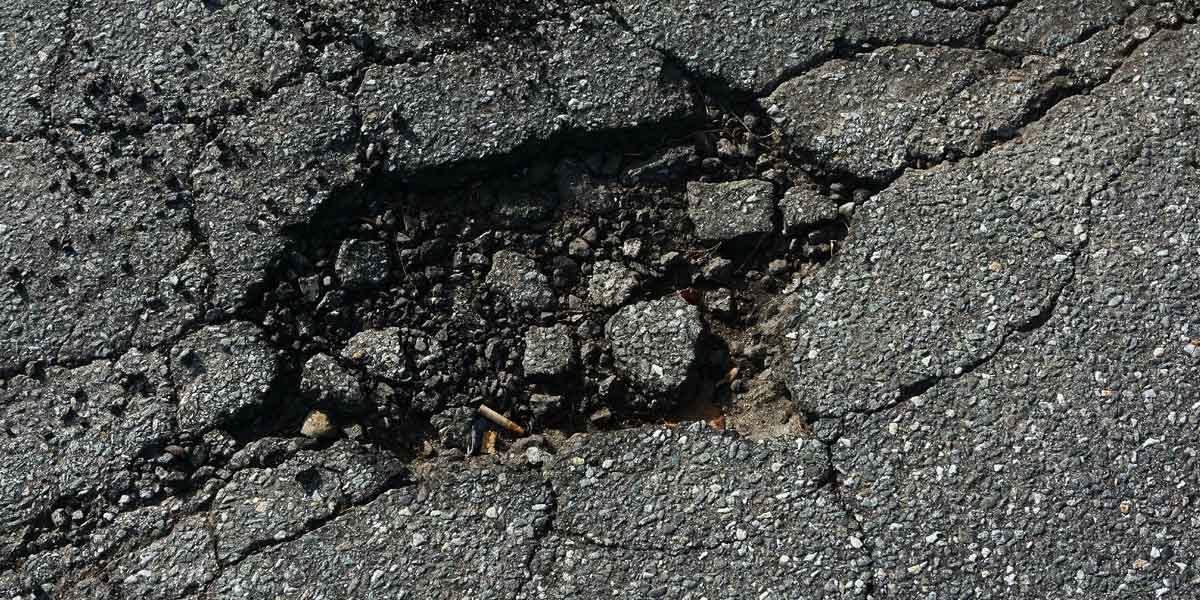

Patch cracks, resurface wear, replace a failed base. Diagnosis is the step that decides whether a driveway repair holds, and it costs ten minutes outside with a tape measure.
The money in a driveway lives in the base, the compacted layer under the asphalt or the slab. Cracks, dips, and potholes are how that layer reports a problem, and a rash of new cracks after one hard winter is the same report, louder.
Failures follow a pattern. Snowmelt gets in at an edge or a joint, freezes, and widens the opening a little each winter. A patch laid on top of that cycle gets pushed out from below, which is why the same crack reopens in the same place every March.
Read the Damage Before You Buy Anything
Most driveway repairs are paid for twice: once for the patch that fails and once for the work that should have come first. Three measurements settle which repair you actually need: how far the crack has opened, which direction it runs, and whether one panel now sits higher than its neighbor.
A crack up to about a quarter of an inch wide, running across the driveway, is usually seasonal movement, and a crack filler handles it. A crack that follows a joint, or that opens and closes with the temperature, takes a flexible sealant able to stretch and recover. Width and direction together tell you more than width alone.
The pattern that ends the conversation is a web of connected cracks with no intact pavement between them. That is alligator cracking, the term pavers use for base failure. Any treatment spread over it re-cracks along the same lines within a winter or two, because the movement underneath never stopped.
Panel movement is the other hard stop. A slab that has dropped an inch or more, or that rocks under a straightedge laid across the joint, has a support problem under it.
Ten minutes and a straightedge.
Which category is yours? If the answer is a web of cracks or a rocking panel, the rest of the decision narrows to one question: lift, or replace.
Where Repair Stops Paying
Three conditions put driveway repair money into a lost cause: alligator cracking across most of the width, edges crumbled down to the base, and panels that have tilted away from each other. A surface treatment still improves the look for a season or two while the pavement keeps moving underneath it.
Driveways read differently in January. The crack that was a hairline in July catches a fingernail, the low spot by the garage apron wears a white ring of dried salt, and the plow has left a ridge of grit along the edge. That is the inspection, done in ten seconds on the way to the car.
Asphalt Repair: The Prep You Skip Is the Patch You Lose
An asphalt patch has to hold like a joint, because that is what it is. Square edges, a dry cleaned void, a tack coat, and compaction in thin lifts are what keep it in place against a plow blade and a front tire.
Start by cutting. A grinder or a chisel opens the crack into a straight-sided channel about an inch deep and wide enough for mix to be pushed in and packed. Loose grit, grass roots, and old sealant come out with a wire brush and compressed air. Feather edges are the enemy here: a thin wedge of new mix has nothing holding its outer sliver, and the plow finds it by February.
If the channel is damp, the job is over for the day.
Emulsion tack coats and cold mixes both bond badly to wet edges, and no amount of extra mix compensates.
Paint the sides with tack coat first, then let it turn from brown to black before anything else goes in.
Fill in lifts about two inches thick, compacting each one before the next goes down. A tamper or a plate compactor does that work, and a car tire does not. Finish slightly above the surrounding surface and compact once more, so traffic wears the patch down level without cupping the middle.
Cold Patch Buys You a Season
The bagged cold patch on a hardware shelf is a winter stopgap. It goes in wet or cold and holds long enough to keep a pothole from spreading through February, and its binder never cures the way a hot mix does. Plan on a sagging, raveling surface by spring and a hot-mix replacement once the weather settles.
Waiting for a dry week beats patching a wet crack in November.
Concrete Repair: Why Patches Pop Out in the First Winter
Concrete patches fail from the inside out. Meltwater sits in the pores around the repair, freezes, and expands by roughly 9 percent, and each thaw lets more liquid back in. The mix is usually the strongest part of the repair. A patch placed in October, just before the first freeze, behaves worse than one placed in June.
The Portland Cement Association has attributed salt scaling to that physical cycle for decades, with de-icers doing most of their damage by keeping the surface wet through more freeze-thaw cycles. Salt left to dry also crystallizes inside the pores and pushes outward from within.
The split shows up on a single slab. Half a driveway that never sees a de-icer keeps its finish through the winter that turns the strip where cars drag in road salt chalky, then flaking away in coin-sized pieces.
Repair mixes have to match the depth of the hole. A shallow spall wants a sand-based resurfacer or a repair mortar, because standard concrete carries gravel that cannot fit into a half-inch void and leaves a patch with a soft edge. A bonding agent goes on the cleaned concrete first, and it has to turn tacky before any patch material follows it.
A sunken slab is a separate job, and weight added on top only speeds the settlement. Slabjacking or polyurethane foam injection lifts the panel from below, and RUBI’s cost guide puts that work at $500 to $1,500 per project, well under the price of a new pour.
The De-icer Advice That Runs Backwards
RUBI’s concrete guide warns that rock salt damages driveways and recommends calcium chloride or magnesium chloride as the gentler choice. A 2008 Iowa DOT study found the opposite reaction inside the cement paste: concentrated calcium chloride and magnesium chloride solutions form calcium oxychloride, which expands and cracks the surface it was meant to protect.
Sodium chloride is the least aggressive of the three on concrete chemistry, though it is the worst on the steel in a car. Sand first; salt only on a slope where traction is a safety question.
What the Three Repair Tiers Cost
Angi’s cost guide puts driveway patching at $2 to $3 per square foot, resurfacing at $3 to $7, and full replacement at $7 to $14. A two-car driveway of about 400 square feet therefore runs from roughly $800 for a patch-and-seal job up to about $5,600 for a new slab.
RUBI’s figure for resurfacing a whole driveway lands between $2,000 and $5,000, and DIY crack filler plus sealer usually comes in under $100. The spread between those numbers is where the decision lives.
Spend repair money where the base is still sound. A fresh surface over alligator cracking looks correct for a winter or two, then re-cracks along the old lines, and the second driveway repair costs more than the first because the asphalt is now sitting on rubble.
Any bid quoted without a look at the crack pattern is a guess.
Ask what the price covers for crack cleaning and base repair, and whether it includes a leveling course or a full resurface.
Sealing, Salt, and What to Do Before Winter
Sealing runs on surface condition, not on a calendar. The Asphalt Institute’s guidance for driveways puts the first seal at about two to five years on a well-built surface, and treats sealing as the answer to dryness, small surface cracks, and open voids once those appear.
A fixed two-to-three-year resealing cycle is common advice from the same shelf that sells the sealer.
Coating pavement that is still sound costs money and buries the small cracks you would rather watch.
Concrete gets a version of the same routine: once a patch has cured, a water-repellent sealer keeps liquid out of the pores and slows the salt damage described above. Silane and siloxane repellents shed rain from a driveway at the surface, while the cementitious and crystalline products that hold back water under pressure belong on a foundation wall.
Before the first hard freeze, shovel while the snow is still dry, keep the plow off the edges, and rinse the salt-heavy slush that runs down from the road before it refreezes inside a crack.
Driveway Repair Questions
What is the cheapest way to fix a driveway?
Crack filler and a sealer, at roughly $15 to $100 in materials, are the cheapest driveway repair while the damage is surface cracking. Once cracks have connected into a web or a panel has dropped, cheap surface work over five years costs more than one replacement.
Will homeowners insurance cover driveway repair?
Insurance rarely covers a driveway repair for wear and tear. Standard homeowners policies pay for sudden events such as a fallen tree, a vehicle strike, or a storm that lifts a panel, and the exclusions section typically names settling, freezing, and gradual deterioration.
Read that exclusion wording before filing, and confirm with your carrier; coverage depends on the policy and the state.
Can a broken driveway be repaired?
Yes when the break is a crack, a spall, or a pothole and the panel is still seated. A panel that has dropped or tilted needs lifting or replacement, because a surface patch leaves the cause in place.
How much does it cost to patch a driveway?
Contractor patching runs $2 to $3 per square foot, so a 30-square-foot pothole lands near $60 to $90. The same hole filled with bagged cold patch costs a fraction of that and holds for one season.
Track how many driveway repairs a year the surface swallows. When a panel needs lifting or more than a few feet of crack has become a web, the repair price stops buying years and starts buying months.