
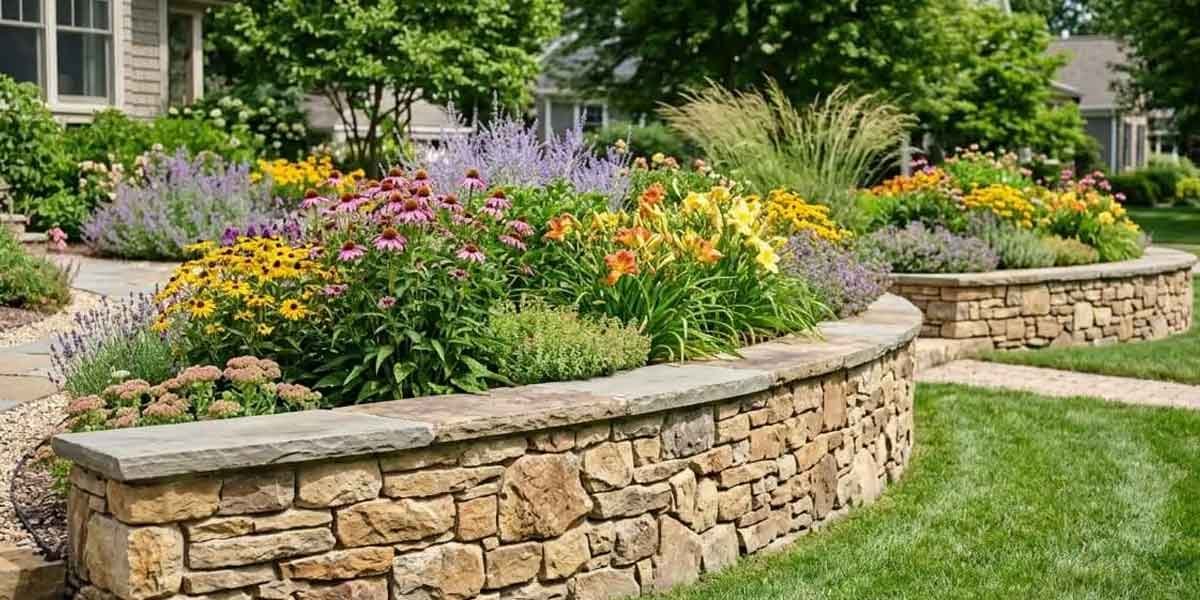

Retaining wall cost runs about $25 to $50 per square foot installed, and the spread inside that range comes from water, height, and site access more than from the block a homeowner picks.
Fixr, a home improvement cost publisher, puts the national average for a concrete block wall 25 feet long and 4 feet high at $5,463. Three contractors in one town will bid that wall thousands apart, and none of them is inventing a number. The gap sits in how much soil gets excavated and hauled, how much of the wall carries reinforcement, and whether the drain is in scope.
The useful question is which of those items a quote left off the page.
Per Foot, Per Square Foot, and Getting the Two to Agree
Contractors quote by the linear foot because they build walls in runs. Homeowners compare by the square foot because that measures the soil a wall holds. Divide a retaining wall cost quoted per foot by the wall height and the two scales agree: a 3-foot wall at $150 a linear foot is $50 a square foot.
Modern Yardz publishes a 2026 range of $40 to $250 per linear foot for professional installation. Fixr’s $5,463 average covers 100 square feet of face, which comes to $55 a square foot, and its low and high cases convert the same way. Work the arithmetic and $1,239 for a wall 10 feet long and 3 feet high is $41 a square foot, while $12,029 for a wall 30 feet long and 5 feet high is $80.
The per-foot figure is the one that gets misread. Forty dollars a foot reads as a bargain until the quote describes a two-foot terrace. Applied to a six-foot wall, the same rate works out to under $7 a square foot, below any installed price a manufacturer or a pricing service reports.
Ask for the wall priced by the square foot before totaling two bids. A contractor who quotes that way has had to think about height, and height decides most of what follows.
What the Manufacturer Splits Into Material and Installation
Allan Block’s technical newsletter comparing big block with segmental systems publishes both halves of the price for its own product line: material at $12 to $15 a square foot, and material plus installation at $25 to $30, for a wall tied back with geogrid. Big-block systems, the crane-set units, run $18 to $25 for material and $35 to $50 installed.
The company’s explanation for the spread is freight. About 520 square feet of segmental block fits one truckload, against 15 to 50 square feet of big block, so the same wall reaches the site for a fraction of the hauling cost.
The two published bands line up like this:
| System | Material per sq ft | Material and installation |
|---|---|---|
| Segmental block with geogrid | $12 to $15 | $25 to $30 |
| Big block, crane set | $18 to $25 | $35 to $50 |
| National average including site work (Fixr) | Not published | About $55 |
Any retaining wall cost splits about half and half, material against labor, and the labor half is where quotes separate. Ware Landscaping puts professional labor on a retaining wall at $20 to $60 a square foot, a range three times as wide as the material band, because labor is what absorbs hand digging, tight access, and short walls that still need a full setup.
That ordering matters when a $4,000 bid sits beside a $7,000 bid on the same wall. The blocks cost nearly the same in both. The work around them does not, and that work decides whether the wall is still plumb in 30 years.
Height Moves the Price More Than the Block Does
Building codes define lateral soil pressure as a weight per square foot for each foot of retained depth, which means the total force behind a wall grows with the square of its height while the face it presses against grows only in step with height. Doubling a wall from three feet to six feet doubles the face and roughly quadruples the load that the base, the footing, and the soil reinforcement have to resist.
Fixr’s cases show the effect in dollars. A wall 10 feet long and 3 feet high prices at $1,239, or $41 a square foot. A wall 30 feet long and 5 feet high prices at $12,029, or $80. Two thirds more height produces nearly double the square-foot price.
Two thresholds sit inside that climb. Ware Landscaping reports that most municipalities require a permit for any wall over three feet, and that is close to where a dry-stacked gravity wall stops being enough on its own. Above it, a designer specifies geogrid layers that run back into the soil to tie the wall, the fill, and the retained ground into one mass. Each layer adds material and time to the square-foot price, and the layers sit closer together as the wall gets taller.
Soil rewrites the same budget from underneath. A wall on clean sand or gravel earns the lightest reinforcement a design allows. The identical wall on expansive clay needs a wider base and more grid across the same retained height, and no contractor can price that difference from a photograph.
Access decides the rest. A machine that reaches the back yard moves the spoil in hours; a fence, a mature tree, or a slope behind the wall turns the same excavation into hand work and barrowed backfill. Ware Landscaping prices machine excavation at $70 to $90 a linear foot, and the hand version of that line is where a budget quietly loses its margin.
The Line Items That Arrive as a Surprise
The Concrete Masonry and Hardscapes Association, which publishes the industry guidance for segmental walls, sets minimum dimensions for two components a low bid tends to skip. Its FAQ SRW-FAQ-002-14 puts the leveling pad, the compacted crushed-stone base under the first course, at least 6 inches thick with 6 inches of bearing past the front and back of the bottom unit. The gravel fill behind the wall runs at least 12 inches wide, and it surrounds the perforated drain that carries water out.
Those two dimensions cost the least and prevent the most. A drain with no outlet lower than the wall base has nowhere to send water, so the water stays where it is and presses on the back of the wall for the life of the structure.
Excavation and haul-off is the second invisible item, and the soil that leaves the property is billed by the load. Permit fees run $100 to $600 in Ware Landscaping’s figures, and in many jurisdictions a wall over three feet cannot be permitted without a stamped design.
Ask for a retaining wall cost broken into six lines:
- Excavation, and haul-off priced by the cubic yard
- The leveling pad, by thickness and length
- The gravel fill and the drain, including where the pipe daylights
- Engineering and permit costs
- The wall, priced by the square foot
- Topsoil replacement, or the state of the site when the crew leaves
A low garden terrace is the boundary case. Two feet of dry-stacked block on well-draining ground, with nothing heavy sitting behind it, needs no engineer, no geogrid, and no permit in most places. The leveling pad and the gravel column still belong in it.
Repair, Rebuild, or Leave It Alone
HomeGuide’s repair figures sort by symptom. A leaking or seeping wall runs $100 to $1,000, cracking or crumbling $150 to $1,000, the white salt bloom of efflorescence $150 to $800, foundation work $40 to $75 a linear foot, and a face that leans or bows $200 to $1,500. Taking a wall out and rebuilding it runs $6,000 to $14,000.
Seepage and salt bloom point at water, and water is the cheap problem: a drain at the base, ground shaped so runoff moves away from the top of the wall, and an outlet that daylights below it. A face that has moved off line is a structural problem, because the load that pushed it has not gone anywhere.
Patching the face of a bulging wall buys one season. A crack that keeps reopening along the same line is the same signal in concrete, and no filler holds it closed while the pressure behind it stays.
Ware Landscaping prices a drainage kit at about $500 and puts a replacement wall at $10,000 within five years. HomeGuide’s national range for taking a wall out and rebuilding it tops out at $14,000.
The five-figure invoices all trace to the line item the cheap quote deleted, and water is what arrives to collect it.
Retaining Wall Cost Questions Homeowners Ask
How much does a retaining wall cost per square foot?
A segmental block wall with geogrid runs $25 to $30 a square foot for material and installation together, and big-block systems run $35 to $50. Published averages that include excavation, haul-off, and engineering land closer to $55.
Does a 2 foot retaining wall need a footing?
A segmental block wall at that height sits on a compacted crushed-stone leveling pad rather than a concrete footing, and CMHA puts the pad at 6 inches thick with 6 inches of bearing past each face of the bottom unit. A poured concrete wall needs a footing at any height.
How much does it cost to build a garden wall?
A 60-foot garden wall two feet high lands near $2,400 at the bottom of Modern Yardz’s published per-foot range, and material alone is roughly half of an installed price. A homeowner buying block and doing that work pays the material half.
What is the cheapest retaining wall material?
Pressure-treated timber and railroad ties are the cheapest option at $30 to $60 a linear foot installed, and also the shortest-lived at roughly 10 to 20 years in wet ground. Segmental concrete block starts at $40 a linear foot in the same published range.
Price the wall by the square foot, and make excavation, drainage, permitting, and haul-off separate lines on the quote. A total that arrives as one lump cannot be compared with anything.