
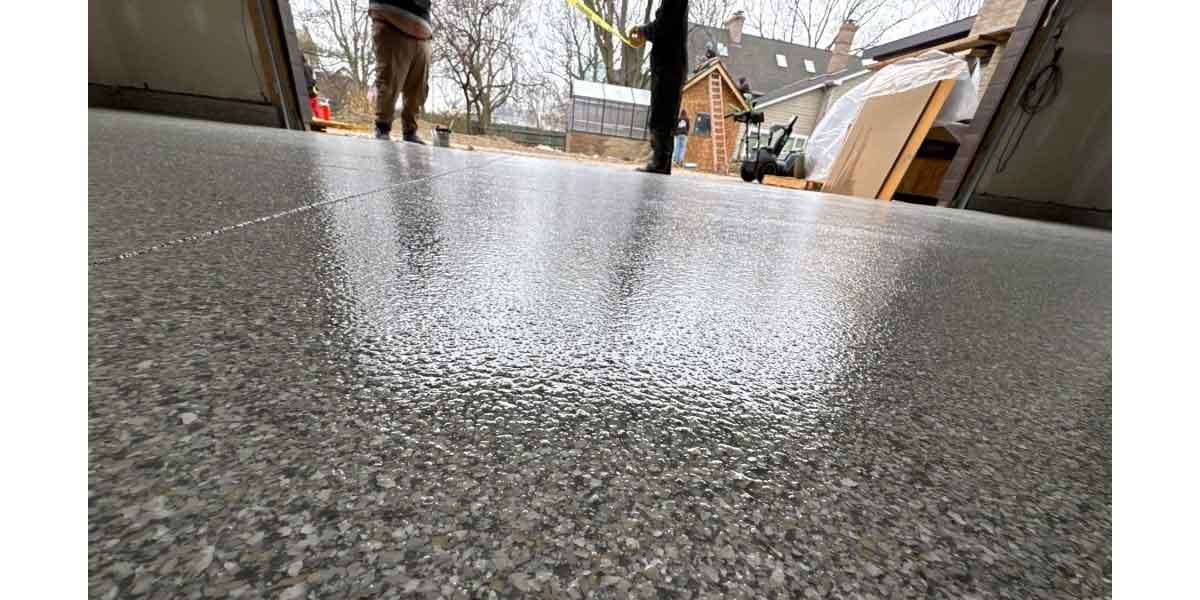

The slab decides whether a garage floor coating lasts, and it makes that call before anyone picks a product.
Most failures trace back to concrete that never passed a moisture test, or to a surface that was swept and wiped rather than ground open.
The resin is rarely the weak link.
Every garage floor coating on the market, from a one-part water-based paint to a sprayed polyaspartic build, can only grip what the slab hands it.
Testing a Garage Slab Before Any Coating Goes Down
Three tests are used on concrete before a garage floor coating goes on: the plastic sheet method (ASTM D4263), the calcium chloride test (ASTM F1869), and in-situ relative humidity probes (ASTM F2170). Only the last two produce a number a manufacturer will stand behind.
The plastic sheet method is the one a homeowner can run this weekend. Tape an 18 by 18 inch square of plastic to the slab, wait at least 24 hours, then lift a corner and check for darkening underneath.
What the Plastic Sheet Test Catches
Garon Products ships a version of this test inside its own garage coating kit instructions: a 4 by 4 foot sheet taped down and checked the next day.
If the concrete under the plastic is still dry, the slab is not showing the hydrostatic pressure that later breaks a bond.
Damp darkening is a stop sign.
The test earns its place because it costs nothing and takes a day, and it proves less than owners assume. It reads moisture only in the top layer of the slab, while the water that drives the failure lies lower, and it returns a yes or a no rather than a number.
Getting a Number Instead of a Yes or No
A calcium chloride test weighs a dish of desiccant before and after 24 hours under a sealed cover, and the weight gain converts to a moisture vapor emission rate. The in-situ method drills into the slab and reads a probe set at 40 percent of the concrete depth, where the moisture actually lives.
Tnemec, a coatings manufacturer that publishes its own testing guidance, puts the ceiling for conventional floor primers at 3 pounds of vapor per 1,000 square feet per 24 hours, or 75 to 80 percent relative humidity inside the slab. Primers built for wetter concrete handle up to 20 pounds and 99 percent RH.
Timing changes the reading.
Tnemec recommends running the building’s HVAC for at least 48 hours before the test, because a slab measured in a cold, closed garage in February reports a different figure than the same slab measured in July.
A slab above the limit needs a different product, a moisture-mitigating primer, or a membrane under the new surface.
Surface Profile: What CSP 3 to 5 Buys on a Garage Floor
Concrete surface profile grades how rough a slab is after preparation, on a scale running from CSP 1 to CSP 10. High-build garage floor coating systems are commonly specified in the CSP 3 to 5 band, and shot blasting can produce anything from CSP 2 to CSP 9.
The scale comes from ICRI Technical Guideline No. 310.2R, which grades profile by amplitude and ships physical chips so that a contractor and an inspector compare the same surface. CSP 1 and CSP 10 look nothing alike. CSP 2 and CSP 4 look identical without a chip beside them.
Epoxy and polyaspartic systems hold by mechanical grip, so the profile is the bond. Diamond grinding and shot blasting are the two methods that reliably reach the middle of the scale. Acid etching, the step printed on most boxed kits, opens the surface far less and leaves no profile to measure. An existing sealer, paint, or old coating comes off first anyway.
Nothing in this sequence works while a cured film still lies between the new coating and the concrete.
Prep work can be checked without instruments. Ground concrete feels like coarse sandpaper under a dry hand and looks uniformly lighter than a sealed surface. A slab that still feels slick has not been opened, and a coating sprayed onto it releases in sheets.
The Three Systems Most Garage Floors Actually Get
Boxed one-part epoxy paint, two-part epoxy at high solids, and a polyaspartic or polyurea topcoat cover nearly every residential garage.
- One-part water-based epoxy paint. Sold by the gallon at hardware stores, it cures to a thin film and is the system most likely to lift under a hot tire. It fits a rental unit, a quick sale, or a floor nobody parks on.
- Two-part epoxy at 100 percent solids or close to it. GARAGECOAT lists its kit at 93 percent solids and 30 pounds per unit, which builds film thickness in a single coat.
- Polyaspartic and polyurea topcoats. A polyaspartic is a polyurea, not a polyurethane; it cures fast, resists ultraviolet yellowing, and normally serves as the clear layer over an epoxy base.
Material math separates the systems faster than a brochure does. Garon’s application sheet covers about 200 square feet per 1.5 gallon unit, so a 1,000 square foot garage takes roughly five units, or 7.5 gallons, for a single coat.
Color is a durability choice as much as a look.
A full flake broadcast hides joint lines, small spalls, and the first tire-path wear that a solid color shows immediately.
Coating It Yourself: What the Kit Leaves Out
A garage floor coating kit includes the resin, the roller, and the instructions, and it stops there.
Grinding is the step that decides whether the film stays, and no kit ships a diamond grinder. Rental yards carry single-head machines with a diamond cup wheel by the day, and a two-car slab takes most of one to open properly.
Acid etching appears in the instructions because it needs no equipment beyond a plastic watering can. It also leaves no measurable profile, which is why coating makers with a published data sheet ask for a grind or a blast.
The kit route can work on a tight, sound, dry slab where the owner accepts a shorter service life. On a slab that has never been tested, the savings on labor tend to come back in a couple of seasons as a peeling floor.
What the Coating Has to Survive
Heat from a parked tire, oil and brake fluid drips, and winter road salt take off more coatings than installation errors do.
Hot-tire pickup is the trade’s name for the black tire-shaped marks that show up in the first warm month. Rubber heats while you drive, and the coatings contractor Galaxy Concrete Coatings puts tire surface temperatures at 120 °F or more. Plasticizers in the tire compound migrate into the film at that temperature, soften it, and bond it to the tread. When the car rolls out, the coating goes with it.
Thick films tolerate that load better than thin ones, which is why a high-solids epoxy base under a polyaspartic topcoat gets specified for drive-over bays and a two-mil water-based paint does not.
Oil and brake fluid work more slowly. A puddle left over a weekend softens the film where it stands, and brake fluid reaches the concrete once the coating has lifted at the edge of a wheel position.
Moisture attacks from the other side. Vapor migrates up through the slab, builds pressure beneath a film that cannot breathe, and the coating blisters or releases in sheets. That is why the moisture test comes before the product choice, and why a slab poured without a vapor barrier under it deserves a closer look than one poured over polyethylene sheeting.
Road salt is the last exposure to show up. Chloride-heavy slush rests against the concrete for months, and where the film is thin or already lifting, the surface under it spalls.
Maintenance for all three is the same routine: sweep grit before it grinds underfoot, rinse salt off the slab after the last storm of the season, and skip acid washes on a coated floor.
Curing Times and When the Car Can Park on It
A typical two-part garage floor coating kit takes foot traffic at 12 to 16 hours and full cure at 2 to 7 days at 70 °F, while a polyaspartic system can return the garage to service in about a day.
Garon’s instructions put the pot life of a mixed batch at roughly 35 minutes. That figure sets the pace of the whole job: small batches, fast rolling, not one mix spread across an afternoon.
Garon’s sheet fixes the working window at 60 to 90 °F with relative humidity below 85 percent. Cold slows the reaction, and humid air traps bubbles in a film that is already starting to set.
Parking is where owners get impatient. Foot traffic at 12 hours is not vehicle traffic at 24. Epoxy takes days to reach full cure, and the weight of a car on a partly cured film presses the tread pattern into the surface.
Why does a floor that looked perfect in October lift the following June? The slab that lifts was never dry or never opened, and the first hot week of summer finishes the job.
What a Real Installer’s Bid Includes
A bid that names a resin and a price per square foot is missing the work that decides the result.
Every garage floor coating bid should carry four items: the moisture test and its number, the method used to open the concrete, the crack and joint treatment, and the film build in mils. Ask for each of them in writing.
Prep is visible on the day of the job. Grinding produces a uniform, lighter, sandpaper-rough slab, and shot blasting leaves a pattern of overlapping passes. A crew that arrives with a garden hose and a jug of acid is not going to remove a sealed skin.
Joints need their own answer. Control joints move with the slab, so a coating laid straight across one cracks in the same line the joint would have opened. The usual detail is a flexible filler in the joint before the base coat goes down.
Warranty scope matters more than warranty length. Vapor migration, standing water, and damage from parked tires fall outside many coating warranties, which is one more reason the moisture number belongs in writing before the first batch is mixed.
When Not to Coat a Garage Floor
A slab that keeps pushing water, salt, or loose concrete through its surface should be repaired or left bare, and no garage floor coating fixes that.
Efflorescence is the white bloom that returns after you scrub it. It marks concrete with moisture moving through it, and a coating on that surface traps the pressure underneath.
By the second winter, an untreated slab in a salt-belt garage shows two gray tire paths, a chalky line at the door sill, and a scatter of popped aggregate at the apron.
Spalled or hollow-sounding concrete comes out before anything else. Coating a loose top layer puts the bond on material that is already letting go.
A floor that holds water near the overhead door after rain has a grading problem. Coating it traps the puddle between the concrete and the film.
Garage Floor Coating Questions That Come Up Most
How do I coat my garage floor?
A garage floor coating goes down in four steps: grind or shot blast the slab, test it for moisture, fill the cracks and joints, then roll a two-part epoxy base with a clear or polyaspartic topcoat. The job runs on preparation hours; the resin is the smaller line item.
What does an epoxy floor look like after 5 years?
After five years, a well-prepped epoxy floor is intact but no longer uniform. The tire paths have lost their gloss, and light colors show traffic grime and a faint amber cast where sun reaches the door.
How much epoxy for 1000 sq ft?
A 1,000 square foot garage takes about 7.5 gallons of mixed epoxy for one coat, which works out to five of the 1.5-gallon kits Garon sells at roughly 200 square feet of coverage each. Flake broadcast and a separate topcoat add material on top of that figure.
Is epoxy or polyurethane better for garage floors?
For a home garage, the usual pairing is epoxy as the base coat with polyurethane or polyaspartic on top. A polyaspartic is a polyurea, and it resists the ultraviolet yellowing that a pure epoxy can develop where sun reaches the slab.
How long does a garage floor coating last?
Service life tracks the preparation more than the resin. A two-part epoxy base with a polyaspartic topcoat over a dry, ground slab with filled joints is often still intact a decade later, while a thin kit over an untested slab fails within the first few seasons.
