
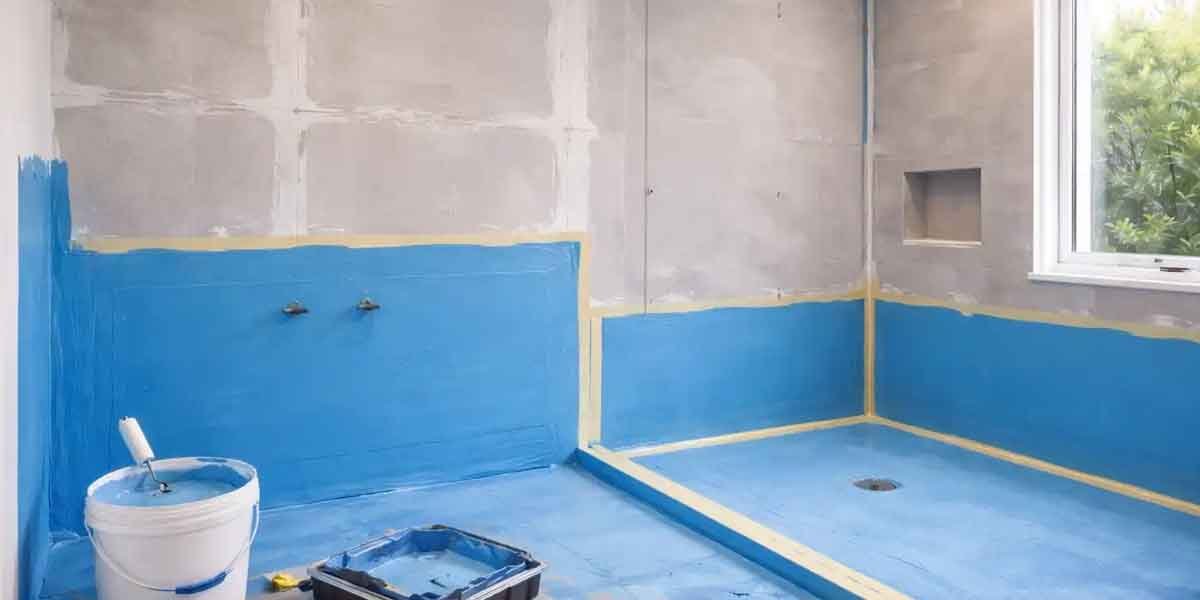

No single type wins. What type of waterproofing is best for a bathroom? Start with how much wet area you are covering and who is applying the material.
Bonded sheet membranes are the most dependable layer over a full tiled shower. Liquid membranes hold their own on tub surrounds and small wet patches. Foam boards trade material cost for install speed.
Wet framing behind a finished-looking tile job is how most homeowners meet this question. The membrane was there. The thickness was not.
What Type of Waterproofing Is Best for a Bathroom? Start With the Standard
Bonded sheet membranes are the most reliable answer for a full tiled shower, and liquid membranes handle smaller wet areas well. What separates either one from a failed job is not the brand on the bucket but whether the dried film meets ANSI A118.10.
ANSI A118.10 covers load-bearing, bonded waterproof membranes. ANSI A118.12 covers crack isolation, a separate job, and both numbers appear on the same product labels often enough to confuse the two.
Tile, grout, and cement backer board do not waterproof anything by themselves. Tile and grout are water-permeable, which is why the layer beneath the finish has to be completely waterproof before the first tile goes down (Fine Homebuilding).
RedGard’s technical data sheet shows what meeting the standard costs in material. Its waterproofness test under A118.10 section 4.5 passes at 25 mils dry film. The high-performance crack isolation rating under A118.12 needs 30 mils. The steam-shower permeance limit of 0.5 perms is met at 0.35 perms once 30 mils are on the wall.
Twenty-five mils is thinner than a credit card. A sheet membrane arrives at that thickness from the factory, and a liquid reaches it only if someone keeps painting.
Sheet Membranes: Factory Thickness and Fewer Ways to Fail
Schluter-KERDI is an 8-mil polyethylene sheet with non-woven fleece on both faces, sold as a bonded waterproof membrane and vapor retarder. Uniform thickness is the point, since an extruded sheet has no corner where a roller thinned the film.
Permeance is where sheet systems separate from coatings. Fine Homebuilding’s comparison lists KERDI at 0.75 perms, Ardex SK 175 at 0.5 perms, and Laticrete’s liquid Hydro Ban at 1.27 perms. Lower numbers mean less vapor moving through the layer, which matters most in a steam environment.
The trade-off lives in the joints. Every overlap and every inside corner stacks material, so the installer switches to a medium-bed mortar and a wider trowel notch to keep the tile plane flat. Schluter’s instructions add a curing wait of 24 hours before the membrane is tested or tiled over.
Full mortar contact under every inch is a sheet membrane’s real requirement, and it explains why many first-time tilers finish a better shower with a different system.
Pans are where sheet membranes earn their price. A bonded sheet over a sloped mud bed keeps water out of the mortar instead of asking the mortar to be watertight, and that pan detail is the one Fine Homebuilding’s author uses on his own jobs.
Liquid Membranes: You Are the Thickness Gauge
RedGard is a ready-to-use elastomeric coating whose data sheet sets two numbers that matter more than the label: two coats, each at 80 square feet per gallon, to reach the waterproofing requirement of ANSI A118.10 and the IAPMO shower pan liner listing.
Applied as general waterproofing, the same gallon covers 110 square feet. The gap between 110 and 80 separates a film that passed a lab test from a film that passes in a shower.
The coverage chart makes the penalty visible. One gallon reaches 55 square feet as a waterproof membrane, 40 square feet as a listed pan liner, and 25 square feet as a high-performance crack-isolation membrane.
Two application habits decide whether the film performs as tested. Wet thickness should not exceed 40 mils in any single coat, and the material shifts from pink to dark red in about 1 to 1.5 hours, which is the signal that the second coat can go on at right angles to the first. That second coat tends to go on late, under a work light, with the tile saw finally quiet, and the cross direction is the first thing dropped when the room is dark and the roller is already wet.
Coat the changes of plane and the floor-to-wall line at least 2 inches past the joint. Reinforcing tape goes into the liquid while that coat is still open, and the second coat buries it. Band and coating have to be laid in the same working window. A band pressed onto a cured film sits on top of the surface instead of tying the layers together, which is the failure that detail exists to prevent, and the same window rule governs sheet systems, where membrane tape turns separate panels into one surface.
The drain flange gets its own piece of fabric, roughly 3 inches long, wrapped around the flange and embedded in the wet film, with the coating lapping over the transition from substrate or mortar bed. The substrate also has to be sloped toward that flange first, since a coating follows whatever plane it is painted onto.
RedGard’s data sheet allows tiling within 72 hours of the final coat, and one more coat extends that window if the surface has to wait longer.
Coating only the seams of a cement backer board is a predictable failure. Water that gets through grout reaches the board across the whole field, not only at the joints, and a liquid system works when the entire wet area receives film at the listed rate.
Foam Boards: Backer and Membrane in One Panel
A foam board is a tile backer and a waterproof core in one sheet. Seams, corners, and penetrations are sealed with a liquid membrane and banding from the same manufacturer, and most systems add preformed pans and niche boxes that interlock with the wall panels.
Two boards draw the most praise from working tilers inside the Fine Homebuilding guide: Wedi Building Board and Laticrete’s Hydro Ban board, both rated stiffer and more durable than KERDI-Board. The material costs more than cement board plus a coating, and that is the honest price of a faster install.
Mixing brands is where the value can disappear, because a foam wall from one maker paired with a sheet membrane from another puts the warranty at risk. The same guide pairs a mud-bed pan with the board maker’s own membrane to keep that coverage intact.
What the Code Tests Before the Tile Goes Down
The International Residential Code requires a site-built shower pan liner to pass a flood test before tile or mortar covers it. Section P2503.6 of the 2021 edition treats that test as a plumbing inspection item, not a finishing step.
The inspector plugs the drain and fills the receptor with at least 2 inches of water measured at the threshold. Fifteen minutes is the code minimum, and many jurisdictions and manufacturers want the water left in longer.
What gets checked along with the water line is geometry that will be invisible afterward: a pre-slope under the liner so water moves toward the drain, folded or dam corners, weep holes left open at the drain, and a liner that climbs high enough behind the curb.
Nothing in the code sets a waterproofing height on the walls or picks a system for a bathroom. Those choices come from the manufacturer’s written instructions and the TCNA details that a membrane listing references, which is why two showers built to code in the same city can stop their waterproofing at different heights.
Steam showers sit in a stricter category, where a system has to be virtually vaporproof and the ASTM E-96 number to beat is under 0.5 perms.
Matching the System to the Room
System choice follows the shape of the wet area and the skill of the person installing it, not the price of the bucket.
- Full walk-in shower on a mud-bed pan: bonded sheet membrane across the pan and the walls, with banding at every change of plane.
- Shower with a factory pan and foam walls: liquid membrane at 80 square feet per gallon per coat, two coats, plus a flood test on the pan.
- Tub surround or a small wet patch: liquid membrane, because the area stays small enough to control film thickness by hand.
- Steam shower or a wet room: a system rated under 0.5 perms, which in practice means a sheet membrane with the maker’s vapor details.
- Re-tiling over an existing pan: open the layer far enough to check the slope, the drain, and the liner, since a patch over a failed liner fails again.
Every line in that list assumes the same two checks afterward. The membrane gets tested with water before tile, and the installer can state the dry-film thickness it reached.
Frequently Asked Questions
What type of waterproofing is best for a bathroom?
A bonded sheet membrane is the most reliable choice for a full tiled shower, a liquid membrane is enough for a tub surround or a small wet area, and a foam board system is the fastest option for walls. All three qualify when they meet ANSI A118.10 at the thickness they were installed, and that thickness is the part that decides the outcome.
Is Hydro Ban better than RedGard?
Both clear the same standards, so the decision comes down to the application. Laticrete states that Hydro Ban exceeds ANSI A118.10 and A118.12 and carries an IAPMO shower pan liner certification, and Custom Building Products lists RedGard for the same two standards with an IAPMO pan liner listing of its own.
Fine Homebuilding measures Hydro Ban’s liquid membrane at 1.27 perms, while RedGard meets the steam-shower permeance limit at 0.35 perms once 30 mils are applied. On a tub surround either one works. On a shower pan, dry-film thickness and the pan liner listing carry more weight than the name printed on the pail.
How should a bathroom be waterproofed?
Slope the substrate toward the drain, band every change of plane and every penetration, apply the membrane to its listed thickness, flood-test the receptor, and set tile only after the test passes.
How can I waterproof my entire bathroom?
The wet zones are what matter: the shower, the tub surround, and the floor immediately around them. A membrane can also act as a moisture vapor barrier under a slab-on-grade floor, and RedGard is rated for that use. A dry bathroom floor over a framed subfloor does not need a waterproof layer.
Pick the system you can install to its listed thickness, then prove it with water before tile covers it.
Pull the data sheet for whatever is on the shelf. The coverage number for compliance tells you how much material to buy, and the flood test tells you whether the install was real.