
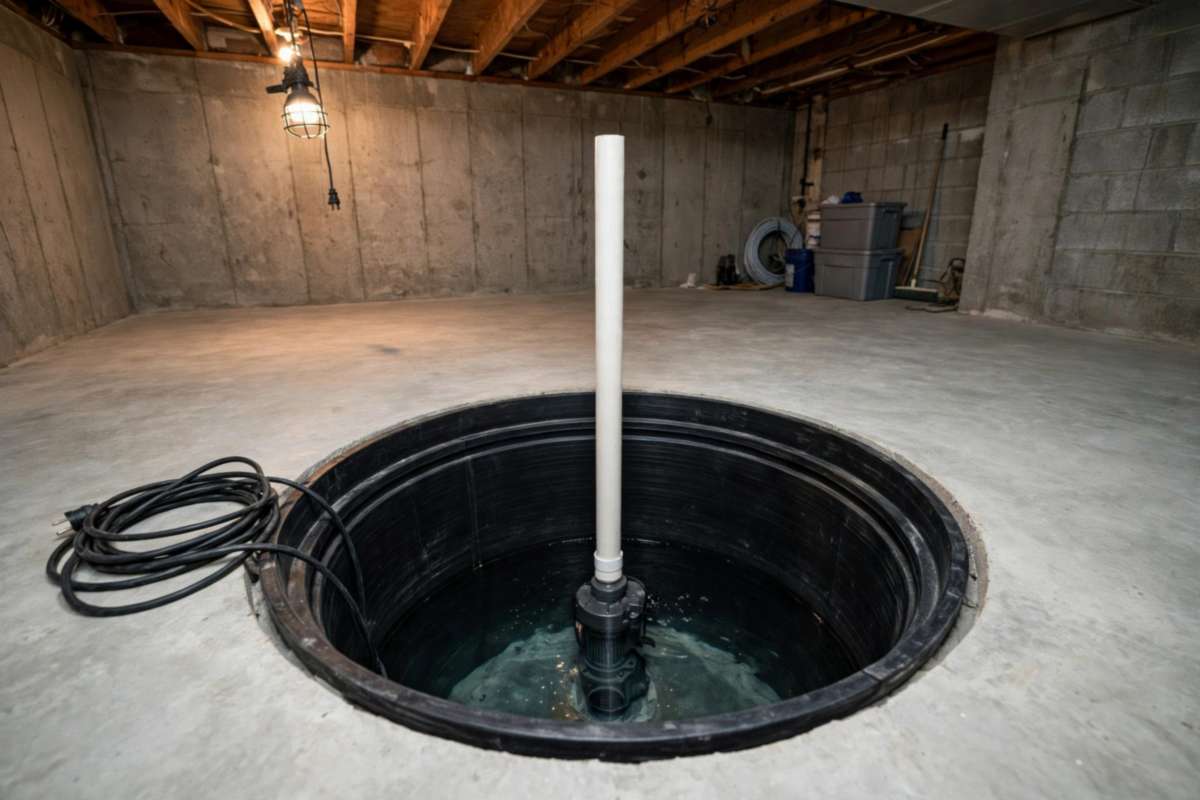

The sump pump cost you’ll be quoted is one of two numbers. The pit decides which. A swap in an existing pit runs $650 to $1,200 installed. A new pit with pump, liner and discharge runs $1,200 to $2,500. Most homeowners land near $1,800, per The Basement Guide’s October 2026 figures.
When a bid comes back at $6,000 or $20,000, the pump is rarely why. That money buys drainage work: interior drain tile, a perimeter trench, sometimes exterior waterproofing. The pump goes in at the end of it.
The ranges below price the pump work alone. They also show what belongs in the number, what gets left out, and the answers that make a quote readable.
Sump pump cost by scope: the four bands
Scope sets the band before pump choice or labor rate gets a vote. An existing pit means a one-day swap. A new pit means cutting the slab, digging, and patching the floor around it.
| What you’re buying | Installed price | What’s included |
|---|---|---|
| Pump swap, existing pit | $650 to $1,200 | Pump, removal, reconnect, test run |
| New pit plus pump | $1,200 to $2,500 | Concrete cut, excavation, liner, pump, discharge |
| New pit plus battery backup | $1,500 to $3,500 | The same, plus backup pump and battery |
| Backup on an existing pump | $350 to $900 | Backup pump, battery, wiring to the primary |
| Crawl space install | $1,000 to $3,000 | Same parts, slower work on a dirt floor |
Those bands come from The Basement Guide’s 2026 installation guide, which prices a typical new-pit job near $1,800. They’re contractor prices too, so a tight space or an old pit moves your number.
Which band applies to you? The pit settles it.
What the pump itself costs, and what labor adds
The sump pump cost splits the same way inside the pump. A 1/3 HP submersible unit sells for $150 to $400. Installed, that same pump comes to $600 to $1,500, and the gap is labor.
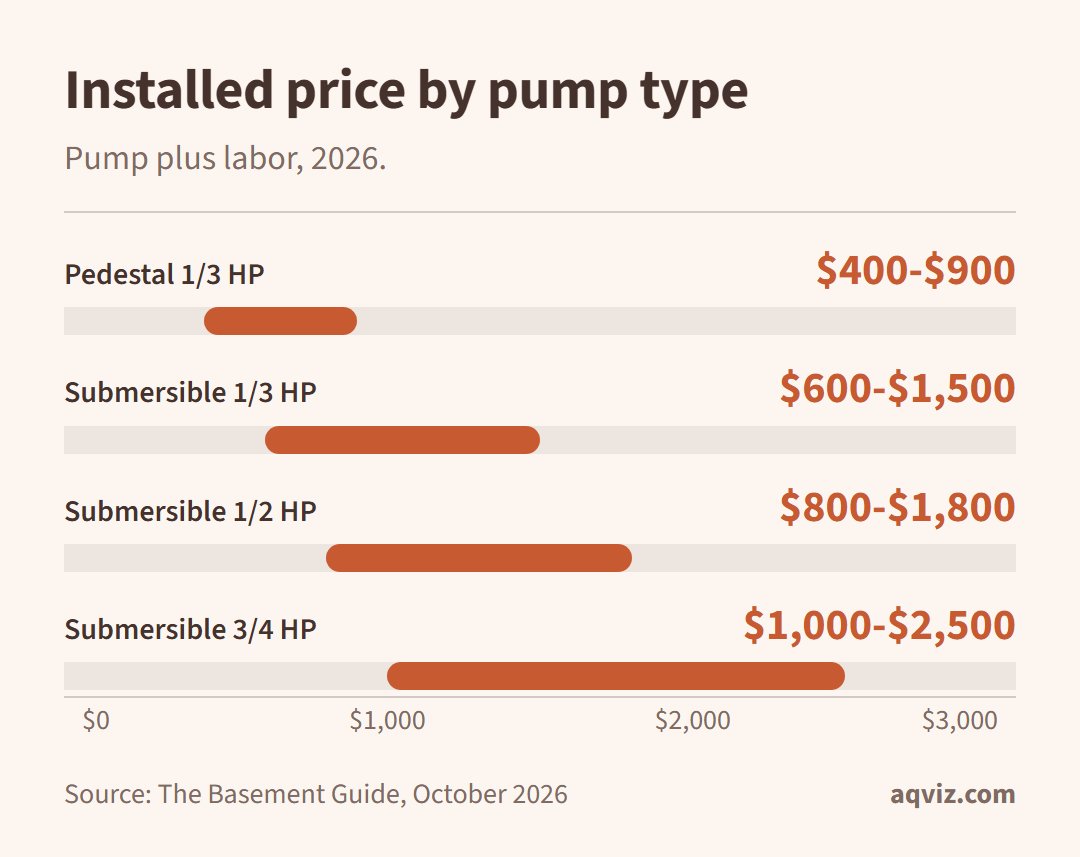
Labor fills the gap. Plumbers and waterproofing crews bill $75 to $150 an hour nationally. A swap takes one to three hours. A first-time job with a new pit takes four to eight, which is most of a working day.
Run that arithmetic on any bid you get. Take the installed price, subtract the pump, then divide by the hours quoted. A two-hour swap that leaves $1,400 for labor works out near $700 an hour.
Capacity is a separate question from price. Our sump pump picks compare units for high water tables and larger basements.
What a base quote includes, and what it leaves out
A complete quote names five things: the pump, pit excavation and liner, discharge pipe with a check valve, a dedicated GFCI circuit, and a test run. It also has to end the discharge at least 10 feet from the foundation.
What’s missing from the base number? That’s where budgets break.
- Battery backup: $350 to $900 installed, quoted apart from the pump
- Electrical permit: required in some jurisdictions, priced by the city
- Concrete patching: around a new pit, often billed as extra
- Discharge insulation: where the pipe crosses unheated space
- Sealed or smart cover: $650 to $1,500 for a quiet setup under a finished floor
- Storm-week scheduling: an emergency call carries a premium
Ask for each one as a line item, including the ones you plan to decline. A bid that folds a $700 backup into “miscellaneous” isn’t cheaper than one that names it.
What pushes the number up
Where does the extra money go? Five conditions carry most of the overage, and each one has a price you can check against a bid.
A new pit. Cutting concrete, digging and setting a basin adds $500 to $1,000 over a swap. Poured slabs cut faster than block, which comes out a unit at a time.
A high water table. A 1/2 or 3/4 HP pump costs 20 to 40 percent more than a 1/3 HP unit, and the pit may need more depth. High-capacity systems land at $800 to $2,500.
No gravity exit. A flat yard leaves nowhere for the discharge to go, so the line gets buried to a dry well or the street. That scope prices at $1,000 to $2,500.
A crawl space. Digging into a dirt floor and running pipe through the rim joist puts the job at $1,000 to $3,000, higher when access is tight.
Timing. Emergency calls after a storm run $900 to $2,000. The premium buys speed, not parts.
Basin size falls inside the pit allowance rather than beside it. An 18-inch basin is the common size. A 24-inch basin means a wider saw cut and more gravel, which pushes that line toward the top of its range.
Why one job quotes $650 and another $20,000
r/HomeImprovement keeps reopening this. One thread is titled “Got quoted 20k for a sump pump install.” Another asks whether $11K is the only option. A third owner collected two bids for identical work, at $26,000 and $6,000.
“I would 1000% do that before I spend $6500”
– r/HomeImprovement, May 2026 (116 upvotes)
None of those totals is a pump price. Once interior drain tile enters the scope, the job is drainage first and pumping second. That means a trench around the perimeter, gravel, perforated pipe, and the pit at the low corner. Contractors price it by the linear foot.
Three questions separate the two kinds of job.
Is the pit new? If water already collects in a basin, you’re buying a swap at $650 to $1,200.
Is drain tile in the scope? A perimeter trench is drainage work, and that’s where five-figure bids come from.
Is the backup in the base price? A $350 to $900 unit that appears only in the total is the quietest mark-up on these jobs.
With those answers, $650 to $1,200 fits a swap, $1,200 to $2,500 fits a new pit, and anything past $3,000 means drainage scope, a hard site, or a padded bid.
If drainage is part of your quote, price that half against our interior French drain breakdown before you sign anything.
DIY: where it saves $150 to $300, and where it stops
Swapping a pump in an existing pit is realistic for a homeowner with basic plumbing skills. The same guide puts the saving at $150 to $300 over a plumber’s visit.
“I’ve installed a lot of sumps. They are not that difficult after you have the hole dug. So I would say it’s doable for a DIYer.”
– r/HomeImprovement, May 2026 (54 upvotes)
Two parts stay off the DIY list: cutting a new pit, and the electrical connection. A new circuit needs a permit in most places, and the pump belongs on GFCI protection.
The pump doesn’t last forever either. A submersible model runs seven to ten years. A backup battery gets replaced every three to five years, at $50 to $150.
What to put in writing before work starts
A quote that survives the questions above is still a paragraph on a phone screen. Get six details on paper, because they’re the ones you’ll argue about later.
- Pump make, model and horsepower, not just “1/3 HP”
- Basin diameter and depth, plus whether the lid is sealed
- Discharge size, route, and where it ends
- Which of electrical, permit and patching are inside the price
- Whether the old pump and debris leave with the crew
- Warranty terms on labor, separate from the pump warranty
Two of those settle most arguments about the final invoice: model and discharge route. The pump has a published price, and the discharge has a visible end point.
Region, timing, and the $75 to $150 hour
Labor rates swing 20 to 30 percent by region. The Northeast and Pacific Northwest sit at the high end. The Midwest and Southeast sit at the low end. Pump prices barely move at all.
A contractor in Boston bills $64 to $107 an hour for plumbing labor, per CountBricks’ cost analysis, and materials make up 35 to 45 percent of the total there. California metros repeat the structure: national pump price, local hourly rate.
That’s why the same swap can land at the low end of the band in one state and the high end in the next without anyone being cheated. If you’re pricing in a metro area, the hourly rate carries most of the difference.
Common questions about sump pump cost
Do you need a plumber to replace a sump pump?
Not for the swap itself. A waterproofing crew, a handyman, or a careful homeowner can pull one pump and set another. The electrical side differs. A new circuit or outlet belongs to a licensed electrician and, in most jurisdictions, a permit.
What size pump do you need?
A 1/3 HP submersible handles most basements up to about 1,500 square feet with a normal water table. High water tables, chronic flooding and larger footprints call for 1/2 or 3/4 HP. Our pump sizing calculator turns basement size and lift height into horsepower.
How often should a sump pump run?
It depends on how fast water enters the pit, so there’s no healthy number in the abstract. A pump that cycles every few minutes in dry weather points to a check valve or float problem. How a sump pump works covers the cycle and the parts that fail first.
Is a $350 to $900 backup worth it?
Yes, if your power fails during the storms that flood the pit. A charged battery provides seven to ten hours of pumping, which covers a typical outage and not a multi-day one.
The pump is an $80 to $700 part. Labor, concrete and water management make up the rest of every number here. Read a bid by those three lines and the total stops being a mystery.