
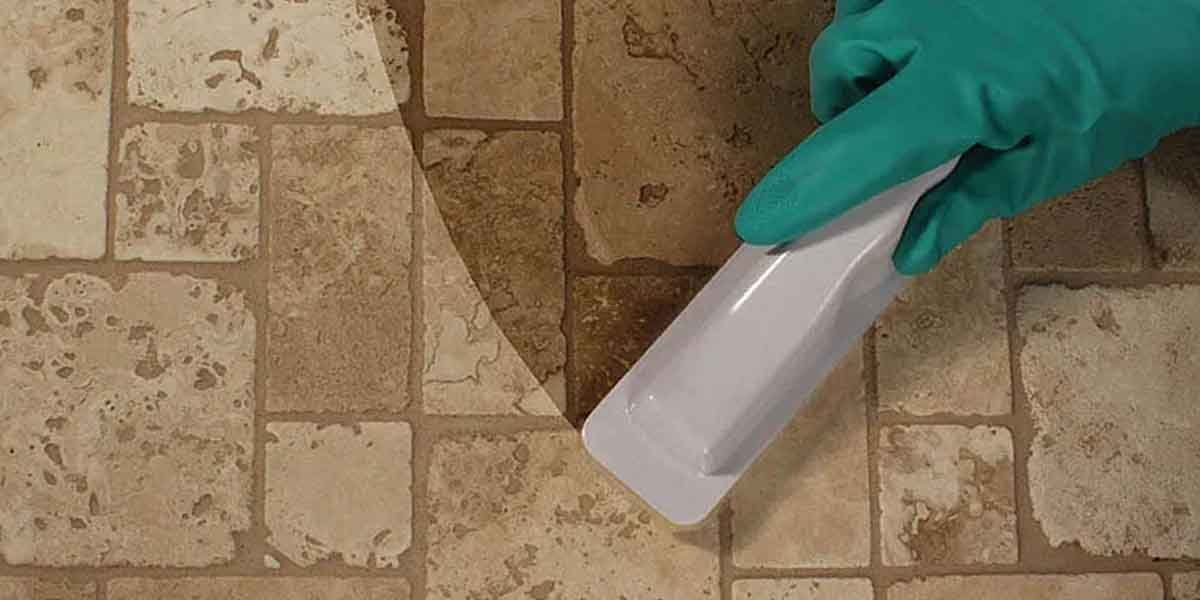

What do you seal tile grout with? For the cement joints that fill most tiled showers, floors, and backsplashes, the default answer is a penetrating sealer, and the maker’s own data sheets narrow that to a pH-neutral, water-based formula. Get that one line right and the common case is handled.
The rest of the question is knowing when the default becomes the wrong tool. Film-forming sealers, silicone products, and pigmented sealants all have a place. Any of them in the wrong place costs you a bottle, and occasionally a weekend spent stripping.
What follows is each material, where it belongs, and the numbers off the instruction sheets that decide whether a coat holds.
Four Materials That Go on Grout
Sealers come in two families and two edge cases. Penetrating sealers work inside the pores of the joint, while film-forming sealers build a skin on top of it. Silicone blends and pigmented sealants sit at the margins of both families.
| Sealer | What it is | Where it belongs | Where it goes wrong |
|---|---|---|---|
| Water-based penetrating | A silane or siloxane repellent carried in water | Cement grout almost anywhere, showers included | Needs recoating sooner than a solvent version |
| Solvent-based penetrating | The same chemistry family in a solvent carrier, soaking deeper | Dense porcelain, unglazed stone, outdoor paving | Solvent smell until it flashes off; ventilation is not optional |
| Film-forming | Acrylic or urethane that dries as a coating | Dry rooms, and porous tile before grouting | Wet rooms, where it traps moisture and wears unevenly |
| Silicone or pigmented | Silicone repellents, or penetrating sealer with color added | Sound but dingy joints you want to freshen | Cracked joints, which are repair work first |
The reason a sealer earns a place at all shows up in test data. Standard cementitious grout is covered by ANSI A118.6, and Section 4.4 of that standard permits up to 18 percent water absorption. Custom Building Products publishes 15 percent as the typical measured result for its unsanded white grout, in technical data sheet TDS-178. A joint that takes in roughly one part water in seven is not a sponge as a figure of speech.
Penetrating Sealers and What Is Inside Them
Penetrating sealers, also sold as impregnators, are the type most often used and the one giving the highest water, chemical, and stain resistance, according to MAPEI’s technical team. They carry no film, so the joint keeps the look it had before the bottle was opened.
The working ingredient is usually a silane or a siloxane, the same chemistry family that makes concrete and masonry shed water. A silane carrying alkyl groups bonds at the mineral surface and turns it water-repellent without sealing the pore shut, which is why a penetrating sealer allows moisture vapor to transmit rather than holding it in. That single property separates a sealed joint from a waterproofed one, and it is why this type belongs in a shower instead of fighting the drying that happens between showers.
What the label calls the carrier matters more to your lungs than to the grout. Water-based versions smell mild enough for a bathroom with no window. Solvent-based versions soak deeper and flash off fast, and their sheets ask for ventilation during application and until the surface is dry.
The dwell window is short in both cases. MAPEI’s sheet for its solvent-based stone, tile, and grout sealer has you work patches of about 15 square feet, let the product soak five to ten minutes, then buff off whatever the grout did not absorb. Leave it longer and the residue dries on the tile faces into a greasy film that has to be stripped. Wipe it off too early and the sealer never reaches the pore it was bought for. A second coat goes on 30 minutes after the first if the joint still drinks it in, and one quart covers 125 to 250 square feet.
Three waits follow. Three hours with no foot traffic, 12 hours kept dry, and 48 to 72 hours with nothing that can stain near the joint. I keep a kitchen timer for the soak, because standing in a shower with a foam brush makes ten minutes feel a great deal longer than ten minutes.
Why Film-Forming Sealers Fail in a Wet Room
A film-forming sealer stops water at the surface, which sounds like the stronger product and behaves like it in a dry kitchen. In a wet room the same barrier turns against you, because moisture moving through the tile and the mud under it needs somewhere to go.
Trapped water under a coating is how a joint that looked finished in spring has gone mildewed by late summer. My own first shower reseal went that way. The joints looked dry, so I rolled on a film-forming product, and three weeks later the run nearest the drain had gone pale and started lifting at the edges. Repair meant a stripper, a stiff brush, and starting over with a penetrating sealer.
There is a second limit that catches people out. A coating adheres poorly to glazed ceramic and polished porcelain, so the same liquid gets sold as a pre-grouting barrier instead. Custom Building Products lists its TileLab SurfaceGard Sealer for use in place of a grout release before grouting, keeping the tile faces from taking color and making wash-up easier. That is protection for the tile, and it lasts about as long as the grouting takes.
Old joints tell their history without any test. The run closest to the drain has gone chalky and a shade or two paler than the same grout two feet away. The line under the shampoo shelf has moved from sand to grey. Neither is a sealer failure. This is a cement joint behaving exactly like a cement joint.
When Sealer Is the Wrong Answer
Three situations make a sealer pointless or worse: a joint material that cannot absorb anything in the first place, grout that has not finished curing, and joints that have already broken.
Epoxy grout already made the decision for you
Grout sold as epoxy covers two different products, and the standard number settles which one is in your joints. Epoxy grout meeting ANSI A118.3 is made from epoxy resins and filler powder, and the Tile Council of North America describes it as “extremely hard, durable, and nearly stain proof.” Sealer adds nothing to a joint like that. Epoxy emulsion grout (ANSI A118.8) blends cement with epoxy resin, and the same Council page says it is “not stain proof” and will “generally absorb liquids and stains.” That one behaves like a cement joint, so it gets sealed like a cement joint.
The word on the bag does not tell you which product you bought. The standard number on the data sheet does.
New grout needs time, not sealer
MAPEI’s sealer sheet sets its shortest wait at 12 hours on new grout, and the grout makers are more patient still. Custom’s unsanded grout sheet calls for misting the installation with clean water for three days and for keeping exterior work out of the rain for a week, with the curing time stretching longer over dense, low-absorption tile. Practically, 48 to 72 hours of drying with air moving through the room is the habit most installers work to.
Seal a joint while it is still releasing water and that water gets trapped under the coat. The visible result turns up days later as pale haze and uneven color, on a floor that looked flawless when you walked away from it.
Cracks are a repair, not a coating job
A cracked or hollow joint needs grout, not sealer. A coat over a break does nothing for the break and hides the warning for a season, which is the worst version of both outcomes.
Matching the Sealer to the Surface
The same question gets different answers depending on where the tile sits and what the joint is made of, which is the part most advice skips on its way to a brand recommendation.
- Shower walls and shower floor, cement grout: water-based penetrating sealer. The joint stays able to release vapor and the tile keeps its finish.
- Bathroom or kitchen floor: water-based penetrating sealer, then test it again inside a year if the household is a busy one.
- Kitchen backsplash and counter grout: penetrating sealer only. A coating there meets acidic cleaners and cooking spatter, and it survives neither well.
- Natural stone and unglazed tile: seal the tile as well as the joint, and seal the tile before grouting so grout color cannot settle into the surface.
- Glazed ceramic and polished porcelain: the tile faces need nothing. The joint still absorbs, so the sealer goes there and only there.
- Sound joints that are merely dingy: a pigmented penetrating sealer refreshes the color and protects the joint in one pass. It cannot rescue a joint that is coming apart.
Tile Grout Sealer FAQ
What do you seal tile grout with if the joint is already stained?
Clean the joint with a pH-neutral cleaner, let it dry completely, then seal with a penetrating product. The old stain stays where it is, and the next round of soil takes longer to sink in. A pigmented penetrating sealer covers the discoloration while it protects.
Is it really necessary to seal grout on tile?
Not for a joint that genuinely cannot absorb, such as 100 percent solids epoxy grout. Cement grout is the other case: the standard it is tested against allows up to 18 percent water absorption, and sealer is what keeps that joint cleanable.
What is a good waterproof sealer for tile grout?
None of them are waterproof. MAPEI states in its own technical blog that “sealing does not make grout stain or waterproof,” and a penetrating sealer is built to let vapor pass. Waterproofing a wet area belongs to the membrane behind the tile, as our walk-in shower waterproofing checklist walks through step by step.
Why do builders not seal grout?
Sealing is maintenance, and the construction contract ends at a cured, grouted installation. No code requires it, nobody inspects it, so it leaves the job list and becomes the owner’s task.
Can you seal grout that is years old?
Yes, if the joint is intact. Scrub it, repair any cracks and let the repair cure, then seal. Grout that is crumbling or sounds hollow needs replacing before any sealer goes near it.
Two products decide the outcome here, the grout and the sealer, and each ships with a sheet that answers the question more precisely than any general habit. Custom Building Products points to a pH-neutral, water-based penetrating sealer for its cement grout. MAPEI’s sealer sheet hands over the dwell time, the recoat window, and the dry times.
Skip the calendar interval, since no standard sets one. Test a joint with a few drops of water instead, and reach for the next coat when the joint drinks them in.
