


The moment you sign a purchase agreement, the countdown starts. You will spend roughly 30 to 45 days inside a process that most sellers describe as equal parts bureaucratic and opaque.
At the end of it, a wire transfer hits your account. Between those two points, a title search runs, an appraisal gets ordered, a stack of documents lands on a table, and someone presses record on a county deed. Understanding the closing process for sellers means knowing what happens in that window — and what you actually need to do..
No two closings are identical, because no two properties, contracts, or state laws are. But the architecture of every closing is the same. You sign. They verify. You wait. You cash out. The details are where things get expensive or get stalled.
What a Real Estate Closing Actually Means for Sellers
A closing is the legal moment when ownership of a property moves from your name to the buyer’s. Money changes hands.
The deed gets recorded. Any mortgage you carry gets paid off, the real estate commissions get disbursed, and whatever remains , your proceeds , lands in your bank account. According to the Consumer Financial Protection Bureau, a closing is formally defined as the consummation of the mortgage transaction, where documents are signed, dated, and notarized, and funds are disbursed..
A third party called a settlement agent or escrow officer orchestrates this. They collect the buyer’s funds, verify the title is clean, pay off your lender, pay the agents and service providers, and record the deed. You do not do any of this yourself. Your job is to show up with ID, sign where you are told, and confirm your wiring instructions are correct.
In practice, a closing is mostly paperwork and waiting , punctuated by moments of real consequence. A missing signature can delay your proceeds by days. A title defect discovered late can kill a deal outright. The settlement statement you receive 72 hours before closing contains every number that matters.
The Closing Timeline: Contract to Settlement Table
Once a buyer signs a purchase agreement and you accept it, the clock starts. For most financed transactions, you are looking at 30 to 45 days from contract to close. Cash purchases move faster , sometimes as little as two weeks , because no lender is involved. Condominium and co-op sales can run longer due to additional association document review periods mandated by state law.
Here is what happens during those 30 to 45 days, and roughly when:
| Phase | What Happens | Typical Timing | Who Drives It |
|---|---|---|---|
| Title Search | Public records reviewed for liens, judgments, ownership disputes | Days 1-10 | Closing agent / Title company |
| Home Inspection | Buyer inspects property; repair requests or credits negotiated | Days 7-15 | Buyer’s agent + inspector |
| Appraisal | Buyer’s lender confirms property value supports loan amount | Days 10-20 | Buyer’s lender |
| Mortgage Payoff | Your lender provides payoff statement showing exact balance owed | Days 5-10 | Closing agent |
| HOA Documents | Estoppel letter confirms account standing, outstanding fees, transfer requirements | Days 10-20 | Seller + HOA management |
| Closing Disclosure | Final settlement statement issued with exact dollar amounts | 3 days before close | Buyer’s lender |
| Final Walkthrough | Buyer verifies property condition and agreed-upon repairs | 24-48 hours before close | Buyer |
| Settlement Day | Documents signed, funds wired, deed recorded | Closing date | All parties |
If you are selling in a hot market, a cash buyer can compress this entire timeline dramatically , but a cash sale does not mean zero due diligence. Title still gets searched. Closing documents still get signed.
What Sellers Need to Do Before Closing Day
Understanding the closing process for sellers starts with knowing exactly what is expected of you. The closing process is not passive for sellers. You have concrete responsibilities that begin the moment you accept an offer, and missing any one of them can delay your closing or cost you money.
First, notify your mortgage lender that you are selling.
Your closing agent will request a formal payoff statement.
But you should alert your lender early so there is no confusion when the request arrives. If your home is part of a homeowners association, order the estoppel letter yourself rather than waiting for the title company to chase it , HOA management companies are notorious for slow responses, and this is one of the most common causes of closing delays..
Second, gather your documentation. You will need your current deed, your most recent property tax bill, your mortgage statement, receipts for any major repairs completed during your ownership, and a government-issued photo ID.
If the property has a well or septic system, many states require recent inspection reports at closing. If you agreed to make repairs after the home inspection, complete them early and keep receipts , the buyer’s agent will want proof..
Third, resolve any known title issues now. An old lien you forgot about, a boundary dispute with a neighbor, an unpermitted addition , these surface during the title search. It is far cheaper to resolve them before the search than to negotiate under pressure three days before closing.
Seller Closing Costs: A Complete Breakdown
Understanding the closing process for sellers means confronting the numbers early. Seller closing costs typically range from 6% to 10% of the sale price when you include the real estate commission. Excluding commission, the settlement fees alone average 1% to 3% depending on your state and local transfer taxes. On a $400,000 home, expect roughly $8,000 to $12,000 in settlement charges before the commission check is cut.
These are the line items most sellers see on their settlement statement:
| Cost Item | Typical Amount | Who Sets It | Negotiable? |
|---|---|---|---|
| Real estate commission | 5-6% of sale price | Listing agreement | Yes, before listing |
| Owner’s title insurance | $500-$3,500 | Title company / State rate | Sometimes (shop providers) |
| Transfer tax / Stamp tax | Varies by state/county | State and local government | No |
| Attorney fees | $500-$2,000 | Attorney | Sometimes |
| Recording fees | $50-$250 | County recorder | No |
| Prorated property taxes | Varies | Tax assessor | No |
| HOA transfer fee | $100-$500 | HOA management | No |
| Wire transfer fee | $25-$75 | Bank | No |
Documentary stamp taxes vary dramatically by location. Florida charges $0.70 per $100 of sale price. New York City tacks on a mansion tax that starts at 1% and climbs to 3.9% for properties above $25 million. Some states, like Texas and Arizona, have no transfer tax at all. Your closing agent can provide an estimated settlement statement early in the process so you are not surprised.
How to Estimate Your Net Proceeds
Your net proceeds are what remains after every lien, loan, fee, tax, and commission gets paid. The math is straightforward but not obvious to first-time sellers. Start with the sale price. Subtract your mortgage payoff amount. Subtract the real estate commission. Subtract the closing costs listed on your settlement statement. What is left is your wire transfer.
A rough worksheet looks like this:
Sale price: $400,000
Minus mortgage payoff: −$220,000
Minus commission (5.5%): −$22,000
Minus settlement fees (2%): −$8,000
Net proceeds: $150,000
That $150,000 is what hits your bank account. From there, you may owe capital gains tax if the property was not your primary residence for at least two of the last five years.
The IRS excludes up to $250,000 in gains for single filers and $500,000 for married couples filing jointly on a primary residence, provided you meet the ownership and use tests. Gains above those thresholds are taxed at long-term capital gains rates..
Closing Day: What Actually Happens
Closing day is less dramatic than most sellers expect. You will not sit across a table from the buyer haggling over last-minute items. In many states, the buyer and seller sign separately , sometimes on different days entirely. What you actually do is review and sign a stack of documents while a notary or closing agent walks you through each one, then wait for the wire.
The deed is the central document. It transfers ownership from you to the buyer. You will also sign an affidavit of title confirming no new liens have appeared since the title search, a closing disclosure or settlement statement acknowledging the final numbers, and a 1099-S reporting the sale to the IRS. If you have an outstanding mortgage, the payoff statement and lien release get recorded alongside the new deed.
In states that allow remote online notarization , now the majority, following pandemic-era law changes , you may never set foot in a title company office. Documents arrive through a secure portal. You verify your identity over video.
You click to sign. A mobile notary can come to your living room for a fee. The old model of everyone crowding around a conference table in a title company office still exists in some markets, but it is no longer the default..
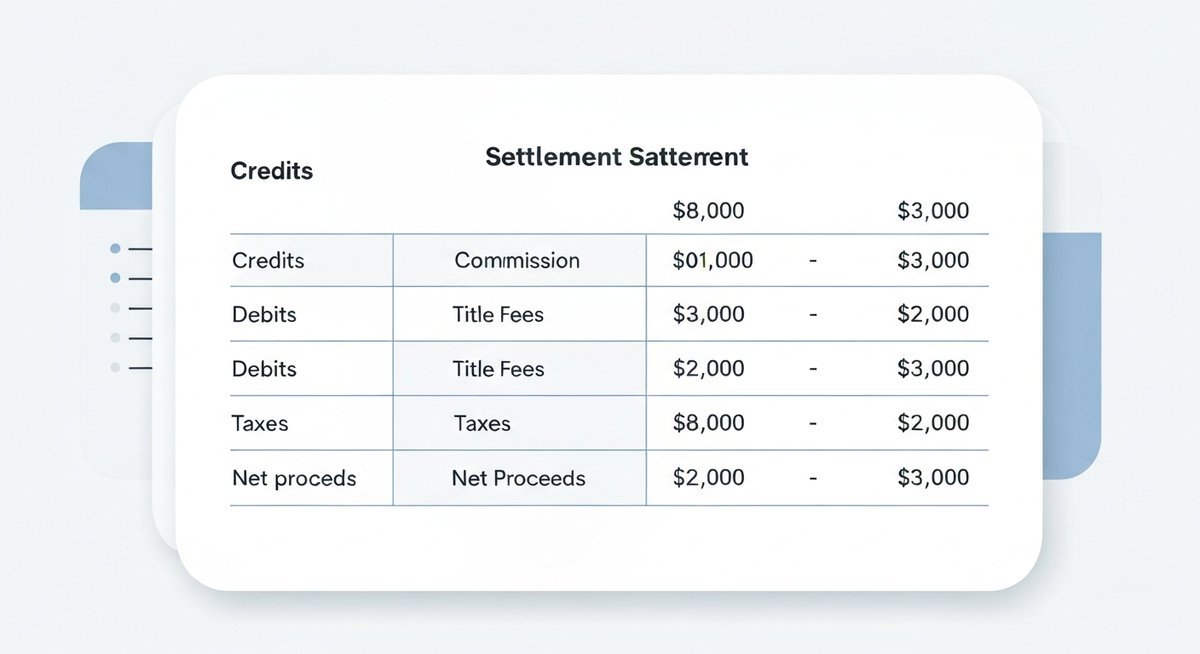
The Settlement Statement: Line by Line
The Closing Disclosure or settlement statement is a standardized multi-page form that itemizes every dollar in the transaction. You receive it at least three business days before closing. Read every line. Errors on settlement statements are common, and once the deed is recorded, correcting a clerical error takes weeks and requires the cooperation of every party.
The statement has two columns: debits (what you pay) and credits (what you receive). The sale price appears as a credit. Your mortgage payoff, commission, transfer taxes, title fees, attorney fees, recording fees, and prorated property taxes all appear as debits. The difference between the two columns is your net proceeds , or, in rare cases, the amount you must bring to the table if your liens exceed your sale price.
Common errors to catch: the property tax proration using the wrong tax year, the mortgage payoff amount not matching your most recent statement, commission calculated on the wrong sale price, recording fees duplicated, and HOA fees charged to the wrong party. A closing agent who spots these before you do is worth their weight.
Closing Documents Every Seller Signs
The stack of paper on closing day looks intimidating, but most documents are standardized. The deed is the only document that actually transfers ownership. Everything else is either a disclosure, an affidavit, or a tax form. According to Nolo’s legal encyclopedia, sellers should expect to see these core documents:
| Document | Purpose | Who Prepares It |
|---|---|---|
| Deed | Transfers legal ownership to buyer | Closing agent / Attorney |
| Settlement Statement | Itemizes all debits and credits | Closing agent |
| Affidavit of Title | Sworn statement that no new liens exist | Closing agent |
| 1099-S | Reports sale proceeds to IRS | Closing agent |
| Mortgage Payoff Statement | Shows exact amount to satisfy loan | Your lender |
| Mechanic’s Lien Affidavit | Confirms no unpaid contractor claims | Closing agent |
| Bill of Sale | Transfers personal property (appliances, etc.) | Closing agent |
If you sold without an agent , a decision with its own trade-offs you can explore in our guide to selling a house without a realtor , you will prepare the purchase contract yourself, which adds responsibility but can save the commission on your side of the transaction.
What Can Delay a Closing
Most closing delays are preventable, but all of them are stressful. The single most common cause is a title defect , a lien, judgment, or ownership claim that the title search uncovers and that takes time to resolve. A low appraisal is second: if the appraised value comes in below the contract price, the buyer’s lender will not fund the full amount, and someone has to bridge the gap.
Buyer-side financing problems are the wild card you cannot control.
A buyer loses a job, opens a new credit card, finances a car between contract and close , any of these can trigger a loan denial. Missing HOA documents are the most frustrating delay because they are entirely within your control as the seller: order the estoppel letter early, follow up repeatedly, and do not let a slow HOA management company derail your closing..
Other common bottlenecks: outstanding municipal violations you did not know about, a survey revealing an encroachment, a death in the chain of title that was never properly probated, and simple paperwork errors like a misspelled name on the deed.
None of these are fatal, but all of them take time to fix. The title search that runs in week one is your best defense , it surfaces problems while there is still time to solve them..
What Happens If the Closing Falls Through
Not every signed contract reaches the settlement table. When a closing falls apart, the outcome depends entirely on why it failed and what protections were built into the purchase agreement. If the buyer’s financing contingency expires and they cannot secure a loan, your earnest money deposit typically protects you , but recovering it may require the buyer to sign a release, and a hostile buyer can delay that for weeks.
If the buyer walks because of an inspection contingency, the earnest money generally returns to the buyer, and you are back to square one with a listing that now carries the stigma of a failed deal. In many states, sellers must disclose that a previous contract fell through, along with the reason, to future buyers.
If you are the one who cannot perform , a title defect you cannot cure, a lien you cannot pay off, a move-out date you cannot meet , the buyer can sue for specific performance, forcing the sale, or for damages.
Most disputes settle before reaching a courtroom because litigation costs exceed the earnest money at stake. The best protection is a properly drafted contract and a closing agent who communicates early when problems surface..
After the Closing: Your Post-Settlement Checklist
Once the paperwork is signed and the keys change hands, a few final steps round out the experience of navigating the closing process for sellers.
The deed is recorded, the wire has landed, and you hand over the keys. But the transaction is not quite finished. A handful of administrative tasks remain, and knocking them out in the first week prevents headaches later.
First, keep every closing document. Store the settlement statement, the deed, the 1099-S, and the mortgage satisfaction letter in a permanent file. Your tax preparer will need the settlement statement next April, and the mortgage satisfaction letter proves you no longer owe that debt , a document you will want if the lender’s record-keeping ever lapses.
Second, cancel or transfer every service tied to the property: homeowners insurance, utilities, HOA accounts, alarm monitoring, lawn care, and any automatic payments linked to that address. Notify the post office of your forwarding address. Contact your county tax assessor to confirm the tax bill will go to the new owner.
If you are using the proceeds to buy your next home immediately, coordinate with your buyer’s agent to time the settlements so funds are available when needed.
If you are renting back the property from the buyer under a post-closing possession agreement, you are now a tenant , treat the home accordingly and get everything in writing about the move-out date and any rent amount..
Choosing a Closing Agent: Attorney, Title Company, or Escrow
Who handles your closing depends heavily on where you live. Some states, particularly in the Northeast and South, are attorney-closing states where a real estate lawyer must oversee the transaction. Others are title-company states where a licensed title agent or escrow officer handles everything. A few states allow either arrangement.
An attorney provides legal advice , they can explain the deed language, identify title issues with legal implications, and represent your interests if a dispute arises. A title company provides title insurance and processes the settlement paperwork but cannot give legal advice. An escrow company acts as a neutral third party to hold funds and documents, common in Western states like California.
| Closing Agent Type | Typical States | Legal Advice? | Comparative Cost |
|---|---|---|---|
| Real Estate Attorney | NY, NJ, MA, GA, SC, NC, AL, MS | Yes | $800-$2,500 |
| Title Company / Title Agent | TX, AZ, CO, FL, WA, OR, NV | No | $500-$1,500 |
| Escrow Company | CA, ID, MT | No | $500-$1,800 |
| Hybrid / Either | PA, OH, IL, MI, IN, MN | Depends on choice | $600-$2,000 |
Your real estate agent typically recommends a closing agent, and that recommendation usually works , experienced agents have relationships with closing professionals who handle transactions efficiently. But you are not obligated to use their recommendation. Shopping title insurance rates alone can save several hundred dollars, and title premiums are regulated differently in every state.
Frequently Asked Questions About the Closing Process for Sellers
How long does understanding the closing process for sellers actually take?
The typical closing process for sellers takes 30 to 45 days from a signed purchase agreement to the settlement date. Cash transactions can close in as little as seven to fourteen days because no lender underwriting is required. Sales involving condominiums or properties in homeowners associations can take longer due to mandatory document review periods that state laws impose on buyers.
Do sellers have to attend the closing in person?
In most states, sellers do not need to attend the closing in person. Documents can be pre-signed and notarized remotely through online platforms, or a mobile notary can visit your home or office.
Some states still require a physical notary, but even those do not require you to sit in a room with the buyer. Your settlement agent will provide options specific to your location and the buyer’s lender requirements..
How much are closing costs for a seller?
Seller closing costs typically total 6% to 10% of the home’s sale price, with roughly 5% to 6% going to real estate commissions and the remaining 1% to 4% covering title fees, transfer taxes, attorney fees, recording charges, and prorated property taxes. On a $350,000 home, a seller can expect to pay between $21,000 and $35,000 in total closing costs, most of which is the commission.
What happens to the seller’s mortgage at closing?
At closing, your existing mortgage is paid off in full from the sale proceeds. The closing agent sends a wire transfer directly to your lender for the exact payoff amount stated on the payoff statement.
Any remaining balance on a home equity line of credit or second mortgage is also paid off at closing. Your lender then records a satisfaction of mortgage , proof that the lien on your property has been released..
When does the seller get paid after closing?
Sellers typically receive their proceeds on the same day as closing, once the deed is recorded and the buyer’s funds have cleared.
In most transactions, the wire transfer arrives within hours of the settlement , sometimes within minutes. Delays can occur if the closing happens late in the day and the county recorder’s office closes before the deed can be recorded, or if the buyer’s wire has not yet been confirmed as received by the settlement agent..
Can a seller back out of a closing?
A seller cannot unilaterally cancel a signed purchase contract without risking legal consequences. If you refuse to close without a contractual reason, the buyer can sue for specific performance to force the sale or seek damages for breach of contract.
Valid reasons to delay or cancel include a title defect that cannot be cured, the buyer’s failure to secure financing within the contingency period, or a mutual agreement to terminate. If you are selling a tenant-occupied property, additional considerations around tenant rights and lease obligations apply..