

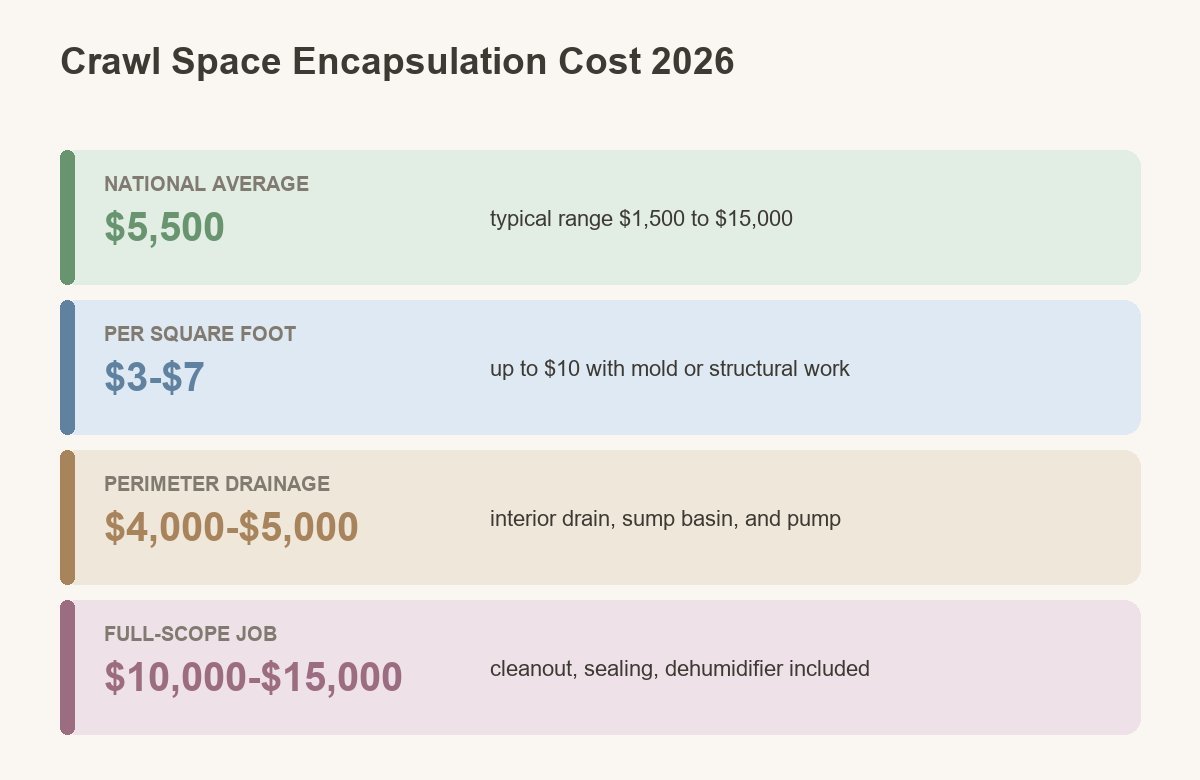
Crawl space encapsulation costs $1,500 to $15,000. Bob Vila’s cost data puts the national average near $5,500, or $3 to $7 per square foot, climbing toward $10 when mold or structural repairs join the scope. Those figures hide the number that matters more: five contractors quoting one house will land anywhere from $3,000 to $30,000.
That spread is not price gouging. It is five different definitions of the word “encapsulation,” and the cheapest definition is the one that should worry you. A $3,000 bid buys plastic laid on dirt. A $12,000 bid, in most markets, buys a sealed system that keeps a dehumidifier from fighting outdoor air for the rest of its life.
What a Complete Encapsulation Includes
A finished job seals every path moisture takes into the space under your floor: a thick vapor barrier across the ground and up the walls, seams and piers taped, vents blocked, the rim joist (the wooden band where the house meets the foundation) closed with foam, and a dehumidifier on its own circuit keeping the sealed box dry.
Skip any one of those and the system leaks. The band is the piece low bids drop most often, and it is the first thing experienced eyes check:
“GC 33 years. That’s a very poor job. The most glaring thing I see, among many, they’ve done nothing with the band. You don’t have an encapsulated crawl unless the band is sealed. The best and easiest way to do that is with closed cell spray foam. Look up Froth-Pak.”
– r/Homebuilding, November 2025 (233 upvotes)
That comment was written under photos of a $21,400 job in Virginia, sold as premium work with a 20-mil liner and sealed piers. The homeowner paid top-tier money and got the bottom-tier scope. Price alone told them nothing; the item list would have.
Cost by Crawl Space Size
Per-square-foot pricing is the cleanest way to sanity-check a bid before anyone crawls under your house. Multiply your home’s footprint by $3 on the low end and $7 on the high end:
| Crawl space size | Standard scope ($3–$7/sq ft) | With mold or repairs (up to $10/sq ft) |
|---|---|---|
| 1,000 sq ft | $3,000 – $7,000 | up to $10,000 |
| 1,500 sq ft | $4,500 – $10,500 | up to $15,000 |
| 2,000 sq ft | $6,000 – $14,000 | up to $20,000 |
| 3,000 sq ft | $9,000 – $21,000 | up to $30,000 |
Two things bend the math. Clearance: a 3-foot-tall space is faster to work in than an 18-inch one, so tight spaces cost more per foot even though they use less material. And water: standing groundwater forces a perimeter drain and sump system before any liner goes down, which adds $4,000 to $5,000 on an average footprint.
What Each Component Costs
Five components make up an encapsulation bill: vapor barrier, insulation, dehumidifier, sealing supplies, and optional drainage. Materials for a typical space total $2,500 to $4,000 retail; everything above that pays for labor, cleanout, remediation, and electrical work. Line-item prices:
- Vapor barrier: about $0.30 to $0.70 per square foot for quality reinforced liner; 20-mil costs more than 6-mil and survives being crawled on.
- Wall and rim insulation: about $1 to $4.50 per square foot depending on foam board thickness versus spray foam.
- Dehumidifier: $300 to $1,500 for the unit itself; crawl-space-rated models with pumps occupy the top half of that range.
- Sealing tape and caulk: $8 to $15 per tube or roll, and a full job uses a case of it, not a tube.
- Perimeter drainage, when needed: about $25 to $29 per linear foot installed, per pricing published by Delaware contractor The Crawl Space People, whose typical full-scope jobs land at $12,000 to $15,000 before rebates.
Add that up for a 1,600-square-foot space and materials come to roughly $2,500 to $4,000. The other $8,000 in a five-figure quote is demolition of the old liner, hauling out soaked insulation, mold treatment, electrical work for the dehumidifier line, and hours of labor performed lying down in the dark. That labor premium is legitimate. Whether every line item is legitimate for your house is the question worth asking.
Why Quotes Span $3,000 to $30,000 for One House
Read enough bids side by side and three tiers appear. Match the quote in your hand against the scope, not the total:
- $2,000–$4,000: plastic and promises. Thin 6-mil liner over the dirt, vents stuffed with foam block, no band sealing, no dehumidifier. This is a vapor barrier replacement wearing the encapsulation label. Pest-control and HVAC firms selling it as an add-on service live in this tier.
- $5,000–$9,000: the middle where averages live. Heavier liner taped and mechanically fastened, walls wrapped, vents sealed, a mid-grade dehumidifier. Fair value for a dry, accessible space with no remediation needed.
- $10,000–$15,000 and up: full scope. Cleanout, mold remediation, band and rim sealed with closed-cell foam, 20-mil liner, dedicated circuit, humidity monitoring. When groundwater intrudes, drainage pushes it higher, and that is the one upgrade you should never delete to save money.
Red flags sit at both ends. A rock-bottom bid means thin materials and skipped sealing. A $30,000 bid for a dry 1,500-square-foot space means the sales rep added a water treatment system, new ductwork, or “structural” jacks nobody diagnosed a need for. Ask what problem each line item exists to fix; items without a problem attached are padding.
Fix the Water Before You Buy the Liner
Encapsulation controls humidity. It does not stop liquid water, and sealing a wet crawl space wraps the problem in plastic. Homeowners on r/homeowners who posted sticker-shock threads got the same advice from every tradesperson in the comments: start outside. Extend the gutters, regrade the soil so it slopes away from the foundation, and give it a rainy season before spending five figures under the house.
The order matters financially. Grading and gutter work costs hundreds to low thousands and sometimes makes the drainage line item unnecessary, which is the largest optional cost on most quotes. A contractor who quotes encapsulation without asking where your water comes from is quoting a product, not a fix. The EPA’s moisture guidance makes the same point from the health side: mold control is moisture control, and the source has to be found before any covering goes on.
The DIY Math, and Who Should Not Attempt It
Doing it yourself on a 1,600-square-foot space costs about $2,500 to $4,000 in materials, a savings of $8,000 or more against a full-scope professional bid. The catch is not skill. Taping liner seams is not hard. The catch is doing it for thirty or forty hours in a space too low to kneel in, hauling every scrap of old insulation out through a 16-by-24-inch access door, with your face eight inches from whatever has been growing down there.
DIY makes sense for a dry, tall, debris-free space and an owner who has crawled its full perimeter once already. It stops making sense the moment mold remediation, electrical work, or drainage enters the scope; those trades carry licensing and failure costs that erase the savings. One honest middle path: pay a pro for the cleanout and band sealing, then lay and tape the liner yourself, following our vapor barrier installation steps.
Is Encapsulation Worth the Money?
For homes in humid regions with musty rooms, cupping floors, or visible crawl space condensation, yes; it protects the wooden structure the whole house stands on. As a pure energy play the case is weaker. ENERGY STAR credits air sealing plus insulation with average heating and cooling savings around 15 percent, but much of that comes from attic work, not the floor. Owners who paid for encapsulation tend to describe the payoff in comfort terms:
“Triangle Radiant Barrier did ours in 2022, was $4200 for 1000sqft but we upgraded from the base level job to thicker insulation and moisture barrier. While it did not drop our utility bills noticeably, it definitely made the house more comfortable overall and helped maintain temperature settings”
– r/raleigh, May 2026 (6 upvotes)
That $4,200 for 1,000 square feet, upgraded scope included, is also a useful reality check against coastal-market quotes double that size. Regional labor rates move these numbers more than any material choice does.
Where the spend earns its keep beyond comfort: moisture damage you prevent (joist sisters and subfloor replacement start around $5,000), pest pressure that drops when the dirt is covered, and a dry, documented crawl space at resale, which inspectors in humid states now flag as a plus. Where it does not: a dry desert-climate home with no symptoms. Encapsulating that house buys nothing measurable.
Crawl Space Encapsulation Cost FAQ
How much does it cost to encapsulate a 2,000-square-foot crawl space?
A 2,000-square-foot crawl space prices between $6,000 and $14,000 at standard per-foot rates, reaching $20,000 when mold remediation or drainage joins the job. Get the scope itemized; two bids matching in price can differ by an entire dehumidifier.
Does homeowners insurance cover crawl space encapsulation?
Homeowners insurance does not pay for encapsulation, because policies class it as preventive improvement and exclude gradual moisture damage. The narrow exception is repair work after a covered sudden event, like a burst pipe flooding the space; the encapsulation itself stays on your bill.
How long does a crawl space encapsulation last?
A properly installed 20-mil liner with sealed seams lasts on the order of 15 to 25 years. The dehumidifier ages out first, commonly within 8 to 12 years, so budget a few hundred dollars for replacement units across the liner’s life.
Is a $3,000 encapsulation quote ever legitimate?
A $3,000 quote is fair only for a small, dry, already-clean space getting a liner-and-vents scope, and the contractor should describe it in those limited terms. Presented as a full encapsulation, that price guarantees thin material and a skipped rim joist, and the coaching from contractors themselves is blunt: walk away.
